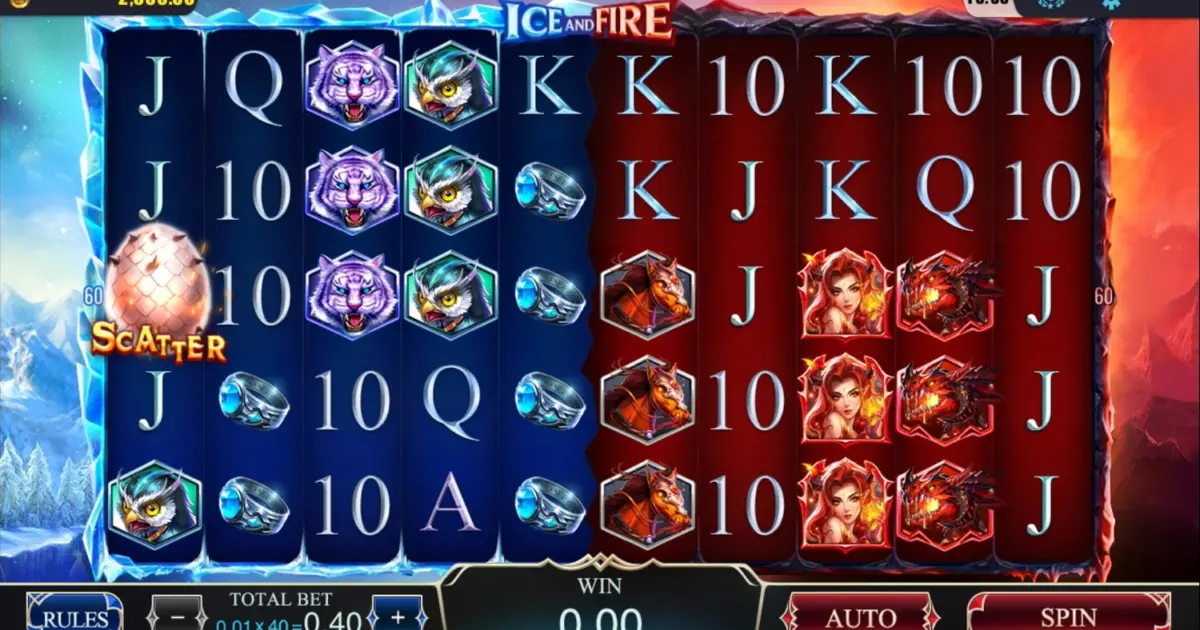
DreamTech’s 97.28% RTP on this title places it roughly 1.6 percentage points above the average slot in our database, which is a meaningful gap. If you only care about theoretical return and nothing else, that figure makes this one of the better-paying games you can find. But return is a long-run concept, and the experience of reaching it depends on volatility, layout, and stake decisions that DreamTech has not published here.
Ice and Fire at a glance
This is a slot machine from DreamTech, a provider that currently lists 77 titles in our database. At rank 348 with a 98.3% popularity percentile, the game draws disproportionate traffic relative to its position on the provider’s own catalogue — it is one of their more watched releases. The defining number is the RTP: 97.28% versus a provider average of 96.9% and a corpus average of 95.71%. DreamTech published this game without a theme label in our records, and several mechanical details — volatility, reel count, stake limits — remain unlisted. That absence matters for how you plan a session, and each gap gets addressed below.
Here are the figures that are confirmed:
| Attribute | Value |
|---|---|
| Provider | DreamTech |
| RTP | 97.28% |
| Provider average RTP | 96.90% |
| Corpus average RTP | 95.71% |
| RTP advantage over corpus | +1.57 percentage points |
| Popularity rank | 348 (98.3rd percentile) |
| Free demo available | Yes |
What a 97.28% RTP actually returns
RTP describes the percentage of all wagered money a game is designed to return to players across an enormous number of spins. At 97.28%, the theoretical return is £97.28 for every £100 wagered. That does not mean any individual session will hit that number — the figure only stabilises after hundreds of thousands, sometimes millions of spins.
What the gap does mean is this: compared with the corpus average of 95.71%, DreamTech has set this game 1.57 percentage points above the field. Across 10,000 spins at a £1 stake, that difference is worth approximately £157 in theoretical return. It does not change whether you win or lose on a Tuesday evening. It changes the rate at which the house edge eats your bankroll over very long horizons.
Against its own provider, the gap is narrower — 0.38 percentage points above DreamTech’s 96.9% average. So this is a better-than-average title from a provider whose overall catalogue already runs slightly hot. If you are choosing among DreamTech games by RTP, look at Crazy Alchemist at 97.36%, which sits marginally higher still.
Missing volatility data and what your session will feel like
DreamTech has not published a volatility classification for this slot. That is a genuine gap in the available information, and it changes how you should approach the game. Without knowing the volatility tier, you cannot predict whether a session will produce frequent small wins or long dry spells interrupted by larger payouts.
As a general principle, a high-volatility slot produces fewer winning spins but larger individual payouts when they land, which demands a larger bankroll to survive the downswings. A low-volatility game pays more often in smaller amounts, keeping your balance relatively steady but rarely producing dramatic spikes. Medium sits between these poles.
Because that data is absent here, treat your first real-money sessions as exploratory. Play conservatively until you form your own read on the distribution of outcomes. Do not assume the strong RTP figure guarantees a smooth ride — high RTP and high volatility frequently coexist.
Missing reel and payline data and how wins are counted
No reel count or payline configuration appears in the published specifications for this game. You will need to confirm the layout directly in the demo before forming any expectations about how wins are constructed.
For context on what those numbers control: a standard 5-reel, 3-row layout with 20 paylines means you need matching symbols along one of 20 predefined horizontal or diagonal lines. Games that use a “ways” mechanic instead count any adjacent matching symbol from left to right regardless of row position, which multiplies the number of possible combinations dramatically. Cluster pays require groups of touching identical symbols.
The mechanics directly affect your effective stake per spin (total bet divided across lines) and the frequency with which symbols line up. Without DreamTech’s published layout for this title, do not assume a conventional structure until you have checked.
Stake range and sizing a bankroll
No minimum or maximum stake figures are available for this slot. You will need to open the game to see where those limits sit, since they vary between operators even for the same title.
The general framework for bankroll sizing: divide your total session budget by the number of spins you want to take, and that quotient is your per-spin ceiling. If you plan 200 spins with a £40 bankroll, your stake should not exceed 20p per turn. The purpose of that rule is simple — you want enough turns to experience the game’s distribution rather than being eliminated by early variance.
Once you know the actual volatility tier (by checking the game or reviewing a provider datasheet), you can adjust. High volatility games typically need 300–500+ spins before outcomes approximate the theoretical return; low volatility games converge faster, around 100–200. Without knowing which tier this game belongs to, err on the side of smaller stakes and longer sessions.
Playing the Ice and Fire demo before you commit
A free demo of this slot is available, and it is the single most efficient way to fill in the gaps that DreamTech has left in the published data. Use the demo to observe the reel layout, note how often wins appear across 100 consecutive spins, and gauge whether the payout distribution feels concentrated or spread. None of that tells you whether real-money results will match, because each spin is independent and the demo runs on the same random engine without carrying forward any session history.
What the demo does reveal is mechanical: how the game looks, how it responds to input, how wins animate, and roughly how the frequency of payouts distributes. That information costs you nothing and helps you avoid spending real money on a game whose rhythm you find frustrating.
If you transition to real-money play, treat the session as paid entertainment with a fixed budget. You must be 18 or older. Decide before you start what amount you can lose without consequence, and stop when it is gone. No sequence of outcomes makes a win more likely on the next spin, and chasing losses is the fastest route to overspending.
Verdict: who should play Ice and Fire
The RTP figure is the reason to look at this game. At 97.28%, it outperforms the corpus average by a wide margin and sits comfortably above DreamTech’s own catalogue mean. If you choose slots primarily by published return and want to minimise the long-run house edge, this is one of the stronger options available from this provider. You might also compare it against Candy House at 96.86% if you prefer a different risk profile within the same developer.
The honest caveat is the missing data. No volatility tier, no reel layout, no stake limits published. That means the math tells you this game returns more than most, but it tells you nothing about what a Tuesday evening session will feel like. For that, the free demo is your best tool. Go in with a small budget if you switch to real money, and let the game’s structure earn your commitment over several sessions rather than one.
Frequently Asked Questions
What is the RTP of Ice and Fire slot?
Ice and Fire has a published RTP of 97.28%, which is 1.57 percentage points above the average slot in our database at 95.71%. That means the theoretical return is £97.28 per £100 wagered across a very large number of spins. The figure does not predict individual session outcomes.
Is there a free demo of Ice and Fire?
Yes, a free demo of Ice and Fire is available on this site. The demo lets you observe the reel layout, win frequency, and general game feel without spending money. It does not predict real-money results because each spin is independent regardless of mode.
What is the volatility of Ice and Fire slot?
DreamTech has not published a volatility classification for this title. Without that figure, you cannot determine whether the game will produce frequent small wins or rare large payouts. Open the demo and track outcomes across 100+ spins to form your own read before committing real money.
How does Ice and Fire compare to other DreamTech slots?
At 97.28% RTP, Ice and Fire sits above DreamTech's provider average of 96.9%. Crazy Alchemist from the same developer runs slightly higher at 97.36%, while Candy House is lower at 96.86% and Blue Sea sits at 96.0%. The RTP gap across their catalogue is moderate.
What are the stake limits for Ice and Fire?
DreamTech has not published minimum or maximum stake figures for this slot. Actual limits often vary between operators. Open the game directly to see the available range, then size your bankroll so that your per-spin stake allows at least 200–300 spins for a reasonable sample of the game's behaviour.




