The single most useful number attached to the crazy alchemist slot is its RTP: 97.36%. That sits above the DreamTech house average of 96.9% and 1.65 percentage points above the 95.71% average across every title in this catalogue. If you filter games by published return figures, this one clears the bar comfortably.
What DreamTech has not published is almost everything else. There is no stated volatility rating, no max win figure, no stake range, no paylines count and no feature list for this title. That absence matters, and this review is honest about it rather than filling the gaps with invented detail.
Who makes Crazy Alchemist
DreamTech is the studio behind this release, and it has 77 titles listed in this catalogue. That is a mid-sized library — large enough that the studio has a house style and a measurable average return, small enough that individual games are not lost in a catalogue of thousands.
The most concrete thing you can say about a provider with 77 games and a 96.9% average RTP is that it does not appear to treat 94% as an acceptable default. Averages across a catalogue that size are reasonably stable; one or two outliers do not drag the figure much. So a DreamTech game you have never heard of is, statistically, more likely to sit in the high 96s than a randomly chosen slot from the wider market.
Beyond that, there is little to report. This FACTS set does not include DreamTech’s licensing jurisdictions, founding date, studio size or awards, so treat any such claims you find elsewhere as unverified until you check them against the studio’s own material. The provider’s published RTP figures are the part you can actually use when comparing games.
| Provider | DreamTech |
|---|---|
| RTP | 97.36% |
| Reels | 5 |
| Theme | Comics |
| Free demo | Yes |
Where Crazy Alchemist sits in the DreamTech catalogue
Against its stablemates, this game is at or near the top of the published-RTP table. Ice and Fire is the closest comparison at 97.28%, which is a difference of eight hundredths of a percentage point — statistically meaningless over any session you will actually play. Across £1,000 of total wagering, the expected difference between the two is under a pound. Choose between them on theme, not on maths.
The gap widens further down. Candy House returns 96.86%, half a percentage point behind, and Blue Sea sits at 96.00%, a full 1.36 points lower. On £1,000 wagered, that 1.36-point spread is £13.60 in expected return — small in absolute terms, but it compounds if you play a lot of spins across many sessions.
Popularity-wise, this title ranks 1,925 and sits in the 90.4th percentile of the catalogue. In plain terms: more played than roughly nine in ten games listed here, but not a front-page name. Rank tells you about traffic, not quality, and it has no bearing on how the game pays.
RTP: 97.36% against a 96.9% house average
RTP is a long-run average, not a promise about your session. A 97.36% figure means that across a very large sample of spins — millions, not thousands — the game is modelled to return £97.36 for every £100 wagered, leaving £2.64 as house margin. Nothing about that figure guarantees any individual result.
Scale it to something recognisable. Stake £0.50 a spin for 500 spins and you have wagered £250; the expected return is £243.40, an expected loss of £6.60. That is the mathematical centre of a very wide distribution. Real 500-spin sessions land all over the place, and the spread around that centre is governed by volatility, not by RTP.
The comparison worth making is against alternatives rather than against zero. Every spin here carries a 2.64% expected cost versus 4.29% on a game sitting at the 95.71% catalogue average. That is a 38% reduction in expected cost per unit wagered. Over long play, that is the most meaningful lever a player controls when choosing a title.
One caution: published RTP can vary by operator on some games, because studios occasionally ship multiple configurations. Check the in-game info panel before playing for real money and confirm the figure matches 97.36%.
Volatility and who it suits
DreamTech has not published a volatility rating for this title, so any claim you read about it being low, medium or high variance is guesswork. What follows is what volatility does in general, so you can judge the game for yourself in the demo.
Low-volatility slots pay small amounts often. Sessions run long, bankroll drains slowly, and the biggest outcomes are modest. High-volatility slots do the opposite: long dry stretches punctuated by rarer, larger hits, which means a bankroll that looks adequate on paper can vanish inside 100 spins. Medium sits between the two.
Two games can share an identical 97.36% RTP and feel nothing alike, because RTP fixes the long-run average while volatility determines how the returns are distributed on the way there. A useful rule of thumb: for higher-variance play, plan on 200 to 300 times your spin stake as a session bankroll; for lower-variance play, 100 times is usually workable.
Since the rating is unpublished, run 100 demo spins at a fixed stake and watch the shape of the results. Frequent small returns point one way; long gaps point the other. Whatever you observe, every spin is independent — a dry run does not make the next spin more likely to pay.
Playing Crazy Alchemist for free
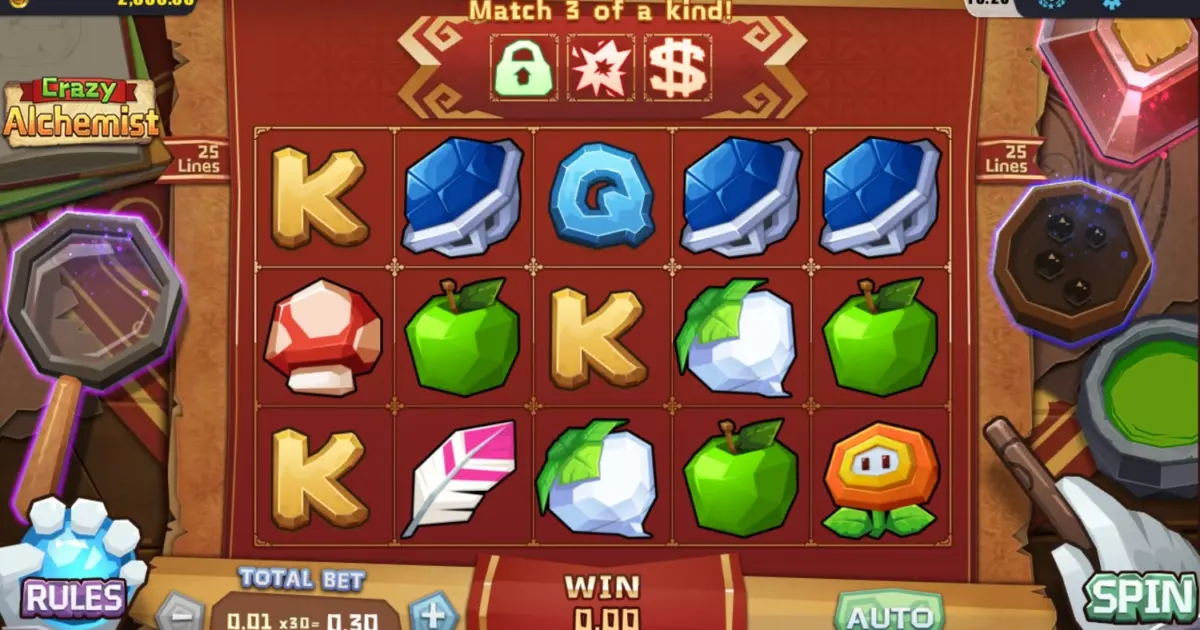
A free demo is available, which means you can load the game in a browser and spin with virtual credits. No deposit, no registration, no download. That is the sensible way to answer the questions the data sheet cannot: how the interface behaves, how fast the base game feels, and whether the comic-book presentation appeals to you.
What the demo cannot tell you is how a real-money session will go. Demo results carry no predictive weight whatsoever — a hot streak in play-money mode says nothing about the spins that follow it with cash at stake. The maths is identical; only your exposure changes.
Slots are paid entertainment, not income. Play only if you are 18 or over, decide your budget before you open the game, and treat that figure as the price of the session rather than something you expect back. If the amount you are staking starts to matter to you, that is the point to stop.
Similar picks
Within the Comics theme — 92 games in this catalogue — the published RTP figures drop off sharply from 97.36%. Billyonaire returns 96.00%, and King Kong Cash is listed at 95.79%, essentially the catalogue average. Both are 1.36 to 1.57 points behind, so if return figures drive your shortlist, they are theme-matched alternatives rather than upgrades.
Comic Craze has no published RTP in this data set at all. An unpublished figure is not automatically a bad one, but it removes your ability to compare, so weigh it accordingly.
Verdict
Worth a demo spin, on the strength of one number. 97.36% is among the better published figures in this catalogue, above DreamTech’s own 96.9% average and comfortably clear of the 95.71% norm. On expected cost per pound wagered, few listed games do better.
The reservation is how thin the rest of the sheet is. No volatility rating, no max win, no stake range, no feature detail — so you cannot plan a bankroll from published data alone, and you cannot judge session feel without playing. The demo closes that gap at zero cost, which is exactly what it is for.
Frequently Asked Questions
Can I play Crazy Alchemist for free without downloading anything?
A free demo is available for this DreamTech title, running in the browser with virtual credits. No deposit, registration or download is needed. Demo mode uses the same underlying maths as the real-money version, including the 97.36% RTP, but virtual credits cannot be withdrawn and results carry no predictive value.
What is the RTP of Crazy Alchemist and is it good?
The published RTP is 97.36%, meaning a modelled return of £97.36 per £100 wagered across a very large sample of spins. That is above DreamTech's 96.9% catalogue average and 1.65 percentage points above the 95.71% average across all games listed here, so the expected cost per spin is comparatively low.
How volatile is Crazy Alchemist?
DreamTech has not published a volatility rating for this game, so no honest figure can be quoted. Volatility governs swing size rather than long-run return, so two games at 97.36% RTP can feel completely different. Run 100 demo spins at a fixed stake and observe whether returns arrive frequently or in rare clusters.
Who is DreamTech and what other slots do they make?
DreamTech is the studio behind this release and has 77 titles in this catalogue, averaging 96.9% RTP. Ice and Fire is its closest match here at 97.28%, followed by Candy House at 96.86% and Blue Sea at 96.00%. The studio's published figures generally sit above the wider market average.
How does Crazy Alchemist compare to King Kong Cash?
On published RTP, this game leads: 97.36% against 95.79% for King Kong Cash, a gap of 1.57 percentage points. Over £1,000 wagered that is roughly £15.70 in expected return. Both sit in the Comics theme, which covers 92 games here, so the choice comes down to presentation and the return figure.