Book of Rebirth is a five-reel release from Spinomenal with a published return of 95.9%, and a free demo you can load without spending anything. That figure sits fractionally above the 95.71% average across the games catalogued here, and it is 0.79 points above Spinomenal’s own house average. If you came for the book of rebirth slot numbers rather than the marketing language, this is what they tell you, and where they stop.
First look at Book of Rebirth
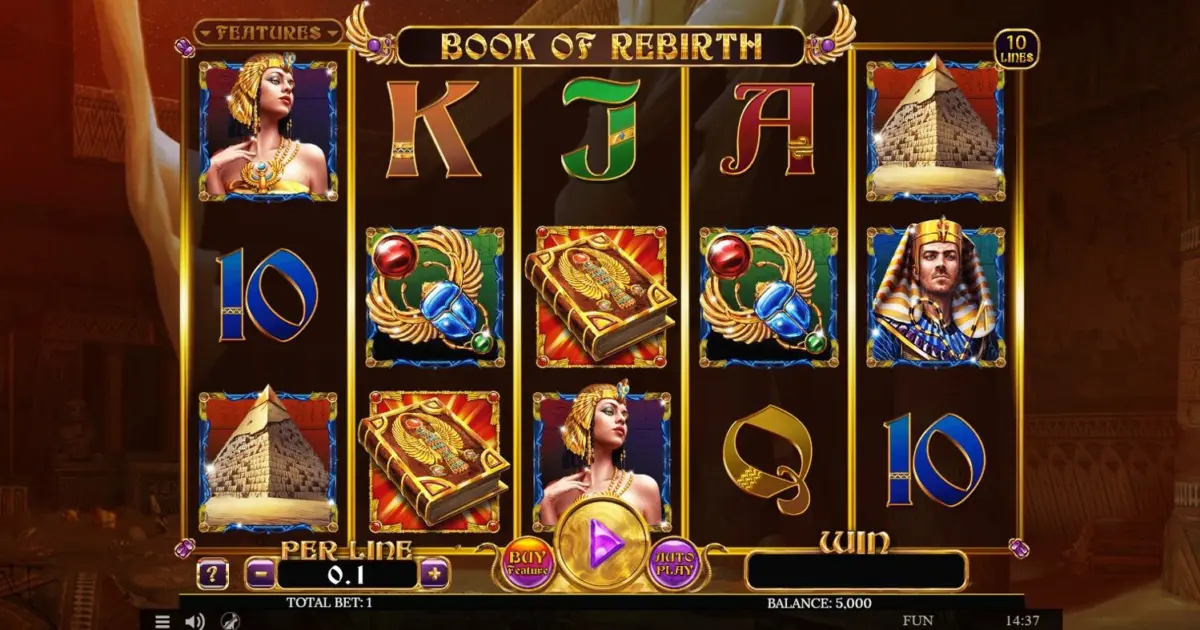
The facts on file are narrow but useful. Five reels, an Egyptian theme, classified as a slot machine, built by Spinomenal, and playable in demo form. Its popularity rank of 2203 places it in the 89th percentile of the games tracked here, so plenty of people are loading it, though rank measures attention rather than quality or generosity.
| Figure | Value |
|---|---|
| Provider | Spinomenal |
| RTP | 95.9% |
| Reels | 5 |
| Primary theme | Egypt |
| Category | Slot machine |
| Provider average RTP | 95.11% across 548 games |
| Database average RTP | 95.71% |
| Popularity rank | 2203 (89th percentile) |
| Free demo | Available |
What is not on file matters as much: no volatility rating, no payline or ways count, no maximum win, no stake range. Treat any of those numbers you see quoted elsewhere as unverified until the studio publishes them.
How a round plays out
With five reels, the visible grid is the standard shape most players already know, and the theme label points to ancient Egypt rather than any specific character or set of symbols. Beyond that, the mechanics are not documented in the data available, so the honest answer is that the Book of Rebirth free demo is the only reliable way to see how a spin behaves.
It is worth separating what is general from what is specific. Many slots in this family use expanding symbols, scatter-triggered free spins, or a bonus-buy option, and titles with “Book” in the name often lean on a special expanding symbol. That is a pattern across the genre, not a claim about this game. Until you see it on screen, assume nothing about trigger frequency, multiplier sizes or feature pricing.
One thing is certain regardless of features: results are produced by a random number generator, and every spin is independent of the one before it. A dry stretch does not make a feature more likely on the next press, and a run of hits does not make one less likely.
Reading the 95.9% return figure
An RTP of 95.9% means that across an extremely large number of spins, the game returns £95.90 for every £100 staked, leaving a house edge of 4.1%. That is a long-run average measured over millions of rounds, not a promise about your session. A hundred spins can land anywhere from nothing back to well above your stake.
The comparisons are where this figure earns its keep. Spinomenal’s average across 548 titles is 95.11%, so this release returns more than the typical game in its own catalogue. Against the 95.71% database average, it is ahead by 0.19 points. Both gaps are real but small. Over 1,000 spins at £0.50, a 0.19-point difference amounts to roughly 95p in expected cost, while the 4.1% edge itself accounts for around £20.50.
In other words, RTP is worth checking and worth comparing, but a fraction of a percentage point will be invisible inside normal session variance. The bigger lever on how long your money lasts is stake size and how volatile the game is.
Why unpublished volatility changes your bankroll maths
No volatility rating is listed for this title, and that is a genuine gap rather than a footnote. Volatility describes how the same 95.9% return is distributed. A low-volatility game pays small amounts often, so a fixed bankroll stretches across many spins with modest swings. A high-volatility game pays rarely and larger, so the same bankroll can vanish in a few dozen spins, or survive on one good sequence.
The practical consequence: with no volatility rating published, you cannot size a bankroll in advance with any confidence. A rule of thumb many players use for high-variance games is 200 to 300 times the base stake before the session feels survivable, versus perhaps 50 to 100 times for a low-variance game. That is a fourfold difference in what you would need to bring.
The demo solves this cheaply. Play a few hundred spins at a fixed stake and watch how often anything lands and how deep the losing runs go. That gives you a rough feel for the shape, though demo sequences are their own random sample and do not predict real-money outcomes.
Bet sizing when the stake range is not published
Minimum and maximum stakes are not recorded for this game. Most Spinomenal releases offer a wide range, and the range shown in the game client at a given casino is the only figure worth trusting, so check it before your first spin.
What you can plan is your own arithmetic. Decide the total you are willing to lose, decide how long you want the session to last, and divide. If you have £40 and want roughly 400 spins, your stake is £0.10. At £0.50 the same £40 buys about 80 spins before variance is even accounted for, and at 95.9% RTP the expected cost of those 400 spins at £0.10 is around £1.64, with the actual outcome scattered widely either side.
No staking pattern changes that expectation. Doubling after a loss, waiting for a quiet spell, or raising your bet after a win alters the size of your swings, not the house edge. Flat staking simply makes your spin count predictable.
Where the book of rebirth slot sits among Egypt slots
Egypt is one of the most crowded categories in the business, with 908 titles carrying the theme here, so the comparison set is large. On return alone, this game is mid-table. Book of the Sun publishes 96.23%, a third of a point higher, and Crazy Mummy sits at 96.0%. Both edge past 95.9%, and both have a volatility profile you can look up before committing a bankroll.
The better-known reference point is Book of Dead at 94.25%, which is 1.65 points below this release. That is the one comparison where the difference is large enough to feel: over 2,000 spins at £0.20, it is roughly £6.60 in expected cost. Fame and generosity are not the same thing.
If you want to stay with the same studio, 1 Reel – Demi Gods 7 returns 95.42% in a far simpler single-reel format, which is a useful contrast in pacing rather than payout.
The honest verdict
This is a reasonable but unremarkable pick. 95.9% is above its provider’s average and marginally above the wider average, which puts it in respectable company without making it a standout among Egyptian five-reelers, where two of the comparisons above return more. The real weakness is disclosure: with no volatility rating, no stake range and no maximum win on record, you are buying partly blind, and that alone is a reason to start in the demo rather than with money on the line.
Play it if the theme appeals and you want to see the mechanics for yourself at no cost. Choose one of the higher-RTP alternatives if the return figure is your deciding factor.
Slots are paid entertainment, not income. Play only if you are 18 or over, decide your budget before you open the game, and stop when it is spent rather than chasing it back. If the spending stops feeling like a choice, most operators offer deposit limits and self-exclusion, and free support services exist in every regulated market.
Frequently Asked Questions
Can you play Book of Rebirth for free?
A free demo is available, so you can spin it with virtual credits and no deposit. That is the practical way to check the pacing and feature behaviour of this five-reel Spinomenal game, since its volatility rating and stake range are not published anywhere in the available data. Demo results never convert to real money.
What is the RTP of Book of Rebirth?
The published return is 95.9%, meaning £95.90 back per £100 staked across a very large sample, with a 4.1% house edge. It beats Spinomenal's 95.11% catalogue average and sits 0.19 points above the 95.71% database average. Short sessions will land far from that figure in either direction.
How volatile is Book of Rebirth?
No volatility rating is published for this title, which makes bankroll planning guesswork rather than arithmetic. High-variance games typically need 200 to 300 times your base stake to ride out dry spells, low-variance games far less. Running a few hundred demo spins at a fixed stake is the cheapest way to gauge the swings.
Who makes Book of Rebirth and what else do they produce?
Spinomenal built it, a studio with 548 titles catalogued here and an average published RTP of 95.11%. Their range spans mythology, fantasy and stripped-back formats such as 1 Reel - Demi Gods 7 at 95.42%. This release, at 95.9%, returns more than the typical game in their own library.
Is Book of Rebirth better value than Book of Dead?
On return, yes by a clear margin: 95.9% against 94.25% is a 1.65-point gap, which over 2,000 spins at £0.20 is roughly £6.60 in expected cost. Book of the Sun goes higher still at 96.23%. Feature design and volatility differ, and those are not documented for this title.