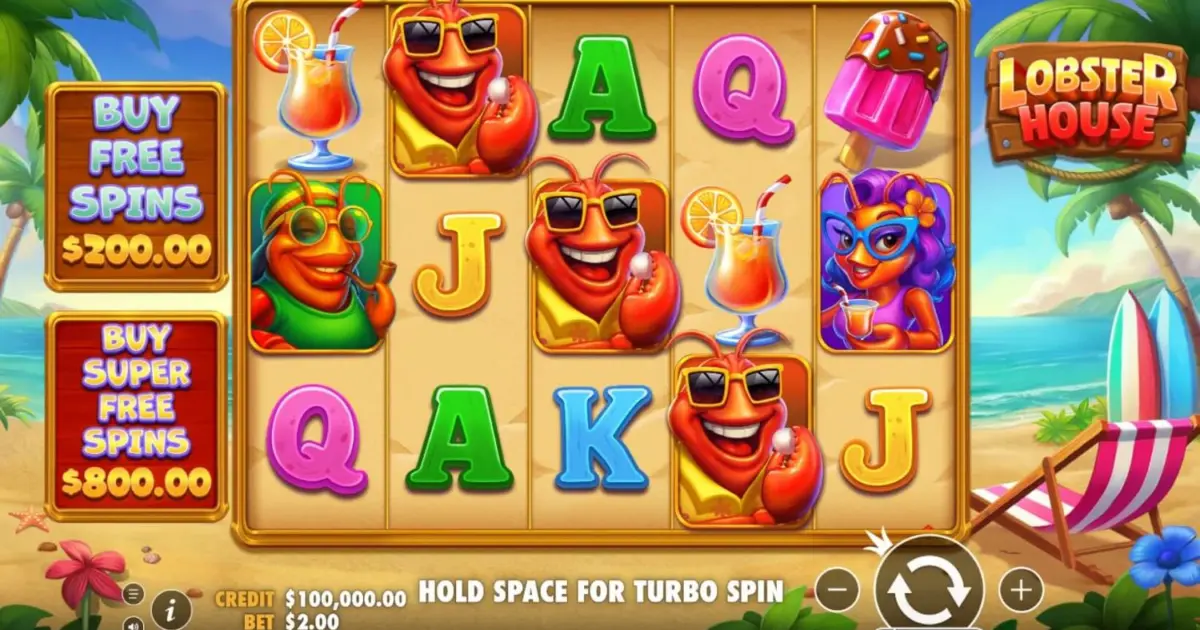
The single number worth knowing here is 96.51%. That puts the lobster house slot above the Pragmatic Play house average of 96.32% and 0.8 percentage points above the 95.71% average across the games in our database. It runs on five reels, carries a summer theme, and can be played as a free demo, so you can see the game move before deciding whether it suits you.
What Pragmatic Play has not published is just as relevant. There is no confirmed volatility rating, no stated payline or ways count, no max win multiplier and no stake range on record for this title. Below, the maths gets the detail it deserves, and the gaps are named as gaps rather than filled with guesswork.
| Figure | Detail |
|---|---|
| Game name | Lobster House |
| Provider | Pragmatic Play |
| RTP | 96.51% |
| Reels | 5 |
| Theme | Summer |
| Type | Slot Machine |
| Provider average RTP | 96.32% across 739 games |
| Database average RTP | 95.71% |
| Popularity rank | 2152 (89.2nd percentile) |
| Free demo | Available |
The 5-reel grid explained
Five reels is the standard modern layout, and it matters more than it sounds. Each reel is an independent set of symbol positions, and the number of reels sets a ceiling on how many symbols a single winning combination can chain together. A five-reel game can therefore produce a wider spread of outcomes than a three-reel one: more small results that return part of your stake, and a longer tail of rarer, larger ones.
What five reels does not tell you is how many symbol positions sit on each reel, whether the grid is fixed or expands, or how the paytable is weighted. Those choices are what separate two five-reel games with identical RTP into completely different playing experiences. Pragmatic Play has not published the row count for this title, so treat any grid dimensions you see quoted elsewhere as unverified.
For a sense of how varied the same reel count can be, compare it with Sweet Bonanza, another Pragmatic Play release carrying an identical 96.51% RTP but a very different structure.
Paylines, ways and how Lobster House pays
The payline or ways count for this game is not on record, so what follows is general and applies across the category rather than to this specific title.
Most five-reel slots resolve wins one of two ways. Fixed paylines define set paths across the reels, and a combination counts only if matching symbols land on one of those paths. “Ways” systems drop the paths entirely and pay whenever enough matching symbols appear anywhere on consecutive reels, which is why ways counts run into the thousands. A third approach, cluster or scatter pays, awards a win when a minimum number of symbols appear anywhere on the grid at all.
Many slots also layer in wilds that substitute for other symbols, scatters that trigger free spins, and multipliers applied to the total bet. None of those are confirmed features here. The practical takeaway: load the demo and read the in-game paytable, which is the only authoritative source for how this particular game resolves wins. Anything else is inference.
96.51% RTP put in context
Return to player is a long-run statistical average, not a session promise. A 96.51% figure means that across a very large number of spins, the game is modelled to return £96.51 for every £100 wagered, leaving a house edge of 3.49%. Over 1,000 spins at £1 a spin, £1,000 staked has an expected return of roughly £965 — but individual 1,000-spin runs scatter widely around that figure, in both directions.
The comparison is where the number earns its keep. The average game in our database returns 95.71%, so this title keeps about 80p more per £100 staked over the long run. Against the Pragmatic Play average of 96.32% across 739 titles, it is modestly above house standard. It also edges out Surfin’ Santa at 96.50% and comfortably clears Tiki Paradise at 95.00% — a 1.51-point gap that compounds into real money over thousands of spins.
Note that operators sometimes deploy multiple RTP versions of the same game. Check the figure shown in the game information panel where you play.
Volatility and hit patterns
No volatility rating has been published for this game, which is a genuine gap, because volatility shapes your session far more visibly than RTP does.
Two games can share the same 96.51% return and feel nothing alike. Low volatility means frequent, small results and a balance that drifts rather than lurches; sessions last longer on a given bankroll and swings stay shallow. High volatility means long stretches of nothing punctuated by rarer, larger outcomes, which demands a bigger bankroll relative to your stake to stay in the game long enough for the distribution to do anything at all.
Hit frequency, the share of spins returning anything, is the related figure and is also unpublished here. Without either number, the demo is your measuring tool: play a few hundred spins and watch how often the balance ticks up and how deep the dry runs get. One thing holds regardless of volatility — every spin is independent, and previous results carry no information about the next one.
Choosing a stake on the lobster house slot when limits are unpublished
The minimum and maximum bet for this title are not on record, so you will see the actual range in the bet selector once the game loads. The framework for choosing within it does not depend on knowing those numbers in advance.
Work backwards from a budget, not forwards from a stake. Decide the total amount you are willing to spend, then divide it by the number of spins you want the session to last. A £40 budget stretched across 200 spins sets a 20p stake; the same £40 at £2 a spin gives you 20 spins. Neither is better, but they are different purchases, and the maths is fixed before you start.
With volatility unknown, the conservative move is to size your stake toward the lower end of whatever range the game offers until you have watched how it behaves. No stake size, betting pattern or timing changes the 3.49% house edge — that figure is built into the game and applies identically to a 10p spin and a £10 one.
Demo play versus real money
A Lobster House free demo is available, and it runs the same mathematical model as the paid version, on play credits instead of cash. That makes it genuinely useful for three things: reading the paytable, learning the bet controls, and getting a feel for hit rhythm before money is involved.
What it cannot do is predict what a real-money session will produce. Demo results are independent random outcomes just like paid ones, and a strong or weak demo run tells you nothing about what comes next. Free credits also remove the emotional weight of losing, which is exactly the variable that matters most once your own balance is on the line.
If you do move to real stakes: this is 18+ only, set a budget before you open the game, and treat the money as the price of entertainment rather than an investment. Stop when the budget is gone. Deposit limits and session reminders are standard tools at licensed operators and are worth switching on.
Verdict on Lobster House
The case for playing is the RTP. At 96.51% it beats both the Pragmatic Play average and the wider database average, and among Pragmatic Play slots it matches the figure carried by the studio’s biggest releases. Rank 2152 places it in the 89.2nd percentile for popularity, so it has found an audience without being a headline title.
The case for caution is the missing information. No published volatility, no confirmed paylines or ways, no stated max win, no stake range. That does not make it a bad game, but it does mean you cannot assess whether its risk profile matches your bankroll from the spec sheet alone. If you want a comparable RTP with documented mechanics, Gates of Olympus at 96.50% is the better-known alternative.
Sensible approach: open the demo, read the paytable, run a few hundred spins to gauge the swing size, and only then decide whether it is worth real stakes. The return figure is good. The rest you will have to see for yourself.
More from Pragmatic Play
- Mammoth Gold Megaways — 96.03% RTP
- Book of Tut Megaways — 96.0% RTP
- The Dog House Multihold — 96.06% RTP
- Lobster Bob’s Crazy Crab Shack — 96.03% RTP
- Madame Destiny — 96.5% RTP
- Queenie — 96.51% RTP
- Big Bass Hold and Spinner Megaways — 96.7% RTP
- Release the Kraken — 96.5% RTP
Frequently Asked Questions
Can I play Lobster House for free?
A free demo version of Lobster House is available, running the same maths model as the paid game on play credits rather than cash. It is the practical way to read the in-game paytable and learn the bet controls, particularly useful here since Pragmatic Play has not published the volatility rating or payline count for this title.
What is the RTP of Lobster House and what does it mean?
The RTP is 96.51%, meaning the game is modelled to return £96.51 per £100 wagered across a very large sample, leaving a 3.49% house edge. That is 0.8 points above the 95.71% database average and above Pragmatic Play's own 96.32% average. Short sessions will vary widely from that figure in both directions.
Is Lobster House high or low volatility?
No volatility rating has been published for this game, so the honest answer is that it is unknown. Low volatility delivers frequent small returns and shallow swings; high volatility means long dry stretches and rarer larger results needing a bigger bankroll. Running a few hundred demo spins is the only reliable way to gauge it yourself.
Who makes Lobster House and what else do they produce?
Pragmatic Play developed it, a studio with 739 titles in our database averaging 96.32% RTP. Their better-known releases include Sweet Bonanza at 96.51%, Gates of Olympus at 96.50% and Joker's Jewels at 96.50%. This title sits slightly above their portfolio average, though it ranks 2152 for popularity rather than among their headline games.
How does Lobster House compare to Tiki Paradise?
On return, Lobster House leads clearly: 96.51% against 95.00% for Tiki Paradise, a 1.51-point gap worth about £15 per £1,000 staked over the long run. Both carry summer themes from a 135-game category. Volatility figures are unavailable for Lobster House, so the comparison rests on RTP rather than session feel.