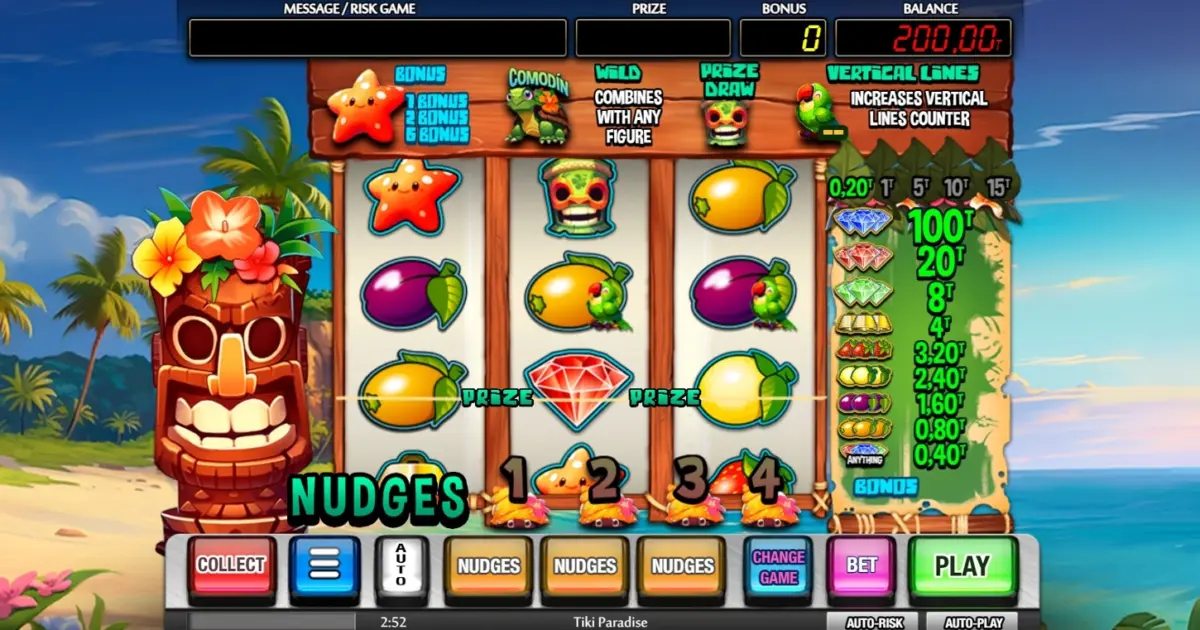
Tiki Paradise is a three-reel fruit slot from MGA that returns 95.0% across a very large sample. It sits above the provider’s own house average but slightly below the broader market, and its popularity percentile suggests more people look at it than most titles in this catalogue. If you want a straightforward retro-format spin with no extra layers, this is in that range.
Who makes Tiki Paradise
MGA builds this title, a provider holding 113 slots in its current catalogue. That is a mid-sized library — smaller than studios with thousands of games, but large enough to suggest a team shipping consistently rather than releasing one or two experiments per year.
Across those 113 games, MGA’s average RTP sits at 91.32%. That figure is notably below the industry norm you will find on most regulated platforms. When a provider’s mean lands at 91.32%, it usually means a meaningful chunk of the catalogue operates in the high-80s or low-90s range, pulling the average down. Tiki Paradise, at 95.0%, is therefore above its own house average by roughly 3.7 percentage points — a clear improvement over picking a random title from this developer.
The provider does not typically appear in top-tier aggregators that license the biggest global names, which means these games are more commonly found in regional or niche operator lineups. If you are browsing a site that carries MGA slots, you are looking at a catalogue curated for specific markets rather than a worldwide distribution platform.
| Provider | MGA |
|---|---|
| RTP | 95.0% |
| Reels | 3 |
| Theme | Fruits |
| Free demo | Yes |
Where Tiki Paradise sits in the MGA catalogue
With 95.0% RTP and a three-reel fruit format, this game occupies a specific corner of the provider’s library. Among related MGA titles, Magic Stones posts a marginally higher 95.08% return while keeping a comparable structure, so the difference in expected loss rate is negligible over any realistic session. Barragan en Laponia matches the 95.0% figure exactly, meaning there is no statistical reason to prefer one over the other on return alone — you would choose between them on theme or layout if both were available.
A third title, Sonia Monroy en el Planeta Navidad, has no published RTP at all. When a provider leaves that number blank, treat it as a warning for long-session planning: without knowing the house edge, you cannot model your expected loss rate, and the operator behind your chosen deployment could be running a significantly lower configuration than any nominal figure. Tiki Paradise at least publishes its number clearly.
The popularity rank of 905 out of the full corpus, combined with a 95.5th percentile rating, tells you this title attracts more player attention than the vast majority of slots in the dataset — unusual for a provider of this size and suggesting either heavy operator promotion or genuine search interest in the fruit-and-summer theme combination.
RTP: 95.0% against a 91.32% house average
Tiki Paradise returns 95.0% of all wagered money to players across a very large sample. That means the theoretical house edge is 5.0% — over 10,000 spins at £1 each, the expected return is £9,500 and the expected loss is £500. This is a long-run statistical average, not a prediction for any individual session. Your actual result on any given evening will differ, sometimes wildly.
Against the corpus average of 95.71%, this game sits 0.71 percentage points below the norm. Over 10,000 spins at £1, that gap costs you roughly £71 extra compared to a game at the market average. It is not a dealbreaker, but if you are comparing between titles with identical themes and formats, the difference compounds over time.
Against MGA’s own provider average of 91.32%, however, this is a meaningful upgrade. The 3.68 percentage point gap means a £1-per-spin session against a random MGA title could cost you roughly £37 more per 1,000 spins than the same session on Tiki Paradise. If you are sticking with this developer, picking a game at or above 95.0% RTP is a smart default choice.
No hit frequency, max win multiplier, or bonus-specific RTP contribution is published for this title. Without those figures, the 95.0% headline number is the only mathematical anchor you have, and any site quoting a “max win” or “hit rate” for this game is guessing.
Volatility and who it suits
MGA has not published a volatility rating for Tiki Paradise. This is a real gap in the information available to you as a player, and it matters more than most readers assume. Volatility determines not how much a game returns — that is RTP — but how unevenly those returns arrive across spins.
Low-volatility games deliver frequent but small wins, stretching your session and keeping swings modest. Medium-volatility games balance win frequency against payout size. High-volatility games go long stretches between hits, then occasionally deliver a single large return that compensates for the dry spell — but only across thousands of spins, not in one sitting.
A three-reel fruit slot with no published bonus details most commonly runs low to medium volatility, as the format historically favours frequent small returns from basic symbol combinations. That said, “most commonly” is not a guarantee. Without MGA confirming it, you should treat volatility as unknown and start any real-money session with a conservative stake regardless.
If you prefer long sessions with small swings, a game in this format probably suits you. If you chase the large isolated payout, an unstated volatility means you are gambling blind on the distribution — and the absence of a stated max win makes that worse.
Playing Tiki Paradise for free
A free demo of this Tiki Paradise free demo version is available without downloading software or registering at most hosting sites. Demo play uses the same math model as the real-money version, so the three-reel layout and symbol set behave identically — you can learn the paytable and test your stake sizing without financial risk.
What demo play cannot tell you is how the game feels when real money is on the line. The volatility question above remains unanswered in demo, because a hundred free spins will not reveal the distribution of returns in any meaningful way. Demo confirms the mechanics; it does not simulate the session.
If you move to real-money play, set a budget before your first spin and treat what you lose as the cost of entertainment, the same way you would a cinema ticket or a round of drinks. Players must be 18 or over. No strategy, timing pattern or stake progression changes the house edge — every spin is independent of the last.
Similar picks
Tiki Paradise belongs to a 2,560-game fruit-themed pool across the corpus. Three related titles worth considering sit at different points on the RTP and risk spectrum.
Hot Hot Fruit posts 96.84% RTP — nearly two full percentage points above Tiki Paradise and more than a point above the corpus average. Over 10,000 spins at £1, that gap saves you roughly £184 in expected losses. If maximizing theoretical return is your single priority among fruit-format games, Hot Hot Fruit is the stronger pick on paper.
Trickstar Spins runs at 94.0% RTP, a full point below Tiki Paradise. The difference costs approximately £100 per 10,000 spins at £1, so unless the theme or mechanic genuinely appeals more, there is no mathematical case for choosing it over this title.
Sevens High has no published RTP. As with the MGA title mentioned earlier, that absence should steer you away from extended real-money play. A 2560-game theme pool with several unknown-return titles means you can always find a game that publishes its number — and you should.
Verdict
Tiki Paradise is a reasonable pick within its narrow category. The 95.0% RTP is honest, published, and well above MGA’s own house average. The three-reel fruit format appeals to players who want simple mechanics and no feature-hunting. The popularity percentile confirms other players agree.
What it lacks is transparency on volatility, max win, and hit frequency. Without those figures, session planning becomes guesswork, and you cannot distinguish this from a 95.0% game that pays out once every 200 spins versus one that pays small wins on nearly every third turn.
Compared to Hot Hot Fruit at 96.84%, you lose roughly £184 per 10,000 spins in expected return — a meaningful gap if you play regularly. If no higher-RTP fruit title appeals to you on theme, Tiki Paradise is a defensible middle ground. Spin the demo first, confirm the layout suits your taste, and walk away if the volatility guesswork makes you uncomfortable.
Frequently Asked Questions
What is the RTP of Tiki Paradise?
Tiki Paradise returns 95.0% to players across a very large sample, meaning a 5.0% theoretical house edge. That places it 0.71 points below the corpus average of 95.71% but 3.68 points above MGA's own provider average of 91.32%. Over 10,000 one-pound spins, the expected loss is approximately £500.
Can you play Tiki Paradise for free without downloading anything?
Yes, a free demo of this slot is available without downloading software at most hosting sites. The demo uses the same three-reel layout and symbol set as the real-money version, letting you learn the paytable and test stake sizing without financial risk before deciding whether to play with real money.
What volatility does Tiki Paradise have?
MGA has not published a volatility rating for this title. Three-reel fruit slots historically run low to medium volatility with frequent small wins, but without confirmation you should treat the distribution as unknown and start any session with a conservative stake regardless of your bankroll size.
Who makes Tiki Paradise and what else does the provider offer?
MGA makes Tiki Paradise and currently holds 113 slots in its catalogue. The provider averages 91.32% RTP across all games, so this title is notably above its house norm. Related MGA games include Magic Stones at 95.08% RTP and Barragan en Laponia at 95.0%.
How does Tiki Paradise compare to other fruit slots in RTP?
Tiki Paradise at 95.0% falls below Hot Hot Fruit's 96.84% but above Trickstar Spins' 94.0%. Over 10,000 one-pound spins, choosing Hot Hot Fruit instead saves approximately £184 in expected losses. The fruit-theme pool spans 2,560 games, so higher-RTP alternatives exist within the same category.