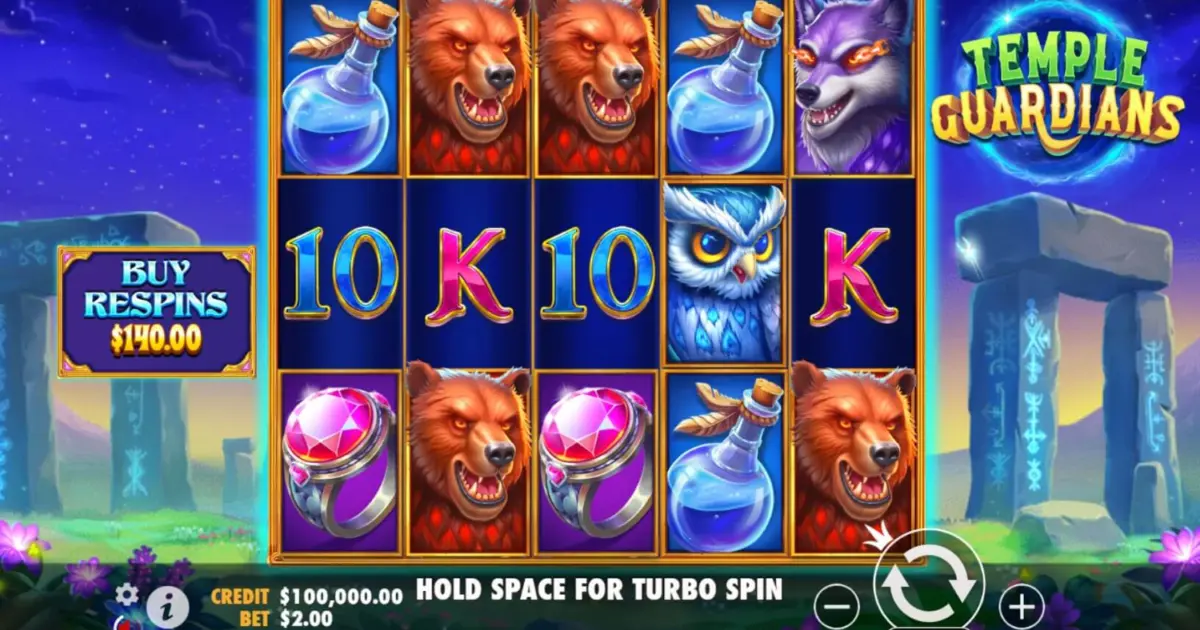
The case for the temple guardians slot is short and numerical: Pragmatic Play publishes a return-to-player figure of 96.53%, which sits above the provider’s own 96.32% average and 0.82 percentage points above the 95.71% average across the games we hold data for. It runs on five reels, a free demo is available, and it ranks 2,118th by popularity, putting it in the 89.4th percentile of titles we track. What is not published is nearly everything else — volatility, paylines, stake limits, max win — so this review works with the maths rather than guessing at the features.
Temple Guardians at a glance
Here are the figures that exist, in one place:
| Detail | Value |
|---|---|
| Provider | Pragmatic Play |
| RTP | 96.53% |
| Reels | 5 |
| Category | Slot Machine |
| Popularity rank | 2,118 (89.4th percentile) |
| Provider average RTP | 96.32% across 739 games |
| Database average RTP | 95.71% |
| Free demo | Available |
That table is deliberately short. Pragmatic Play has not published a volatility rating, a paylines or ways count, a stake range or a maximum win multiplier for this title, so any of those numbers you see quoted elsewhere should be treated as unverified until the provider or a regulator confirms them. For a reader deciding where to spend a session, the useful takeaway is that the return figure is measurably above average and the risk profile is undocumented. That combination suits someone who cares about long-run return and is willing to establish the swing behaviour themselves in demo mode. It suits a player who wants a known bonus structure and a known ceiling much less well, because neither is on the record.
What a 96.53% RTP actually returns
RTP is a long-run statistical average, not a promise about your session. At 96.53%, every £100 wagered returns £96.53 across a very large sample of spins, leaving a house edge of 3.47%. Work that through a concrete case: 1,000 spins at £1 a spin puts £1,000 through the game, and the mathematical expectation is £965.30 back, an expected cost of £34.70 for those thousand spins. Real sessions will land well above or well below that, because 1,000 spins is a small sample for a slot.
The comparison is where the figure earns its keep. Against the 95.71% database average, the same £1,000 wagered would return £957.10 — so this game is worth roughly £8.20 more per £1,000 staked than a typical title, purely on the published percentage. Against Pragmatic Play’s own 96.32% house average across 739 games, the gap narrows to about £2.10 per £1,000. Small, but it moves the right way, and it costs nothing to prefer the higher number. Note also that some slots ship in multiple RTP configurations depending on the operator, so check the figure displayed in the game’s own info panel before you play for money.
Volatility is unpublished, and what that means for your session
No volatility rating has been released for this game, which is a genuine gap rather than a detail to gloss over. Volatility describes how the return arrives, not how much of it arrives. Two slots can both pay 96.53% and feel nothing alike.
In general terms: low-volatility games pay small amounts often, so balances drift down slowly and sessions last a long time on a modest budget. High-volatility games pay rarely and larger, which means long stretches of nothing punctuated by occasional big hits, and they need a deeper bankroll and a higher tolerance for drawdown to play at the same stake. Medium sits between the two. Because the same RTP can be delivered either way, the 96.53% figure tells you nothing about which pattern to expect here.
The practical answer is to find out yourself. A few hundred demo spins will show you roughly how often the game pays anything at all and how big the typical hit is relative to your stake. That is qualitative, not predictive, but it is enough to decide whether the swings suit you. And whatever you observe, every spin is independent — a long dry run does not make the next spin more likely to pay.
The 5-reel layout and how wins are counted
Five reels is the standard modern layout and the one most players are used to. What the provider has not stated is how wins are evaluated on those reels, and that matters more than the reel count itself.
Across the market, five-reel games resolve wins in one of a few ways. Fixed-payline games check a set number of defined lines across the reels and pay matching symbols along them, usually left to right. Ways or all-ways games drop the lines and pay any combination of matching symbols in adjacent reels, which is why you see figures like 243 or 3,125 ways quoted. Cluster and pays-anywhere systems ignore position entirely and count total symbols on screen. Each system produces a different rhythm of small wins even at identical RTP.
Since the counting method for this title is not documented, treat the info panel inside the game as the authority. It will list the active lines or ways, the paytable and how many matching symbols a payout needs. If you want a Pragmatic Play five-reeler with a well-known structure to compare against, Joker’s Jewels is a stripped-back fixed-line design returning 96.5%, effectively the same percentage on a much simpler grid.
Stake range and sizing a bankroll
The minimum and maximum bet for this game are not published, so the figures will be whatever the operator’s build displays. Check them before your first spin; the range determines how long any budget lasts far more directly than the RTP does.
The arithmetic is straightforward once you know your stake. Wagered turnover equals stake multiplied by spins, and the expected cost is 3.47% of that turnover. At £0.20 a spin, 1,000 spins is £200 of turnover and an expected cost of about £6.94. At £2 a spin, the same 1,000 spins is £2,000 of turnover and roughly £69.40 expected. Ten times the stake, ten times the expected cost, same percentage.
Variance, though, will swamp that expectation in any single session, which is why the sensible approach is to decide the total you are willing to spend first and then pick a stake that buys the number of spins you want from it. No staking pattern, progression or timing changes the 3.47% edge — it is fixed per spin, and each spin is settled independently of the last.
Playing the Temple Guardians slot demo before you commit
A free demo is available for this title, and given how much of the spec sheet is blank, it is the most efficient research you can do. Demo mode runs the same underlying maths with play-money credits, so it is the cheapest way to see the layout, read the paytable, learn how wins are counted and get a rough feel for how often the game pays. The Temple Guardians free demo needs no account and no deposit to try.
What a demo cannot do is forecast a real-money session. Results in play money have no bearing on results with cash, and a warm or cold run in either mode says nothing about what comes next.
Slots are paid entertainment with a built-in house edge, not a way to make money. Play only if you are 18 or over, set a budget before you start and treat anything you stake as spent. If the amount you are betting starts to matter to you, stop.
Verdict: who should play Temple Guardians
This one suits a player who picks games on published return and is comfortable filling in the blanks themselves. The 96.53% figure is above both the Pragmatic Play average and the wider database average, and on a return basis that is a mark in its favour. The 89.4th-percentile popularity ranking says a reasonable number of people do play it.
The reservation is the missing information. Volatility, paylines, stake limits and any maximum win are all unpublished, which makes it hard to plan a bankroll around before you load it. If you want documented mechanics at a comparable return, Gates of Olympus pays 96.5% and Sweet Bonanza pays 96.51% — both within 0.03 points of this game and both far better described. Start in the demo, read the in-game info panel, and only move to real money once you know what the game does.
More from Pragmatic Play
- Gates of Olympus Xmas 1000 — 96.5% RTP
- Fire Archer — 96.07% RTP
- Might of Ra — 96.49% RTP
- Pizza Pizza Pizza — 96.04% RTP
- Buffalo King Megaways — 96.52% RTP
- Bigger Bass Bonanza — 96.71% RTP
- Gates of Olympus 1000 — 96.5% RTP
- Hot to Burn Hold and Spin — 96.7% RTP
Frequently Asked Questions
Can you play Temple Guardians for free?
A free demo is available for this Pragmatic Play title, so you can spin with play-money credits before deciding whether to stake anything real. That is worth doing here because the volatility rating, payline count and stake range are unpublished, and the demo plus the in-game info panel are the quickest way to see all three for yourself.
What does the 96.53% RTP mean in practice?
It means the game is built to return £96.53 for every £100 wagered across a very large sample, leaving a 3.47% house edge. Over 1,000 spins at £1, the expected return is £965.30 and the expected cost £34.70. Short sessions vary widely around that average, so treat the figure as long-run maths rather than a session forecast.
Is Temple Guardians high or low volatility?
Pragmatic Play has not published a volatility rating for this game, so nobody can state one honestly. Identical 96.53% returns can arrive as frequent small wins or rare large ones. A few hundred demo spins will give you a rough sense of hit size and frequency, and remember each spin is settled independently of the last.
Who makes Temple Guardians, and what else do they make?
Pragmatic Play develops it, and we hold data on 739 of their games with an average published RTP of 96.32%. Their better-known Pragmatic Play slots include Gates of Olympus at 96.5%, Sweet Bonanza at 96.51% and Joker's Jewels at 96.5% — all within a few hundredths of a point of this title's return figure.
How much should you budget per session?
Decide the total first, then pick a stake that buys the spins you want. Expected cost is 3.47% of turnover, so £200 wagered across 1,000 spins at £0.20 works out to roughly £6.94 in expectation, though real swings will be much larger. The stake range itself is unpublished, so check the operator's limits before spinning.