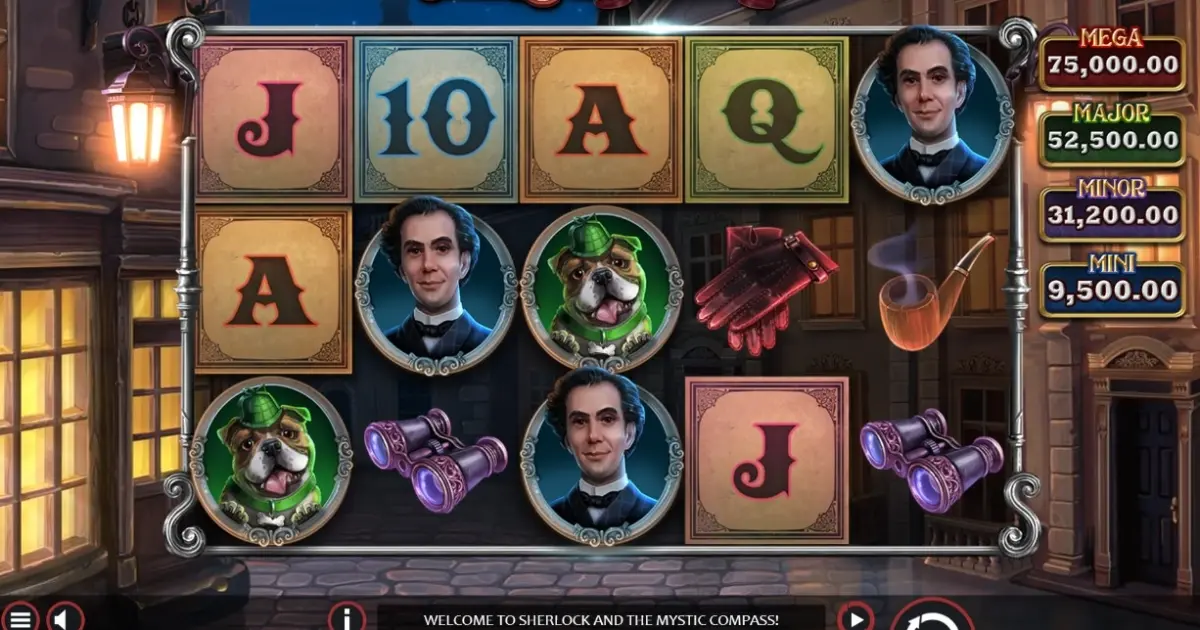
Before you spend a session on Sherlock and the Mystic Compass, you should know that Nucleus Gaming has published no RTP, no volatility classification and no stake range for this title. The mathematics behind this slot are effectively invisible. That absence alone should change how you approach the game.
Sherlock and the Mystic Compass at a glance
| Attribute | Value |
|---|---|
| Provider | Nucleus Gaming |
| Reels | 5 |
| Game type | Slot Machine |
| Popularity rank | 624 |
| Popularity percentile | 96.9 |
| Provider average RTP | 95.91% |
| Free demo available | Yes |
Sherlock and the Mystic Compass slot is a five-reel release from Nucleus Gaming, a studio with 108 titles in our database. It occupies rank 624 and sits in the 96.9th percentile for popularity, which means roughly 97% of catalogued games receive fewer spins. That tells you the presentation draws players in, even though the underlying numbers remain unpublished.
What you will not find anywhere in our records: a specific RTP figure, a volatility rating, a stake range, a payline or ways count, a max-win multiplier, or a hit-frequency percentage. The only quantitative anchor is the provider’s 108-game average of 95.91%, which edges above the corpus-wide figure of 95.71%. An average across 108 titles always conceals a spread, and without this game’s individual number you cannot place it inside that range. You are making a decision with one eye closed.
What the RTP actually returns
No RTP has been published for this specific slot, so any percentage you encounter on a third-party site is either unverified or borrowed from the provider average. The honest starting point is Nucleus Gaming’s portfolio-wide figure of 95.91% across 108 games. Treat that as context, not as a guarantee for this title.
Working through the maths: if this game did match the provider average, wagering £1 at a time for 1,000 spins (a total stake of £1,000) would theoretically return £959.10 over a very large sample. That leaves £40.90 as the house margin across those thousand spins. The corpus average of 95.71% produces the same calculation at £957.10 returned, a difference of £2 per thousand spins. Those two-tenths of a percentage point sound trivial, and over a single evening they genuinely are. The gap becomes meaningful over tens of thousands of spins, which is the horizon over which RTP functions as a statistical law rather than a short-term result.
For a concrete comparison within Nucleus Gaming’s catalogue, Sherwood Heist Hold & Win reports a published RTP of 96.11%. If you want a game from the same provider where you can plan against a known number, that is the clearer option. You can calculate expected returns before you fund a session rather than after.
Volatility and what your session will feel like
Nucleus Gaming has not classified this title’s volatility, so you cannot predict whether your session will deliver frequent small wins or sparse large payouts. That gap matters because volatility shapes every practical aspect of play more than RTP does over realistic session lengths.
A low-volatility slot typically pays a winning combination on perhaps one in four to one in six spins, with individual wins clustering near or slightly above your stake. Sessions feel steady; your balance drifts gently rather than swinging. You get more spins per pound, and the bankroll required to survive a cold stretch is modest. High-volatility games invert this: winning spins might arrive once every ten or fifteen, but each hit carries a larger multiplier. Balances lurch downward for long stretches before a single spin compresses months of losses into one payout. You need a larger starting bankroll and the discipline to sit through the drought.
Medium-volatility games split the difference and suit players who want visible swings without extreme risk. Without knowing where Sherlock and the Mystic Compass falls, you are guessing at the shape of your session. The free demo lets you observe win frequency directly: spin two hundred times, count the winning spins, and note the size of each payout relative to your stake. That gives you a rough personal read, though it is far from statistically reliable.
The five-reel layout and how wins are counted
This game uses a five-reel configuration, which is the standard arrangement across the majority of modern online slots. Five reels create a grid tall enough for stacked symbols, expanding wilds and multiple paylines or ways without overwhelming the player’s ability to track what happened on a spin. The theme label in our data reads simply “5-Reels,” so we have no confirmed theme category beyond that structural description.
We also have no data on whether this title uses fixed paylines, adjustable paylines, or a ways system such as 243 ways or Megaways. That distinction changes how wins are counted and how much the number of active lines affects your stake per spin. On a fixed-line game, your total bet divides across all lines simultaneously. On a ways game, matching symbols on adjacent reels form a win regardless of horizontal position, and the cost structure differs. The provider’s catalogue shows games using both approaches, including 12 Animals and Bandits and Bounties, but neither has a published payline count in our records either.
Without the specifics, you will need to check the in-game information screen, which Nucleus Gaming titles typically include as a paytable accessible during demo play. That screen is the only authoritative source for this game until the provider publishes its own documentation.
Stake range and sizing a bankroll
No minimum or maximum stake has been recorded for this game. Without those boundaries, you cannot calculate how many spins a given bankroll will last, which is the single most useful planning step before playing any slot.
As a general framework: a bankroll of £100 at a stake of £0.20 per spin buys you five hundred spins before variance, not losses, takes any of it. At £1.00 per spin the same bankroll gives you one hundred spins, which may not be enough to trigger any bonus structure the game contains. The practical rule is to divide your session budget by the number of spins you want. Most bonus rounds on medium and high-volatility games trigger within a range of one hundred to three hundred spins, so sizing your stake so that your budget covers at least that many turns is sensible planning rather than gambling strategy. No stake level changes the house edge.
Because this game’s volatility is unknown, you cannot confirm whether a three-hundred-spin buffer will be sufficient or whether the swings will exhaust your balance well before that. Sizing conservatively is the only prudent response to missing data.
Playing the Sherlock and the Mystic Compass slot demo before you commit
A free, no-download demo of this game is available, and it is the most useful tool you have given the data gaps described above. Demo play does not pay real money, and its results carry no predictive weight for funded sessions because the RNG produces independent outcomes regardless of whether money is on the line. What the demo does provide is a chance to observe the game’s rhythm: how often symbols align, how the bonus structures appear, and whether the presentation keeps you engaged.
Spin at least two hundred times in demo mode and record your observations. Count the winning spins. Note the largest payout relative to your stake. If the demo’s behaviour feels consistent with a low-volatility pattern, your funded session will likely share that character. If wins are sparse and multipliers occasionally spike, plan a larger bankroll.
If you do move to real money, set a spending limit before your first funded spin and treat the session as paid entertainment with a known cost. Nucleus Gaming slots, including this one, are for adults aged 18 and over. Stop when the budget ends, regardless of where your balance sits at that point.
Verdict: who should play this game
Sherlock and the Mystic Compass earns a cautious recommendation from the popularity data alone: its 96.9th-percentile ranking shows strong player interest, and the free demo lets you evaluate the experience with zero financial risk. The presentation evidently works.
However, the absence of a published RTP, volatility rating, stake range and payline structure means you cannot make an informed mathematical decision before you spin. You are choosing a game on visual appeal and curiosity, not on numbers. That is a valid approach if your budget is strictly entertainment and you accept the opacity, but it is a poor approach if you want to optimise session length or compare this title against alternatives on measurable grounds.
Players who prioritise data will find better-informed choices within Nucleus Gaming’s own catalogue, where Sherwood Heist Hold & Win publishes a 96.11% RTP. Players who care mainly about presentation and do not mind the unknowns can try the demo, judge the feel, and decide from there. Just go in aware that the maths are missing, not favourable.
Frequently Asked Questions
Does Sherlock and the Mystic Compass have a published RTP?
No RTP figure has been published for this specific slot. Nucleus Gaming reports a portfolio average of 95.91% across its 108 titles, but that average does not tell you where this game sits within the range. Any individual RTP you encounter on another site is unverified.
Is Sherlock and the Mystic Compass a free demo slot?
Yes, a free demo is available for this title with no download required. You can spin through it without funding an account to observe the game's rhythm, bonus behaviour and presentation before deciding whether to play with real money.
What volatility does Sherlock and the Mystic Compass use?
Nucleus Gaming has not published a volatility classification for this game. You will need to spin at least two hundred times in demo mode and count your wins to form a rough personal read on whether the behaviour matches a low, medium or high-volatility profile.
Who develops Sherlock and the Mystic Compass?
Nucleus Gaming develops this title, a studio that has produced 108 games in our database. Their portfolio average RTP is 95.91%, slightly above the corpus-wide figure of 95.71%. Their Sherwood Heist Hold & Win slot reports a published RTP of 96.11%.
How does this game compare to Sherwood Heist Hold & Win?
Both are Nucleus Gaming titles, but Sherwood Heist Hold & Win has a published RTP of 96.11% while Sherlock and the Mystic Compass has none. That gives Sherwood a concrete planning number, making it the better choice if you need to calculate expected session costs before funding.




