If you want published numbers before you play, this one will frustrate you. The okie doggie slot from PlayStar arrives with a confirmed 5-reel layout and a free demo, but no released RTP, no volatility rating, no stated stake limits and no max win figure. That absence is the single most decision-relevant thing about it, and it shapes everything below.
What follows sticks strictly to what PlayStar has actually confirmed, plus the mathematics that applies to every slot ever built. Where a number is missing, that is said plainly rather than filled in.
| Detail | Value |
|---|---|
| Game name | Okie Doggie |
| Provider | PlayStar |
| Reels | 5 |
| Category | Slot Machine |
| Theme label | 5-Reels |
| Popularity rank | 2,110 (89.4th percentile) |
| Games in PlayStar catalogue | 82 |
| Site-wide average RTP for comparison | 95.71% |
| Free demo | Available |
| Published RTP | Not disclosed |
The 5-reel grid explained
Five reels is the default shape of the modern online slot, and it is the one confirmed structural fact here. Reels are the vertical strips of symbols that come to rest when a spin resolves. Five of them gives a designer enough columns to build combinations that read left to right across the screen, which is why the format replaced the three-reel classic as the industry standard.
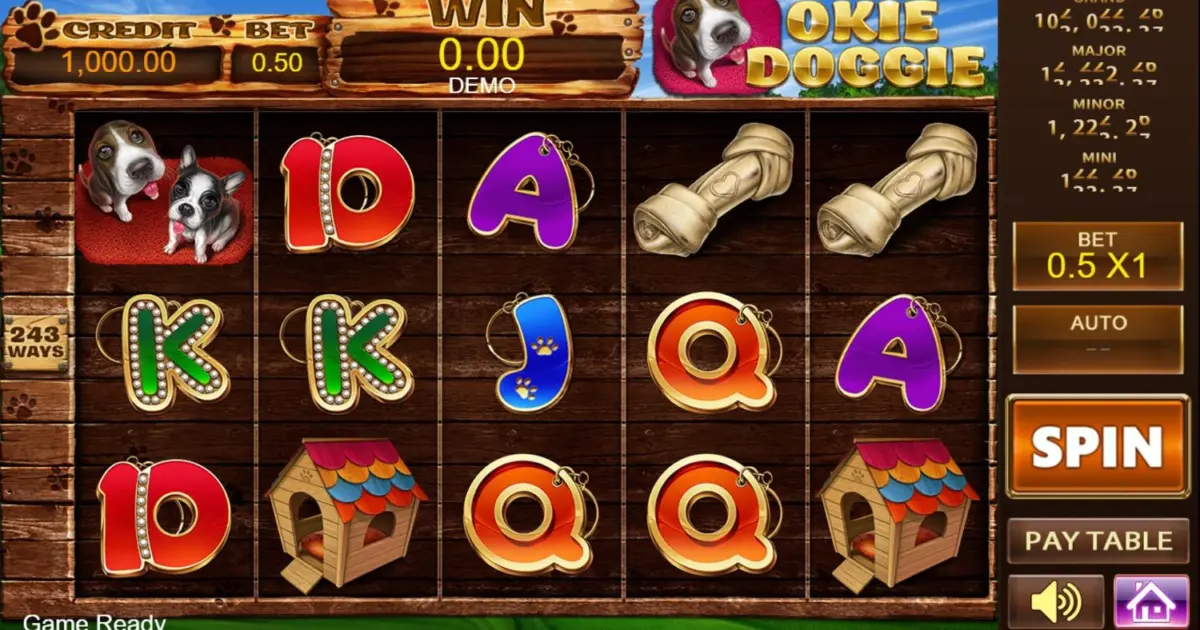
What five reels does not tell you is the number of rows. A five-reel game can be three rows deep, four deep, or variable. That distinction matters, because rows multiply out the number of symbol positions and therefore the number of possible winning routes. PlayStar has not stated a row count for this title, so the grid depth is something you will observe in the demo rather than read in a spec sheet.
The theme label attached to the game is simply “5-Reels”, which describes the hardware rather than a setting. There is no mythology, fruit, adventure or animal theme documented, so treat any thematic description you find elsewhere as someone’s interpretation rather than confirmed information.
Paylines, ways and how Okie Doggie pays
PlayStar has not published a payline or ways figure, so this section covers how the mechanics work in general across the category. Nothing here should be read as a confirmed feature of this particular game.
Traditional slots use fixed paylines: defined paths across the reels, and a combination only pays when matching symbols land on one of those paths. A 20-line game gives you twenty routes per spin. Many modern releases instead use a “ways” system, where any matching symbol anywhere in a column counts, producing figures like 243 or 1,024 ways. Neither approach is inherently more generous. The payline count is a presentation choice, and the paytable is scaled to match it.
Most five-reel games also include wilds that substitute for other symbols, and scatters that trigger a feature regardless of position. Free-spin rounds and buy features are common across the market. Whether this title uses any of them is undocumented, and it would be irresponsible to claim otherwise. The demo is the only way to see the actual paytable and feature set.
The Okie Doggie slot RTP figure, put in context
There is no published RTP for this game. PlayStar has not disclosed one, so any specific percentage you see quoted for it should be treated as unverified.
Here is why that matters. Return to player is the long-run statistical average a game pays back across a very large number of spins. A 96% RTP means roughly £96 returned per £100 wagered over hundreds of thousands of spins, with the remaining £4 forming the house edge. Across a single session of a few hundred spins, actual results can sit far above or far below that line. RTP is a tendency, not a promise, and it never applies to your afternoon.
For comparison, the average RTP across the games catalogued on this site is 95.71%. Without a figure for this title, you cannot place it against that benchmark. That is a genuine gap in your information, and it is reasonable to prefer games that publish the number. PlayStar’s other releases share the problem: neither 777 nor Super Win has a disclosed RTP either, which looks like a studio-wide disclosure habit rather than an oversight on one game.
Volatility and hit patterns
No volatility rating has been published, so treat the risk profile as unknown. The general framework still helps you interpret what you see in the demo.
Volatility describes the shape of the return rather than its size. Low volatility means frequent small wins, a bankroll that drains slowly, and long sessions with modest swings. High volatility means long stretches with nothing, punctuated by rarer, larger payouts, which demands a deeper bankroll to survive the dry spells. Medium sits between the two. Two games with identical RTP can feel completely different depending on which end of that scale they sit at.
Hit frequency is the related measure: the share of spins that return anything at all. It is not disclosed here either. You can get a rough sense of both by spinning the demo a few hundred times and watching how often something lands and how large the outliers are, though a few hundred spins is a small sample and will not settle the question.
One thing is certain regardless: every spin is independent. Results do not build up, and no game is ever due.
Choosing a stake when the limits are not published
Minimum and maximum bet levels have not been disclosed for this title, so you will see the actual range only when the game loads. Most five-reel online slots sit somewhere between a few pence and a few hundred pounds per spin, but that is a market generalisation, not a figure for this game.
The useful way to think about stake is spins per budget. Divide the money you are willing to spend by your stake, and you have the length of your session. A £50 budget at £0.20 a spin is 250 spins; the same budget at £2 is 25. Nothing about that division changes the house edge, and no staking pattern, progression or timing adjustment alters expected value. What stake size controls is how long you get to play and how violently the balance moves.
If the game turns out to swing hard, a smaller stake buys the spin count needed to sit through the flat periods. Set the number before you load the game, not while you are watching the reels.
Demo play versus real money
The Okie Doggie free demo runs the same maths as the paid version, and it is the practical route to filling the documentation gaps: grid depth, payline structure, features, stake range and the general rhythm of wins. Given that the RTP and volatility are both unpublished, the demo is doing more work here than it would on a fully documented game.
What the demo cannot do is pay you. Demo credits carry no cash value and cannot be withdrawn, and a demo session tells you nothing predictive about how a real-money session will go. A good run on play money and a poor run with real stakes are both entirely normal.
Slots are 18+ and priced entertainment, not a way to make money. Decide what the session is worth to you before you start, treat that figure as spent the moment you sit down, and stop when it is gone rather than topping up. If it stops feeling like entertainment, close it.
Verdict on Okie Doggie
This is a reasonably popular game with thin published information. It sits at rank 2,110, inside the top 11% of the titles catalogued here, which suggests people do find and play it. Against that, the missing RTP, volatility rating, stake range and max win figure leave you assessing a five-reel slot almost entirely on feel.
That is a fair trade only if you are comfortable playing without the numbers. If you would rather compare against the 95.71% catalogue average before committing, this title cannot give you that comparison. If you want to stay inside the same studio while browsing, Brazil Carnival is another of PlayStar’s 82 releases and worth a look in demo form alongside this one.
The sensible order of operations: spin the free demo, watch the paytable and the swing size, work out your stake and spin count, and only then decide whether it earns real money. Play it free first, because the spec sheet will not answer your questions.
Frequently Asked Questions
Can I play Okie Doggie for free without downloading anything?
A free demo is available, and it runs in the browser with no download required. It uses play credits with no cash value, so you can test the 5-reel layout, paytable and stake range at no cost. It is the most useful option here, since PlayStar has not published RTP or volatility details.
What is the RTP of Okie Doggie?
PlayStar has not published an RTP figure for this game, so no reliable percentage exists. Any number quoted elsewhere should be treated as unverified. For context, the average RTP across the games catalogued on this site is 95.71%, but without a disclosed figure you cannot place this title against that benchmark.
Is Okie Doggie high or low volatility?
No volatility rating has been published, so the risk profile is undocumented. Low volatility generally means frequent small wins and slower bankroll movement; high volatility means longer dry spells and rarer, larger payouts. Spinning the demo a few hundred times gives a rough impression, though that sample is too small to settle it.
Who is PlayStar and what other slots do they make?
PlayStar is the studio behind this title, with 82 games in its catalogue. Others include 777, Brazil Carnival and Super Win. None of those three has a published RTP either, which points to a studio-wide disclosure habit rather than a gap on one release. All are available in demo form.
How much does it cost per spin?
Minimum and maximum stakes have not been disclosed, so you will see the real range only when the game loads. Plan by session length instead: a £50 budget at £0.20 per spin gives 250 spins, while the same budget at £2 gives 25. Stake size controls duration, not the house edge.