The single number that should shape your decision on the lucky meow slot is its 95% RTP. That is below the 95.71% average across the games catalogued on this site, and well below the 96.63% average across Spadegaming’s own 120 titles. If you are choosing purely on published return, three of the provider’s other releases beat it outright. If you are here for the Asian theme and the free demo, the maths is still workable — you just want to understand what you are accepting before you stake anything.
Lucky Meow at a glance
This is a five-reel release from Spadegaming, filed under Slot Machine, with an Asian theme label. It sits at rank 2046 in the popularity list, which places it in the 89.7th percentile — a title people actively look for rather than a catalogue filler, though not a headline act. Beyond that, the published data is thin. Spadegaming has not put out a max win figure, a hit frequency, a payline or ways count, or a volatility rating for this game, and no stake range is listed either. That absence matters. A slot where the operator publishes return but withholds variance and ceiling is a slot you can only partly assess on paper, and any max win or “feature frequency” number you see quoted elsewhere without a source should be treated as invented.
| Figure | Value |
|---|---|
| Provider | Spadegaming |
| RTP | 95.00% |
| Reels | 5 |
| Primary theme | Asian |
| Category | Slot Machine |
| Popularity rank | 2046 (89.7th percentile) |
| Provider average RTP | 96.63% across 120 games |
| Site average RTP | 95.71% |
| Difference vs site average | -0.71 points |
| Free demo | Available |
Who does that suit? Someone who wants a short, low-commitment session on a familiar theme and is not treating published RTP as the deciding factor. Anyone optimising for return should look further down this page at the comparisons.
What a 95% RTP actually returns
RTP is a long-run statistical average, not a session promise. A 95% figure means the game is modelled to return £95 for every £100 wagered across a sample far larger than any individual will ever play — millions of spins, not thousands. Over your own session, the outcome can land anywhere.
Work it through concretely. Wager £1 per spin for 1,000 spins and you have put £1,000 through the game. The modelled return on that is £950, implying an expected cost of £50, or 5p per spin. At 20p a spin across the same 1,000 spins you stake £200 and the modelled cost is £10. That expected cost is the honest price of the entertainment, and it is the same whether you spin fast or slow, because every spin is independent of the last.
The comparison is where 95% starts to look expensive. Against the 95.71% site average, you are giving up 0.71 percentage points — about £7.10 more expected cost per £1,000 wagered. Against Spadegaming’s own 96.63% catalogue average, the gap is 1.63 points, or roughly £16.30 per £1,000. Princess Wang from the same studio is listed at 97.04%, a 2.04-point improvement on identical mechanics territory. That is a real difference over a long playing history, even if it is invisible across one evening.
Unpublished volatility and what your session will feel like
No volatility rating has been published for this title, so anyone telling you it is low, medium or high is guessing. What you can do is understand what each profile would mean, then watch the demo for the signature.
Low volatility generally means frequent small returns, a balance that drifts down slowly, and a session that lasts a long time on a modest bankroll. High volatility means long stretches of nothing punctuated by larger hits, a balance that moves in steps rather than a slope, and a much larger bankroll needed to survive the dry runs. Medium sits between the two. Crucially, volatility does not change RTP — two games can both return 95% while feeling completely different to play.
Because the figure is missing here, the safe planning assumption is the more demanding one: size your bankroll as though swings could be wide. If you spin the free version for two or three hundred spins and the balance moves in small regular increments, that points one way; if it sits flat and then jumps, that points the other. Either way it is an observation about a demo sample, not a measurement of the maths.
The 5-reel layout and how wins are counted
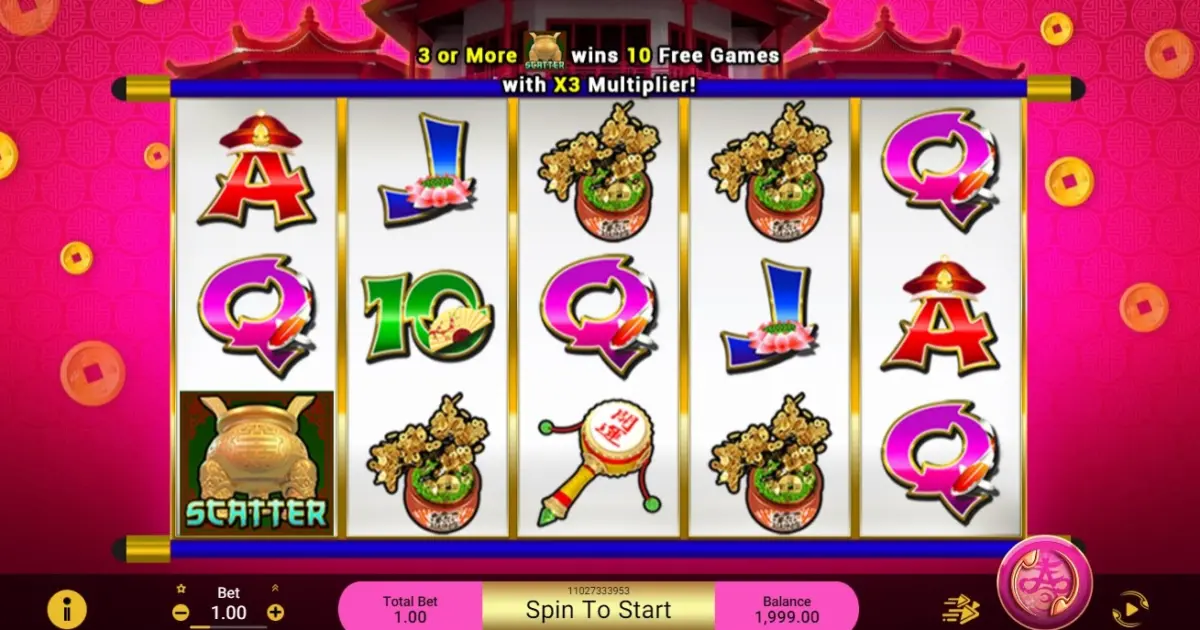
Five reels is the standard modern format, and it is the one structural fact confirmed here. What is not confirmed is how wins are evaluated across those reels — no payline count and no ways figure is published.
That distinction is worth knowing in general terms. Fixed-payline games award wins when matching symbols land along defined patterns, so the number of lines sets both how many ways a spin can pay and, on many titles, how the total stake is divided. Ways or cluster systems ignore fixed patterns and pay on matching symbols appearing anywhere in a column, which tends to produce many small awards rather than fewer larger ones. Many five-reel slots also use wilds that substitute for other symbols and scatters that trigger free spins, and some sell a feature entry directly. None of that is confirmed for this game, so treat all of it as background knowledge rather than a feature list. The demo will show you the actual structure in under a minute, which is faster than any review can describe it.
Stake range and sizing a bankroll
No minimum or maximum stake is listed, so check the figures in the game window before you plan anything around them. The sizing principle does not depend on the specific numbers.
Decide your session budget first, then divide it by the number of spins you want. A £40 budget across 400 spins means 10p per spin. A £40 budget at £1 per spin buys roughly 40 spins before variance decides how long you actually last. Bet size does not change expected value per pound staked — at 95% RTP, the modelled return is the same proportion whether you spin at 10p or £5. What stake size changes is how quickly the maths is applied to your money and how much of a swing your balance can absorb. No stake pattern, progression or timing alters that, because outcomes are independent and the game holds no memory of what came before. If your intended stake divides your budget into fewer spins than you find comfortable, the fix is a smaller stake, not a different betting sequence.
Playing the lucky meow slot demo before you commit
A free version is available, which is the practical answer to almost every open question above. The Lucky Meow free demo runs on play-money credits, so you can confirm the stake range, see how wins are evaluated across the five reels and get a feel for the rhythm of the balance without staking anything. Play it in the browser with no download and no account.
Be clear about what demo play does and does not tell you. It shows you the structure and the pace. It cannot predict real-money results: a lucky or flat run in demo credits carries no information about what happens next, since each spin is independent and the underlying maths is the same either way.
This is adults-only entertainment, 18+. Set a budget you are comfortable losing before you open the game, treat that amount as the price of the session rather than an investment, and stop when it is gone. If it stops being enjoyable, close it.
Verdict: who should play Lucky Meow
Reasonable for a short session on a familiar theme, hard to justify on the numbers alone. The 95% return is the lowest figure in this comparison set, the volatility rating and max win are unpublished, and no stake range is listed — a thinner data picture than most Spadegaming slots offer. Its 89.7th-percentile popularity says people do seek it out, so the appeal is presumably in the play rather than the paytable.
If return is your priority, Wong Choy covers similar ground at 96.74%, a 1.74-point improvement. If you want the same 95% return but a different Asian-themed presentation, The Book of Amaterasu is matched exactly on RTP. Either way, spin the free version here first, confirm the stake range suits your budget, and go in with a figure you have already decided you can lose.
Frequently Asked Questions
Can I play Lucky Meow for free without downloading anything?
A free demo is available for this Spadegaming title and it runs in the browser on play-money credits, so there is nothing to install and no deposit involved. It is the quickest way to confirm the stake range and see how wins are counted across the five reels, since neither is published in the game data.
What is the RTP of Lucky Meow?
The published RTP is 95.00%, meaning the game is modelled to return £95 per £100 wagered across a very large sample of spins. That sits 0.71 percentage points below the 95.71% average across the games listed here, and 1.63 points below Spadegaming's own 96.63% catalogue average.
Is Lucky Meow high or low volatility?
No volatility rating has been published for this game, so any claim that it is low, high or medium is guesswork. Plan for the wider outcome: size your bankroll as though swings could be large. Volatility affects how a session feels, not the 95% long-run return figure itself.
Who makes Lucky Meow and what else do they produce?
Spadegaming developed it, and the studio has 120 titles catalogued here with an average RTP of 96.63%. Other releases include Wong Choy at 96.74%, Princess Wang at 97.04% and Lucky Koi Exclusive at 96.52% — all three carry a higher published return than this game.
How much bankroll do I need for Lucky Meow?
No stake range is published, so check the minimum and maximum in the game window first. Then divide your session budget by the spins you want: £40 across 400 spins is 10p per spin. At 95% RTP the expected cost is 5p per £1 staked regardless of bet size.