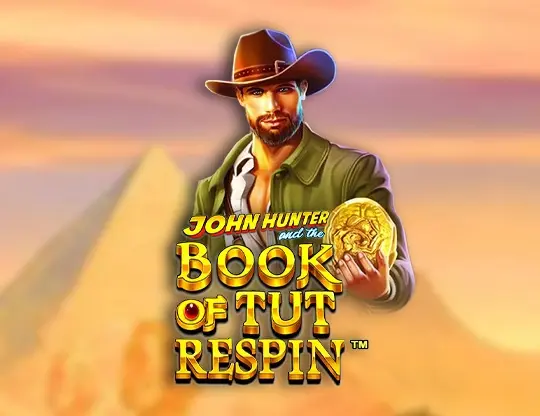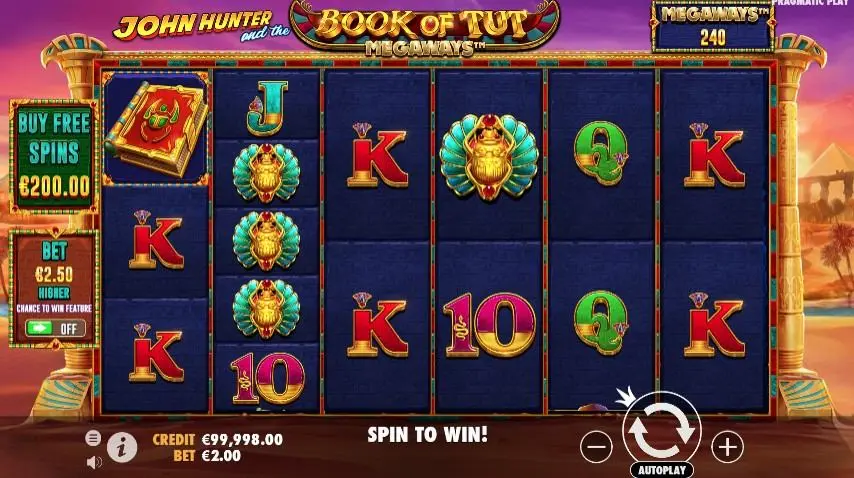
Pragmatic Play’s book of tut megaways slot returns 96.0% across a very large sample of spins, sits in the high-volatility bracket, and accepts stakes from $/£/€0.20 up to $/£/€240.00. That return is marginally above the 95.71% average of the games catalogued on this site, and marginally below Pragmatic’s own 96.32% studio average. If you want a six-reel Egyptian game you can test at no cost first, it is worth your time — provided you accept that high volatility means long flat stretches between anything interesting.
Book of Tut Megaways slot versus the average slot
The gap is 0.29 percentage points above the 95.71% corpus average. That sounds trivial, and in session terms it is. Wager 1,000 units on a game returning 95.71% and the theoretical return is 957.10. Wager the same 1,000 here and the theoretical return is 960.00. A difference of 2.90 per 1,000 staked is real, it compounds over thousands of spins, and it will be completely invisible inside any single sitting.
What that figure does tell you is that this title is not an outlier in either direction. It is not one of the sub-95% releases that quietly cost you more per spin, and it is not one of the 97%-plus titles that occasionally surface. It is a fraction above the middle of the pack.
Popularity is a different story. The game ranks 2012 in our catalogue, placing it in the 89.9th percentile for traffic. Roughly nine in ten titles here draw less attention. Popularity says nothing about whether a game will treat you well, and it is not a proxy for quality, but it does mean you are unlikely to be the only person in the lobby.
RTP breakdown: 96.0% in context
A 96.0% return means 96.00 comes back per 100.00 wagered across a sample large enough for the maths to settle — millions of spins, not hundreds. The other side of that coin is a 4% house edge on turnover, and turnover is the number that matters. At 0.20 a spin, 500 spins is 100.00 staked, with a theoretical return of 96.00 and an actual result that could be anywhere from nothing to a multiple of your stake.
| Feature | Detail |
|---|---|
| Provider | Pragmatic Play |
| RTP | 96.0% |
| Volatility | High |
| Reels | 6 |
| Minimum bet | $/£/€0.20 |
| Maximum bet | $/£/€240.00 |
| Themes | Egypt, 6-Reels, Megaways |
| Type | Slot Machine |
| Popularity rank | 2012 (89.9th percentile) |
| Free demo | Available |
Two things are worth noting about what is absent. Pragmatic Play has not published a maximum win figure for this title in the data available here, so treat any headline multiplier you see quoted elsewhere with scepticism until the studio states it. Hit frequency is likewise unpublished. Neither absence changes the 96.0% figure, but both mean you cannot model the shape of the return, only its long-run size.
Volatility profile
High volatility is the single most decision-relevant fact here. It describes the shape of the distribution rather than its average: fewer paying spins, bigger swings when they arrive, and a far wider range of possible session outcomes than a low-volatility game with the identical 96.0% return. Two games can share an RTP and feel nothing alike.
The practical consequence is bankroll depth. A high-volatility game can run through dozens of consecutive spins that return nothing, and your budget has to absorb that without forcing you to stop early or top up. Sizing each spin as a small fraction of the total you have set aside is simply arithmetic — it buys you more spins from the same budget. It does not improve your expected return, because nothing does. Every spin is an independent event, the reels carry no memory of the last outcome, and no stake pattern, timing choice or progression alters the 4% edge by a fraction of a percent.
The six-reel Megaways framework fits that profile. Megaways titles generally vary the number of symbols landing on each reel from spin to spin, so the number of ways to win changes as you play rather than staying fixed at a set payline count. The precise ways range for this game is not published in the data here, so treat the mechanic as a broad description rather than a specification.
Pragmatic Play as a studio
Pragmatic Play is one of the largest suppliers in the sector, with 739 titles in our catalogue and an average RTP of 96.32% across them. That average is the useful context: at 96.0%, this release sits 0.32 percentage points below what the studio typically ships. Not a red flag, but if return is your main filter, the studio has better-paying options.
Gates of Olympus is the obvious internal comparison at 96.5% — half a percentage point more back per unit staked, from the same studio, and also a high-variance design. A catalogue of 739 games means Pragmatic covers nearly every mechanic and volatility band on the market, so you are rarely stuck choosing between a studio you like and a return figure you can live with. Check the number on each individual release rather than trusting the studio average, because a 96.32% mean is assembled from titles well above and well below it.
Three Egypt alternatives worth comparing
Egypt is among the most crowded categories in the business, with 908 themed titles catalogued here, so there is no shortage of substitutes. Three make a useful comparison set.
- Book of the Sun at 96.23% returns slightly more per unit staked than this title, and is the closest like-for-like if you simply want a better number on a similar theme.
- Crazy Mummy matches it exactly at 96.0%, which makes it a clean test of whether you prefer the presentation rather than the maths.
- Book of Dead is the famous name of the group at 94.25% — and that figure is the point. It returns 1.75 percentage points less than the game reviewed here, or roughly 17.50 more lost per 1,000 staged in theory. Reputation and return are separate things.
Among Egypt slots, theme is the least useful thing to choose on. The RTP figure and the volatility band will shape your session; the setting will not.
Getting the most out of the free demo
A Book of Tut Megaways free demo is available, which is the cheapest possible way to find out whether high volatility suits your temperament. Play a few hundred spins at a fixed stake and pay attention to how the dry runs feel, not to whether you finish ahead. Demo results are driven by the same randomness as real play and the same 96.0% long-run figure, but a short sample tells you nothing predictive. A good demo run does not mean a good real-money run is waiting, and a poor one does not mean the game is somehow against you.
When you move to real stakes, the rules are simple. This is for adults only, 18 or over. Decide the amount you are willing to lose before you open the game, treat that amount as the price of entertainment rather than an investment, and stop when it is gone. If the session stops being fun, close the tab.
Should you play Book of Tut Megaways?
If you already enjoy high-variance six-reel games and want a broad stake range, this is a reasonable pick. The 96.0% return is fractionally above the catalogue average, the 0.20 to 240.00 spread suits both cautious and heavy stakes, and the free demo removes any reason to commit money before you know what you are getting.
If return per spin is your priority, the case weakens. It sits below Pragmatic’s own 96.32% average, and both Gates of Olympus at 96.5% and Book of the Sun at 96.23% pay back more over the long run. The unpublished max win and hit frequency also mean you cannot see the full shape of the game before you commit.
The honest summary: a competent, mid-table return attached to a demanding volatility profile, from a studio with 738 other options if this one does not fit. Try the demo, judge the swings, then decide.
Frequently Asked Questions
Can I play Book of Tut Megaways for free?
A free demo of Book of Tut Megaways is available, so you can spin it without staking money. The demo uses the same 96.0% theoretical return and the same high-volatility behaviour as real play, but a few hundred demo spins is far too small a sample to predict anything about a future real-money session.
What is the RTP of Book of Tut Megaways and what does it mean?
The RTP is 96.0%, meaning 96.00 returns per 100.00 wagered across a very large sample of spins. That leaves a 4% house edge on turnover. It is 0.29 percentage points above the 95.71% catalogue average and 0.32 below Pragmatic Play's 96.32% studio average. It says nothing about any individual session.
Is Book of Tut Megaways high volatility?
It is classified as high volatility, which means fewer paying spins and wider swings than a low-variance game with the same 96.0% return. Expect long stretches with nothing landing. That demands a deeper budget relative to your stake, since sessions can end early if each spin takes too big a share of it.
Who makes Book of Tut Megaways and what else do they produce?
Pragmatic Play, one of the largest studios in the sector, with 739 titles catalogued here at an average 96.0 to 96.32% range and a 96.32% mean RTP. Their better-known releases include Gates of Olympus at 96.5%, Sweet Bonanza at 96.51% and Joker's Jewels at 96.5% — all higher-returning than this one.
How does it compare to Book of Dead?
It returns considerably more. Book of Dead pays back 94.25% against 96.0% here, a gap of 1.75 percentage points, or roughly 17.50 per 1,000 staked in theoretical terms. Book of Dead is the more famous title of the two, but on the return figure alone this Pragmatic Play release is the stronger choice.