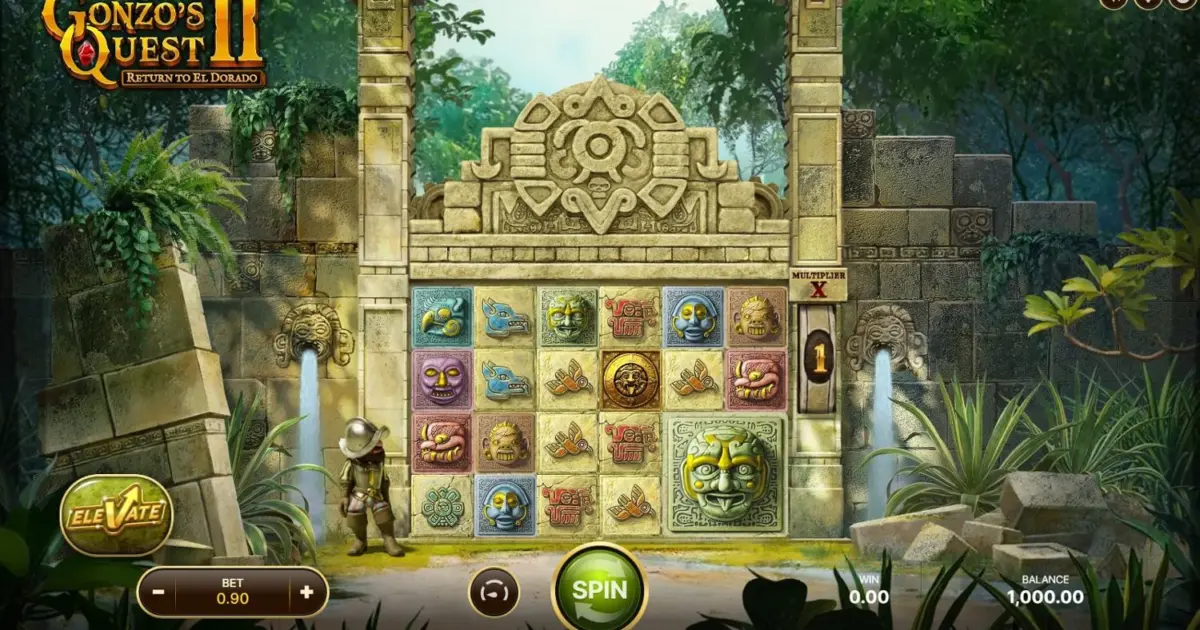
If you want the short version: this is a NetEnt six-reel Aztec-themed game with a published return of 96.06%, and a free demo is available so you can look at it without staking anything. That return sits 0.35 percentage points above the 95.71% average across the slots catalogued on this site, and marginally below NetEnt’s own 96.1% house average. It ranks 2035th by popularity here, which places it in the 89.8th percentile — well played, without being a headline title.
First look at the Gonzos Quest 2: Return to El Dorado slot
NetEnt has 191 games in this database, so the studio is not short of a back catalogue, and this one carries the name of its best known release. The facts available are deliberately narrow: six reels, an Aztec theme, a 96.06% return, and demo access. There is no published payline or ways count here, no stated volatility rating, no max win multiplier and no stake range.
That absence matters more than it might seem. A max win figure and a hit frequency are the two numbers that tell you how a game distributes its return, and without them you are judging the title on its RTP alone. If you see a max win quoted elsewhere, treat it as unverified until NetEnt or the game’s own paytable confirms it. The paytable inside the demo is the authoritative source, and it costs nothing to open.
The theme label tells you the setting draws on Aztec imagery, which is one of the most heavily worked seams in slot design — 273 games in this catalogue share it. Nothing in the available data describes the symbols, the soundtrack or the animation.
| Provider | NetEnt |
|---|---|
| RTP | 96.06% |
| Reels | 6 |
| Theme | Aztecs |
| Free demo | Yes |
| Site-wide average RTP | 95.71% |
How a round plays out
What can be said with confidence: each spin resolves across six reels, and each spin is a fresh, independent event. The result of one has no bearing on the next. Six-reel layouts generally give designers room for wider symbol grids and mechanics that reward clusters or “ways” combinations rather than fixed lines, but whether this game uses paylines, ways or clusters is not recorded in the data available, so open the game’s information screen and check before you commit money.
Many modern slots pair a six-reel grid with features such as cascading symbols, wild substitutions, scatter-triggered free spins or a purchasable bonus. Those are industry conventions, not confirmed features of this title. Do not assume any of them are present here.
The practical approach is the same for any game where the feature set is undocumented: run the demo for a few hundred spins, note when features trigger and how often small returns land, and form your own picture of the rhythm. That gives you a feel for pacing. It does not give you a prediction — demo sessions run on the same random outcomes as real money, and a good or bad run in one tells you nothing about the next.
Reading the 96.06% return figure
96.06% RTP means the game is built to return £96.06 for every £100 wagered across a very large sample of spins — typically millions, far beyond anything one player produces. The remaining £3.94 per £100 is the theoretical house margin.
Scale that to a realistic session. At £1 a spin, 500 spins is £500 staked, and the long-run expectation on that turnover is a £19.70 loss. Your actual result will almost certainly not be £480.30 returned. Short samples scatter widely around the average; that scatter is the whole reason slots are entertaining and the whole reason they cost money over time.
Compared against the wider field, 96.06% is a slightly better-than-average number. The corpus average is 95.71%, so the edge here is 0.35 points in your favour relative to the typical game listed. Against NetEnt’s own 96.1% average it is fractionally worse, a difference of four hundredths of a point — statistically irrelevant over any session you will ever play.
One caution: some operators configure games at multiple RTP settings. Check the figure displayed inside the game you load rather than trusting a single published number.
Why volatility changes your bankroll maths
NetEnt has not published a volatility rating for this title in the data available, so this section is about the concept rather than a confirmed property of the game. It still matters, because volatility, not RTP, decides what a session feels like.
Two games can both return 96.06% and behave nothing alike. A low-volatility design pays small amounts often, so a modest bankroll stretches across many spins and swings stay shallow. A high-volatility design pays rarely and larger, which means long stretches of nothing punctuated by occasional bigger returns — and it requires a deeper bankroll to survive those stretches without being wiped out early.
The rule of thumb experienced players use: divide your bankroll by your stake to get your spin count, then ask whether that count is enough to see the game’s features at all. Two hundred spins on a high-variance game may not be. A thousand might.
Since the rating is unpublished, the demo is your measuring instrument. Play several hundred spins and watch the shape of your balance line. A jagged, frequently recovering line suggests lower variance; long flat declines suggest higher.
Bet sizing from the unpublished minimum upwards
No minimum or maximum stake is recorded for this game, and stake ranges often vary by operator anyway, so the figure you see in your own client is the one that counts. What generalises is the arithmetic.
Decide the session budget first, then work backwards to the stake. A £50 budget at £0.20 a spin buys roughly 250 spins before variance is accounted for; the same £50 at £2 a spin buys 25. Those are two entirely different experiences of the same 96.06% return, and the second one ends a lot faster.
What does not work is adjusting stakes in response to results. Raising your bet after losses, or after a win, changes nothing about the odds of the next spin — each outcome is independent, and the house margin applies identically at every stake level. All a progression does is change how quickly your budget is consumed.
Set the stake, set a stop point, and let the maths be the maths.
Where this game sits among Aztecs slots
The Aztec theme is crowded: 273 games in this catalogue use it. On return alone, this title sits mid-pack. Gems Bonanza is the stronger number at 96.51%, a 0.45-point edge that compounds meaningfully over high volumes of play. Kukulkan’s Queen matches it exactly at 96.06%, so the choice between them comes down to mechanics and pacing rather than maths, while Hypercharged Inca Jungle sits fractionally lower at 96.00%.
Within NetEnt slots, the obvious comparison is the original Gonzo’s Quest at 96.00% — six hundredths of a point below the sequel, which is to say identical in practice. If you liked the first, the return figure gives you no reason to avoid this one.
The honest summary: nothing in the numbers makes this game stand out or rules it out. It is a slightly above-average return on a heavily used theme from a studio with 191 titles to its name.
The honest verdict
A 96.06% return is respectable — better than the 95.71% average across the games listed here, and within a rounding error of NetEnt’s own 96.1%. That is the strongest thing the data says about it. The weakest is how much is missing: no volatility rating, no max win, no stake range, no hit frequency. You cannot judge session character from RTP alone, and anyone quoting a specific max win for this title is going beyond what NetEnt has published.
The sensible route is the free one. Load the demo, read the paytable, run a few hundred spins and decide whether the pacing suits you. If it does, and the original still appeals, the two are effectively equivalent on return.
Slots are paid entertainment, not income. Play only if you are 18 or over, decide your budget before you open the game, and treat whatever you stake as money spent rather than money invested. If it stops being enjoyable, close the tab.
Verdict: an above-average return on a well-worn theme, with too little published detail to recommend blind — try the demo first.
Frequently Asked Questions
Can I play Gonzos Quest 2: Return to El Dorado for free?
A free demo is available for this title, so you can spin it with virtual credits and no deposit. That lets you read the paytable, check the stake range your operator offers and see how the six-reel grid behaves before committing money. The demo uses the same random outcomes as the real-money version.
What is the RTP of Gonzos Quest 2: Return to El Dorado?
The published return is 96.06%, meaning the game is designed to pay back £96.06 per £100 wagered across a very large sample. That is 0.35 points above the 95.71% average across the games catalogued here and a fraction under NetEnt's 96.1% studio average. Short sessions will vary widely from it.
Is Gonzos Quest 2: Return to El Dorado high or low volatility?
NetEnt has not published a volatility rating for this game, so treat any confident claim you read elsewhere sceptically. Volatility determines swing size and how deep a bankroll you need, independently of the 96.06% return. The most reliable check is running several hundred demo spins and watching how your balance moves.
Who makes this game and what else do they produce?
NetEnt developed it, and the studio has 191 titles in this catalogue with an average return of 96.1%. Their output includes Starburst at 96.1%, Pirates Party at 96.17% and the original Gonzo's Quest at 96.00%. The sequel's 96.06% sits squarely in line with the studio's typical figure.
How does it compare to Kukulkan's Queen?
Both publish exactly 96.06%, so on long-run return the two are identical and the choice comes down to mechanics and pacing. Among Aztec-themed games listed here, Gems Bonanza is the higher figure at 96.51%, while Hypercharged Inca Jungle sits marginally lower at 96.00%. Try the demos to compare feel.