This is a six-reel Reel Play release with a published return of 96.16%, which sits marginally above the provider’s 96.0% average and 0.45 percentage points above the 95.71% average across the games catalogued here. A free demo exists, so you can spin it without spending anything. What you will not find below is a description of bonus rounds, multipliers or a max win figure, because Reel Play has not published those details for this title and inventing them would not help you.
What follows is the maths you can actually use: what 96.16% does to a bankroll, what the “10K Ways” label tells you about the reel structure, and which comparable games are documented as paying back more.
Is Atlantis 10K Ways worth playing?
It is worth a look if you want a six-reel ocean-themed game with a return figure slightly better than average and you are happy to test it for free first. It is not worth chasing if you need published detail on features, hit frequency or maximum payout before you play, because none of that is on record for this title.
The case for it rests on three documented numbers. The return is 96.16%, which is above the 95.71% corpus average and above Reel Play’s own 96.0% average across 64 games. It ranks 2007th for popularity, placing it in the 89.9th percentile — meaning roughly nine in ten catalogued slots draw less attention than this one. And free demo play is available, which removes the cost of finding out whether the pacing suits you.
The case against is simply the gaps. Volatility is not published. Stake range is not published. There is no confirmed max win multiplier. Those absences do not make the game bad, but they do mean you are going in with less information than you would have for a title where the studio publishes a full spec sheet. Treat any max win figure you see quoted on other sites with real suspicion — if the provider has not stated it, someone else has guessed.
| Provider | Reel Play |
|---|---|
| RTP | 96.16% |
| Reels | 6 |
| Theme | Ocean and sea |
| Free demo | Yes |
What 96.16% RTP means over 1,000 spins
Return to player is a long-run statistical average measured across millions of simulated spins, not a promise about your session. At 96.16%, the game is modelled to return £96.16 for every £100 wagered over that very large sample. The remaining £3.84 per £100 is the house edge.
Run that against a realistic session. A thousand spins at £0.20 is £200 staked. The mathematical expectation returns £192.32 of that, for a modelled loss of £7.68. Push it to £1 per spin and you have staked £1,000 with a modelled return of £961.60 and an expected shortfall of £38.40. Those figures are averages of enormous samples, though, and a thousand spins is a tiny sample. Your actual result will land somewhere either side of the average, sometimes a long way either side.
Two things follow. First, every spin is independent — the reels hold no memory of what came before, so a run of dead spins does not shorten the odds on the next one. Second, RTP compounds against you as you keep playing: the longer the session, the closer your result drifts toward that 3.84% edge. Short sessions have wide outcomes. Long sessions converge on the maths.
How volatile is Atlantis 10K Ways?
Reel Play has not published a volatility rating for this game, so the honest answer is that nobody outside the studio knows. That is worth stating plainly rather than guessing, because volatility affects your session far more directly than RTP does.
Here is what the concept means in practice. Low volatility slots pay small amounts often, so your balance drifts down gently and sessions run long on a modest budget. High volatility slots pay rarely but larger, which produces long dry stretches punctuated by occasional bigger returns — and demands a deeper bankroll to survive those stretches. Two games can share an identical 96.16% RTP and deliver completely different experiences, because RTP describes the total returned while volatility describes how lumpily it arrives.
Since the figure is not on record, the free demo is your best available instrument. Play a few hundred demo spins and pay attention to how often the balance moves, how deep the quiet runs go, and whether the swings feel comfortable at the stake you plan to use. That gives you a feel for the rhythm. It does not predict your real-money results, and it cannot — demo and cash play draw from the same independent random outcomes, so past spins in either mode tell you nothing about future ones.
What the Ocean and sea theme brings to the game
The theme is catalogued as Ocean and sea, with Fishing listed alongside it and 6-Reels as a structural tag. That places it in a well-populated category: 527 games in this catalogue share the ocean and sea theme, which makes it one of the most crowded corners of the slot market.
What the label supports is limited, and worth being precise about. It tells you the game draws on marine and fishing imagery. It does not tell you which specific symbols appear, what the soundtrack does, or how the animations behave, and no honest review can fill those in without seeing the published paytable. The theme is a signal of category, not a spec.
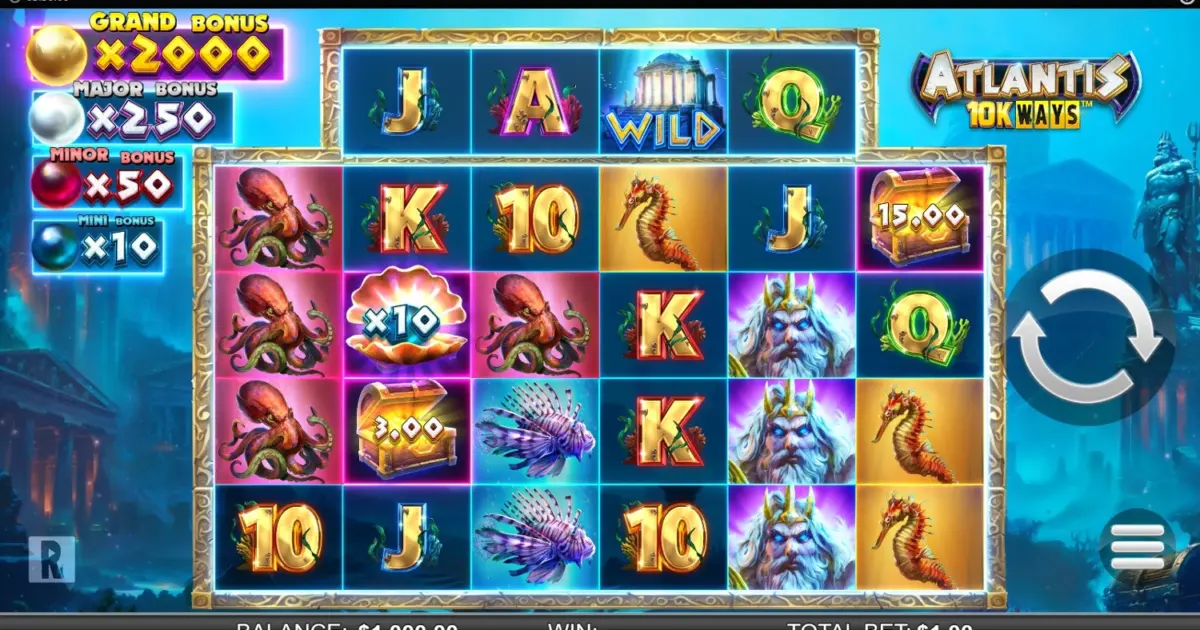
The “10K Ways” element in the name refers to a ways-based win structure rather than fixed paylines. Ways mechanics generally count wins across adjacent reels in any symbol position, so the advertised figure describes the maximum number of possible winning combinations rather than a payout. Ten thousand ways sounds large, and structurally it is, but the number of combinations does not raise your return — the 96.16% figure already accounts for however the win structure works. More ways means more frequent small hits with correspondingly smaller values, not more money.
Stakes, session length and bankroll
The stake range is not published for this title, so check the minimum and maximum inside the demo before you decide anything. That single check tells you whether the game fits your budget, and it costs nothing.
Work backwards from what you are prepared to lose rather than forwards from what you hope to win. Decide the total figure first, then divide. A £50 budget at £0.20 per spin buys roughly 250 spins before variance is accounted for; the same £50 at £1 per spin buys 50. Neither is correct — they are different products. The first is a long, low-stakes evening. The second is over quickly, with wider outcomes in both directions.
One thing no stake plan can change is expected value. Raising your bet after losses, lowering it after wins, or waiting for a particular moment does not shift the 3.84% house edge by a fraction. Each spin is independent and priced identically. Staking patterns only alter how fast you move through your budget and how wide your results scatter. The only variable genuinely under your control is how much you stake in total.
Alternatives if Atlantis 10K Ways is not for you
If the missing volatility and stake data bother you, several documented alternatives sit close by. Within the ocean and fishing category, Big Bass Bonanza carries a published 96.71% RTP — 0.55 percentage points more returned per £100 wagered, which compounds meaningfully over a long session. Pearls of Aphrodite goes further at 96.81%, the highest return among the related titles listed here.
Staying with the same studio, Hypernova Infinity Reels runs at 96.20%, marginally ahead of this game and built on Reel Play’s Infinity Reels structure rather than a ways count — a different mechanic if the six-reel ways format is not what you are after. Age of Beasts Infinity Reels sits lower at 95.57%, below both the corpus average and this title, so it is the weaker choice on return alone.
Reel Play has 64 games in this catalogue averaging 96.0% RTP, so this title is one of the better-returning entries in its own studio’s range. The gap between 96.16% and 96.81% is small on any single spin and material across thousands.
Final take
A slightly above-average return, a six-reel ways structure, strong popularity, and a free demo to test it with. Against that: no published volatility, no stake range, no confirmed max win. If those gaps matter to you, the higher-RTP ocean alternatives above are better documented.
Play only if you are 18 or over. Set a budget before you start, treat the money as the price of entertainment rather than an investment, and stop when you reach the figure you set. If it stops being enjoyable, close it.
The most useful next step costs nothing: open the demo, check the stake range, and run a couple of hundred spins to see whether the pacing suits you. That answers the questions the published data leaves open, without putting anything at stake.
Frequently Asked Questions
Can I play Atlantis 10K Ways for free?
Free demo play is available for this title, so you can spin it without depositing or staking real money. The demo uses the same six-reel ways structure and the same 96.16% RTP model as the cash version. It is the practical way to check stake range and pacing, since Reel Play has not published either figure.
What is the RTP of Atlantis 10K Ways?
The published return is 96.16%, meaning the game is modelled to pay back £96.16 per £100 wagered across a very large sample of spins. That is above the 95.71% average across this catalogue and above Reel Play's own 96.0% average. The remaining 3.84% is the house edge and it applies to every spin equally.
Is Atlantis 10K Ways high or low volatility?
Reel Play has not published a volatility rating, so it cannot be stated with confidence. Volatility determines how lumpily the 96.16% return arrives — often and small, or rarely and larger. Running a few hundred demo spins is the only way to gauge the swing pattern yourself, since the studio has not put a number on it.
Who makes Atlantis 10K Ways and what else do they produce?
Reel Play developed it, and the studio has 64 games in this catalogue averaging 96.0% RTP. Their Infinity Reels range includes Hypernova Infinity Reels at 96.20%, Money Mariachi Fiesta Infinity Reels at 96.16% and Age of Beasts Infinity Reels at 95.57%. This title sits slightly above the studio's average return.
How does it compare to Big Bass Bonanza?
Big Bass Bonanza publishes a higher return at 96.71% against 96.16% here, a difference of 0.55 percentage points, or £5.50 more returned per £1,000 wagered on average. Both sit in the ocean and fishing category, which spans 527 games in this catalogue. Pearls of Aphrodite goes higher still at 96.81%.