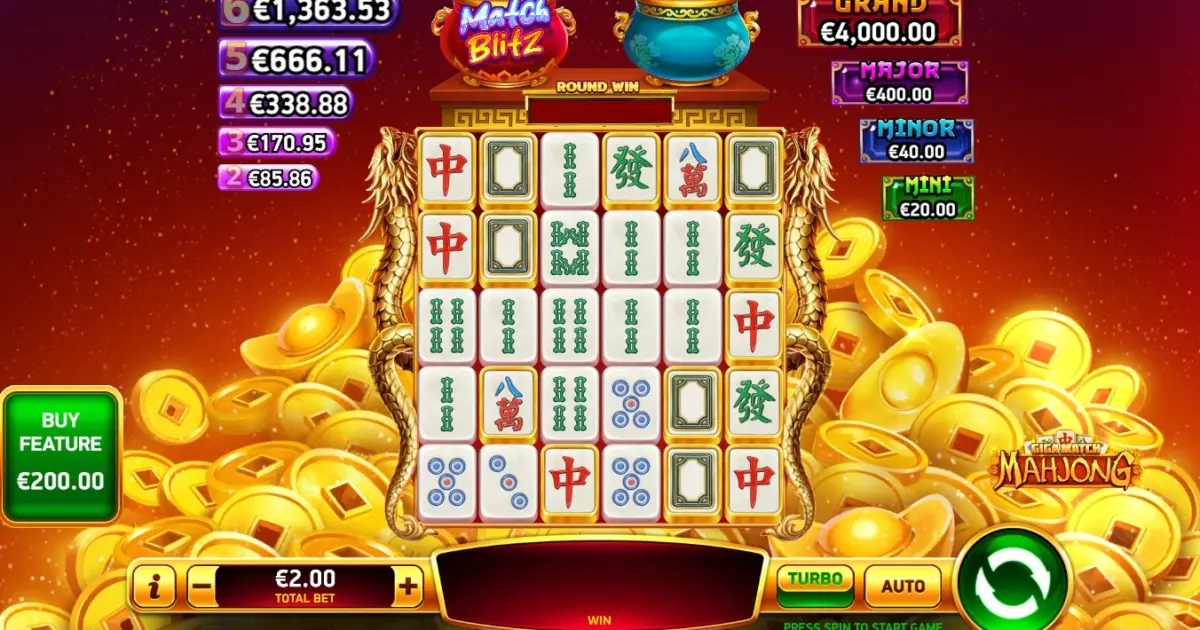
Ruby Play built 6 reels into a game that leans on mahjong aesthetics without disclosing the math model that drives payline structure. The RTP of 96.38% is within a tenth of a percentage point of the provider’s catalogue average, which puts it squarely in mid-pack for expected long-run return. If you are comparing Asian slots by numbers alone, this one does not offer a statistical edge over its siblings, but neither does it lag.
Below is every hard figure Ruby Play has published, followed by what the gaps in that data should tell you before you stake real money.
Who makes Giga Match Mahjong
Ruby Play is the studio behind this title, with 145 games listed in the catalogue we track. That is not a small operation, but it is nowhere near the output of the largest providers in the space. The company’s average RTP across all 145 titles is 96.4%, which means Giga Match Mahjong at 96.38% is essentially a by-the-book release from this studio — no outlier, no flag.
The provider does not appear to publish a hit frequency, max win multiplier, or volatility rating alongside this game’s metadata. That absence matters for how you plan a session, and I will address it in the volatility section below. For now, treat the 6-reel layout and Asian theme label as the only confirmed structural facts.
The game ranks 1,937th in overall popularity within our tracked corpus and sits in the 90.3rd percentile. That percentile is not the same as being at the top of the heap — it means the game outperforms roughly nine in ten titles by play volume, which still places it well below the most-busy machines on any aggregator. If you are looking for the provider’s best-known work, Ruby Play slots like Immortal Ways Magic Gems and Rush Fever 7s carry higher visibility.
Where Giga Match Mahjong sits in the Ruby Play catalogue
Within the 145-game set, Ruby Play clusters its Asian and 6-reel releases in a range that runs from 96.3% to 96.46% RTP. Immortal Ways Magic Gems posts 96.3%, which is 0.08 percentage points below Giga Match Mahjong. Rush Fever 7s reaches 96.9% — a meaningful 0.52-point gap that translates to £52 more returned per £10,000 wagered over a sufficiently large sample.
Those three numbers tell you the provider does not differentiate sharply on RTP across its catalogue. The spread between its lowest and highest published figures in this Asian/6-reel cluster is roughly half a percentage point. That is narrow. If you pick a Ruby Play title primarily on RTP, you are making a micro-optimisation that will not shift your expected session cost by much unless you are wagering tens of thousands of spins.
The more useful differentiator between these titles is the mechanic each one uses, and here the published data stops short of helping you. You will need to open the demo and watch how each game behaves on the reels.
RTP: 96.38% against a 96.4% house average
Ninety-six point three eight percent means that, across an astronomically large number of spins, the game returns £96.38 for every £100 wagered. The house edge is therefore 3.62%. In a single 200-spin session at £1 per spin, you are wagering £200; the theoretical expected cost is £7.24. Your actual result will deviate from that by an unpredictable amount, and that deviation is the entire experience of playing.
Against the corpus average of 95.71%, Giga Match Mahjong’s 96.38% is 0.67 percentage points above the field. That is not a standout figure — many providers publish 97%+ titles — but it clears the median comfortably. Within Ruby Play’s own catalogue, the game lands 0.02 points below the 96.4% provider mean, which is rounding-level noise.
The practical takeaway: this RTP does not give you a reason to prefer this game over other Ruby Play titles on return grounds, and it does not penalise you either. You are choosing this slot for its layout or theme, not for a mathematical advantage.
Volatility and who it suits
| Attribute | Value |
|---|---|
| Provider | Ruby Play |
| RTP | 96.38% |
| Reels | 6 |
| Theme | Asian |
| Popularity rank | 1,937 |
| Popularity percentile | 90.3 |
| Free demo | Available |
| Volatility | Not published |
| Max win | Not published |
| Stake range | Not published |
| Hit frequency | Not published |
Ruby Play has not disclosed a volatility rating, a max win ceiling, a hit frequency figure, or a minimum and maximum stake for Giga Match Mahjong. This is the single biggest gap in the data available to a reader comparing games before committing a bankroll.
Without a volatility label, you cannot determine session planning from published information alone. A low-volatility 6-reel game might deliver frequent small wins that extend a £50 budget well past 200 spins; a high-volatility version of the same layout could drain that £50 in 60 spins with no meaningful payout in between. The RTP stays at 96.38% in both cases. What changes is the variance around that average.
Your best available workaround is to play the demo with a fixed stake — the same amount you intend to use at real money — for 200 to 300 spins and record your longest dry stretch and your single biggest win. That gives you a private volatility estimate from observed behavior, which is more useful than the absence of a published rating. It does not predict real-money outcomes; it tells you how the game’s payout distribution behaves in practice.
Playing Giga Match Mahjong for free
A free demo version of this game is available, and using it costs nothing beyond your time. The demo uses the same RNG and the same mathematical parameters as the real-money version, which means the reel outcomes in the demo are not a rehearsal for your real-money session. They are independent. Demo results tell you what the game feels like; they do not tell you what your next real-money session will produce.
Use the demo to decide whether you find the 6-reel Asian layout engaging enough to sustain a session, and to build that private volatility picture described above. If you move to real money, set a loss limit before you open the lobby and treat the cost as entertainment spending, not an investment. You must be 18 or over to play for real money.
No provider, including Ruby Play, publishes a stake range for this title. When you reach the real-money version through a casino lobby, the available minimums and maximums will depend on that casino’s configuration, not on a game-wide standard.
Similar picks
The Asian theme is well-covered in the corpus, with 1,455 games in the broader set spanning this visual territory. Two alternatives with confirmed data points deserve a look if you are shopping by numbers: Mystic Fortune Deluxe posts a 96.71% RTP, which is 0.33 percentage points above Giga Match Mahjong — enough to save roughly £33 per £10,000 wagered over a large sample. Wong Choy sits even higher at 96.74%, a 0.36-point edge.
Those gaps are real but small. A 0.33-point RTP difference will not change your short-session experience. Over 10,000 spins at £1 each, you wager £10,000; the expected difference between the two games is about £33. Over 100 spins, the noise from variance will swamp that difference entirely. The reason to click through to those pages is not to chase a better return figure — it is to see whether a different 6-reel or Asian-mechanic layout holds your attention longer, because session duration is the variable you actually control.
Verdict
Giga Match Mahjong is a mid-catalogue Ruby Play title with an above-corpus-average RTP and no published volatility, max win, hit frequency, or stake data. That combination makes it difficult to recommend on numbers alone when several Asian-theme alternatives in the same catalogue range post both higher RTPs and more complete metadata. The 6-reel layout and Asian theme may justify a demo session if those structural elements appeal to you personally, and the free-play version lets you form your own volatility picture before deciding whether real money is worth risking.
Frequently Asked Questions
Is there a free demo for Giga Match Mahjong slot?
Yes. Ruby Play's Giga Match Mahjong has a free demo available that uses the same RNG parameters as the real-money version. You can play it without downloading software or registering at a casino, which lets you observe how the 6-reel layout behaves across a few hundred spins before deciding whether to stake money.
What is the RTP of Giga Match Mahjong and what does it mean?
The published RTP is 96.38%, meaning the game returns £96.38 per £100 wagered across an extremely large number of spins. The house edge is 3.62%. That figure sits 0.67 percentage points above the 95.71% corpus average and nearly matches Ruby Play's own 96.4% provider mean across their 145 tracked titles.
What volatility does Giga Match Mahjong have?
Ruby Play has not published a volatility rating for this game. Without that label, you cannot determine session-length expectations from provider data alone. The workaround is to run 200 to 300 demo spins at your intended real-money stake and record your longest dry stretch to build a personal volatility estimate from observed behavior.
How does Giga Match Mahjong compare to other Ruby Play games?
At 96.38% RTP, it sits between Immortal Ways Magic Gems at 96.3% and Rush Fever 7s at 96.9%. The spread within Ruby Play's 145-game catalogue is narrow, so choosing by RTP alone offers minimal differentiation. Popularity data places Giga Match Mahjong at rank 1,937 with a 90.3rd percentile, meaning it draws more play than roughly nine in ten tracked titles.
Can playing Giga Match Mahjong in demo mode predict real-money results?
No. Demo and real-money sessions use the same underlying math model but produce independent outcomes. A demo run cannot tell you whether your next real-money session will hit a winning cluster or a dry stretch. Demo play is useful for evaluating layout engagement and forming your own volatility picture, not for forecasting results.