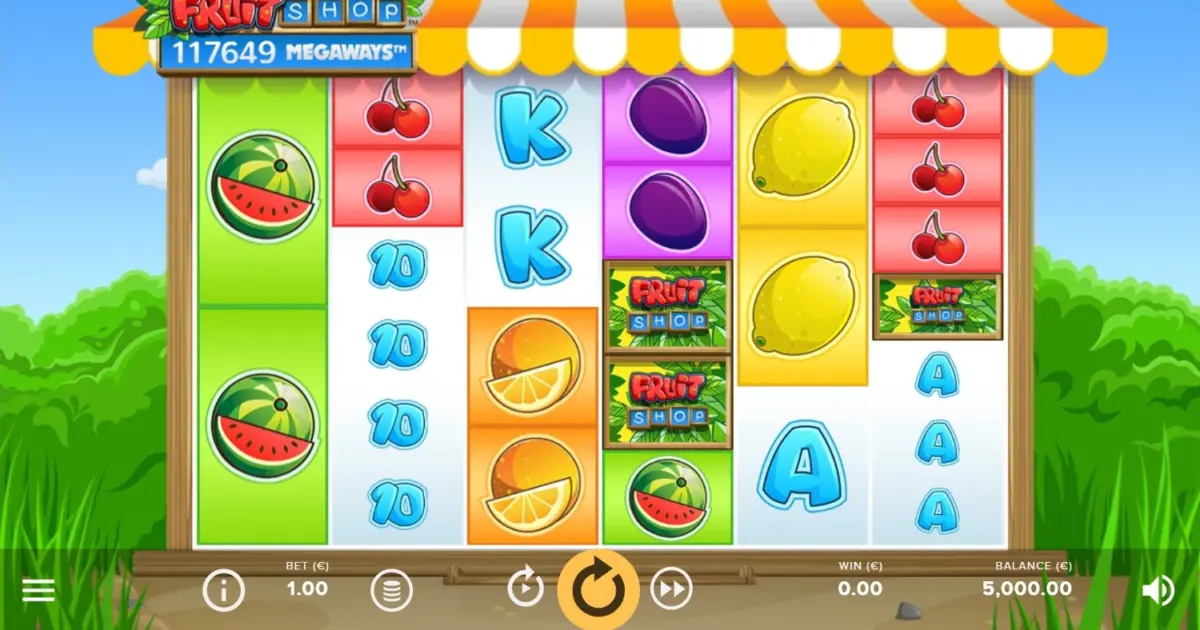
If you are weighing up the fruit shop megaways slot against other NetEnt titles, the headline is uncomfortable: its 93.01% RTP sits 2.7 points below the corpus average and 3.09 points below what NetEnt typically publishes. That gap is the single most decision-relevant number here, and everything else — the 6-reel Megaways layout, the free demo access, NetEnt’s production polish — has to be judged against it.
Fruit Shop Megaways Slot at a Glance
NetEnt built this title on the Megaways engine across six reels, pairing a classic fruit-symbol theme with a variable-row mechanic that changes the number of ways to win on each spin. It ranks 1,398th by traffic within this review corpus, sitting in the 93rd popularity percentile — meaning it draws more players than 93% of catalogued slots despite the below-average theoretical return.
| Metric | Value |
|---|---|
| Provider | NetEnt |
| RTP | 93.01% |
| Reels | 6 |
| Theme | Fruits / Megaways |
| Popularity percentile | 93rd |
| Provider average RTP (191 titles) | 96.1% |
| Corpus average RTP | 95.71% |
| Free demo available | Yes |
Several figures that matter for session planning — volatility classification, stake range, and maximum win — are not published in the data available here. That absence is itself informative; you will want to verify those numbers at the casino you intend to play before committing real funds.
What a 93.01% RTP Actually Returns
RTP describes the theoretical proportion of wagered money a slot returns to players across an enormous sample. It is not a per-session guarantee and no individual sequence of spins will land on the stated figure. Over 1,000 spins at a one-unit stake, a 93.01% return implies roughly 930 units paid back against 1,000 wagered — a net loss of 70 units. The same 1,000-spin exercise against the corpus average of 95.71% would show 957 units returned and a 43-unit loss.
The difference between those two scenarios is 27 units per thousand spins, which compounds linearly: double your wager and you double the gap. Over a long session this is not a rounding error — it is the dominant factor determining how much play your bankroll buys. Compared to Starburst, which publishes 96.1% RTP from the same provider, the gap widens to roughly 31 units lost per additional thousand spins.
NetEnt operates 191 titles at an average of 96.1%. Fruit Shop Megaways falls below that provider mean by three points, making it one of the weaker returns in their catalogue based on the data available here. The figure is low enough that if RTP is a priority in your game selection, this title demands genuine justification from other qualities — entertainment value, volatility profile, or feature design.
Volatility and What Your Session Will Feel Like
No volatility classification appears in the data published for this slot, which means you cannot predict swing size or session-length behaviour from the numbers alone. Understanding what volatility controls helps you interpret what you observe in the demo: low-volatility games distribute wins frequently but in small amounts, keeping your balance relatively flat across hundreds of spins. High-volatility games go longer without meaningful payouts, then concentrate returns into fewer, larger hits that can swing your balance sharply in either direction.
A game with 93.01% RTP and unknown volatility is riskier for session planning than one with both figures disclosed, because RTP tells you the rate at which money is lost on average while volatility tells you how bumpy that loss curve feels. Two slots with identical RTP can produce entirely different bankroll experiences depending on where wins cluster.
Until NetEnt or your casino publishes a volatility rating, use the free demo to record your own observations over at least 200 spins: note the longest dry spell, the largest single-spin return relative to your stake, and how many spins your starting balance survives. Those three data points give you a working volatility profile specific to your play pattern.
The 6-Reel Layout and How Wins Are Counted
Fruit Shop Megaways runs six reels using the Megaways mechanic, a system originally licensed from Big Time Gaming in which each reel changes its visible row count independently on every spin. The practical effect is that the number of ways to win is not fixed — it fluctuates from spin to spin as reels expand and contract, creating variable line patterns that a traditional 6-reel, 20-payline slot never offers.
In a conventional layout, you match symbols along a predetermined number of paylines; wins are easy to scan visually. In a Megaways game, any matching symbols on adjacent reels count as a win provided they land on the same row position within the expanded reel area. This makes the base game more visually busy: many small, cascading wins can appear simultaneously, and the total line count per spin shifts constantly.
The specific maximum number of ways for this title is not stated in the available data, so treat any figure quoted elsewhere as unverified until you confirm it in the game’s own information screen. Many slots do include a “how to play” or “paytable” panel showing the exact ways count for the current configuration.
Stake Range and Sizing a Bankroll
The minimum and maximum stakes for this title are not included in the data reviewed here, which means bankroll sizing advice cannot be anchored to a specific figure. The general principle holds regardless of the exact range: your starting bankroll should tolerate the game’s volatility without you dipping below zero before the variance curve evens out toward the stated RTP.
A slot returning 93.01% drains faster than one at 96% simply because the per-spin expected loss is larger. If you normally plan 500 spins at your chosen stake, multiply that stake by 500 to find your session budget; then add a safety margin — the Megaways mechanic can produce clusters of very short turns followed by longer dry patches, and an unknown volatility rating means you are planning with incomplete information.
Before funding a real-money session, check the stake limits displayed on the game lobby or the information panel at the casino itself, because NetEnt titles sometimes ship with different minimum bets across operators. If your target budget divides unevenly by that minimum, your effective session length will be shorter than planned.
Playing the Fruit Shop Megaways Free Demo Before You Commit
A no-download free demo is available for this title, and it is the most responsible first step given the missing volatility and stake data. Demo play lets you confirm three things the numbers alone cannot: the pace of wins relative to your expectations, how the variable-row mechanic reads visually in practice, and whether the fruit-symbol presentation holds your attention over several hundred spins.
Nothing about the demo carries forward to real-money outcomes. The random number generator treats each spin independently, so a dry spell in the demo is neither a predictor nor a reason to avoid real play, and a lucky run is neither a good omen nor a reason to chase the same pattern with funds. If the RTP figure is your reason to skip this slot, the demo will not change that arithmetic — but it will show you the experience so you can judge whether the below-average return is worth accepting for entertainment value.
This is paid entertainment. Set a fixed budget before you deposit, treat any money wagered as spent the moment it leaves your balance, and stop when the budget is reached rather than when a win or a loss occurs. If you are 18 or over and gambling is no longer a choice but a compulsion, support services are available in most jurisdictions.
Verdict: Who Should Play Fruit Shop Megaways
This slot suits players who already know what they are accepting: a 93.01% return that costs roughly three percentage points more per unit wagered than NetEnt’s average across 191 titles, and costs nearly the same against games like Hot Hot Fruit at 96.84% in a comparable fruit theme. The Megaways 6-reel mechanic delivers visual variety and variable win lines that a fixed-payline slot cannot match, and if that presentation appeals to you personally, the RTP trade-off may feel reasonable.
It does not suit players whose selection criteria are primarily mathematical. If you choose games by the lowest theoretical house edge available, the 3.09-point gap between this title and NetEnt’s own average is too large to justify without a compensating feature you can verify — and no such feature is documented in the data reviewed here. For players who want a Megaways fruit slot with better odds, check Trickstar Spins at 94.0% or compare against provider titles closer to the mean.
Play the demo, confirm the volatility and stake range at your chosen casino, and only fund a session if you are genuinely entertained by what you see during free play.
More from NetEnt
- Starburst — 96.1% RTP
- Twin Spin — 96.6% RTP
- Twin Spin Megaways — 96.04% RTP
- Dead or Alive — 96.82% RTP
Frequently Asked Questions
Is Fruit Shop Megaways available as a free demo?
Yes. The free demo is available without registration, letting you test the 6-reel Megaways layout and observe the win frequency before deciding whether to play with funds. The demo does not predict real-money outcomes, and the 93.01% RTP figure applies identically to both modes across a very large sample.
What does 93.01% RTP mean for my balance?
It means the theoretical long-run return is 93.01 units per 100 wagered — a 6.99% house edge. Over 1,000 spins at a fixed stake, you would expect to lose approximately 70 units total, compared to 43 units against the corpus average of 95.71%. The figure is 3.09 points below NetEnt's own provider average of 96.1%.
Is Fruit Shop Megaways low or high volatility?
No volatility rating is published in the available data for this title. Until NetEnt or your casino discloses the classification, you cannot predict swing size or dry-spell length from the numbers. Running 200+ demo spins and recording the longest gap between wins and the largest single-spin return gives you a working personal profile.
How does Fruit Shop Megaways compare to Starburst from the same provider?
Starburst returns 96.1% RTP — the same as NetEnt's provider average — while Fruit Shop Megaways returns 93.01%, placing it three points below. Starburst uses a fixed 5-reel, 10-payline layout against the variable-row Megaways mechanic here. Over 1,000 spins the RTP gap costs you approximately 31 additional units.
Can I win real money by playing the Fruit Shop Megaways demo?
No. The free demo operates on a simulated balance with no financial input or output. Real-money play requires a funded account at a licensed NetEnt casino. The demo is useful for learning the mechanics and confirming the stake range, but it has no bearing on whether real-money results will be positive or negative over any session length.