Rise of Olympus 100 is a high-volatility, 5-reel slot from Play’n GO where patience matters more than hit rate. If you want steadier session length, look elsewhere; if you are comfortable with swings for a shot at a 15,000x max win, the rise of olympus 100 slot deserves a considered demo before you commit real funds.
Rise of Olympus 100 versus the average slot
This comparison is the fastest way to decide if the game fits your expectations. Rise of Olympus 100 sits at 96.2% RTP, which is 0.49 percentage points above the corpus average of 95.71% measured across the wider catalogue. That gap is modest on a single session but meaningful across thousands of spins, where even half a point changes the expected loss rate.
On a simple model, £100 wagered would return £96.20 to players in aggregate at 96.2%, versus £95.71 at the average. Over 1,000 spins at £1 a spin, the expected cost is £38.00 at 96.2% compared with £42.90 at the corpus average — a £4.90 difference for the same volume. Over 10,000 spins at £1, the expected cost becomes £380 versus £429. The maths does not predict your session; it describes the long-run average across a very large sample where individual results vary widely.
RTP does not work in isolation. Volatility shapes how that average is delivered. A high-volatility game can sit above average on RTP yet still produce longer losing stretches than a lower-volatility title with a slightly lower RTP, because more of its return is concentrated in rarer, larger payouts. Popularity also adds context: ranked 1,370 with a 93.1st percentile, Rise of Olympus 100 is played far more than the median game, so its published figure is scrutinised more in practice, but that does not change the house edge on any single spin. Every spin remains independent, and demo play does not alter the odds.
RTP breakdown: 96.2% in context
96.2% means the game is designed to return £96.20 for every £100 staked when measured over millions of spins. The remaining £3.80 is the theoretical house edge. You will never see that exact return in a short session; you might see 40% or 140% over a few hundred spins. RTP is a statistical average, not a promise for your bankroll tonight.
In practical terms, the figure helps you plan cost per volume rather than predict wins. At £0.20 a spin, 500 spins represents £100 wagered and an expected return of about £96.20, for an average theoretical cost of £3.80 for that block. At £1 a spin, the same 500 spins is £500 wagered and an expected return of £481, for an average theoretical cost of £19. Those are long-run expectations; actual results swing above and below due to variance, especially in a high-volatility structure.
Context against the provider average also helps. Play’n GO titles average 95.8% across 434 games in the dataset, so this title sits 0.4 points above its studio’s typical level. Against the broader market average of 95.71%, it sits 0.49 points above. Neither gap turns a negative-expectation game into a positive one, but it does mean this title takes slightly less per £100 wagered over a very large sample than the average Play’n GO game and the average slot overall. Use that to compare efficiently: if two games offer similar volatility and stake ranges, the higher RTP has the lower long-run cost per volume.
| Feature | Value |
|---|---|
| Provider | Play’n GO |
| RTP | 96.2% |
| Volatility | High |
| Reels | 5 |
| Stake range | $/£/€0.20 – $/£/€100 |
| Max win | 15,000x |
| Themes | Mythology, 5-Reels, Gods |
| Category | Slot Machine |
| Popularity rank | 1,370 (93.1st percentile) |
Volatility profile
High volatility describes the shape of returns, not the size of the average return. It typically means fewer winning spins overall, longer stretches without a meaningful hit, and a greater share of total return coming from infrequent larger payouts. Session length shrinks faster on a limited bankroll than in low or medium volatility games at the same stake, because the bankroll has to absorb those gaps.
With a stated max win of 15,000x, the distribution is clearly built around rare, high-multiplier outcomes rather than frequent small nudges. That does not tell you how often you will trigger any particular result, as hit frequency is not published for this title, but the general principle holds: the higher the top end and the higher the volatility label, the more you should expect balance swings within a single session. The published RTP still governs the long-run average, but the path to it is bumpier.
For bankroll planning, treat stake as a session-length tool. At $/£/€0.20 minimum, you can get more spins for a fixed budget than at higher stakes, which helps you see more of the game’s variance without increasing expected loss per £100 wagered — expected loss scales with total amount staked, not with volatility. Conversely, at $/£/€100 maximum, total exposure rises quickly, and a high-volatility profile can produce sharp drawdowns in a small number of spins. Because every spin is independent, raising or lowering your stake after wins or losses does not change the underlying expected value; it only changes how quickly you experience the variance.
Play’n GO as a studio
Play’n GO has released 434 games in the tracked catalogue, making it one of the larger studios by volume. Its average RTP across those titles is 95.8%, which sits just above the corpus average of 95.71% but below the 96.2% offered here. In other words, Rise of Olympus 100 returns slightly more per £100 wagered over the long run than the studio’s typical game.
That scale matters when you are comparing within the same provider. If you like Play’n GO’s 5-reel structure but want to see how different maths models feel, contrasting this title with others in the portfolio isolates RTP and volatility rather than interface differences. For example, Book of Dead runs at 94.25% RTP, so its long-run theoretical cost per £100 wagered is £5.75 versus £3.80 here — a noticeable increase in house edge over volume, even though short-term variance can mask it.
On the other side, Legacy of Dead at 96.58% RTP sits 0.38 points above Rise of Olympus 100, giving it a slightly lower theoretical cost per volume (£3.42 per £100 wagered) with the same provider’s design language. Divine Divas at 96.25% is almost identical to this game on RTP alone (a 0.05 point difference), so any choice between them should come down to volatility preference, stake comfort and theme rather than expected return. Those are the kinds of like-for-like checks that make provider comparisons useful before you play for real.
Three Mythology alternatives worth comparing
Mythology is a crowded theme with 801 games in the dataset, so you have plenty of alternatives if you want the same motif with different maths. Comparing on RTP and volatility first keeps the decision grounded in session cost and swing size rather than artwork.
Gates of Olympus is the closest direct comparison on headline numbers, at 96.5% RTP — 0.30 points above Rise of Olympus 100. Over 1,000 spins at £1, its expected cost is £35 versus £38 here, a £3 difference across that volume. If you prefer the same gods-and-mythology setting but want a marginally lower house edge on paper, that gap is worth noting, though volatility and distribution will still dominate how any single session feels.
1 Reel – Demi Gods 7 sits at 95.42% RTP, 0.78 points below Rise of Olympus 100. That translates to an expected cost of £45.80 per £1,000 wagered versus £38 here. The theme overlaps, but the maths is clearly less favourable over the long run, so you would need a specific preference for its reel format to justify the higher theoretical cost.
9 Arrows of Odysseus at 94.0% is a sharper contrast, 2.2 points below this game. Expected cost per £1,000 wagered is £60 versus £38, a substantial difference when you scale volume. It remains a Mythology option if you like that specific take, but from a pure numbers perspective it is the most expensive of the three to run over a large sample. Use these gaps to shortlist: pick the Mythology title whose RTP and volatility trade-off you actually want to pay for across the number of spins you plan.
Getting the most out of the free demo
A free demo is available for this title, and it is the best place to test whether the high-volatility rhythm suits you without financial risk. Use it to answer practical questions: how quickly does a fixed number of spins consume a hypothetical bankroll at $/£/€0.20 versus $/£/€1, and how does the balance behave during lean stretches? Treat the demo as a way to learn the pace and stake interaction, not as a predictor of real-money results — every spin is independent, and demo outcomes do not carry over.
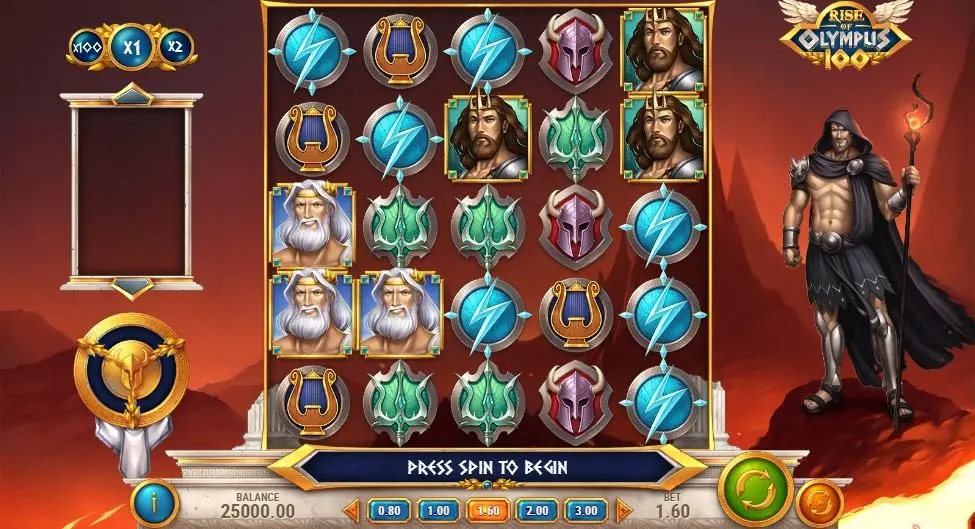
The Rise of Olympus 100 free demo also lets you confirm the basics published in FACTS: 5 reels, $/£/€0.20 to $/£/€100 stakes, and the 15,000x max win ceiling that explains the volatility label. Because no bonus mechanics, hit frequency or feature details are published for this title, the demo is your only reliable way to see the interface and paytable presentation first-hand instead of relying on descriptions elsewhere that may be invented. If a detail is not in the paid table or help file you see in the demo, treat it as unverified.
Keep play responsible even in demo. You must be 18+ to gamble, and the same habits help in free play: set a time limit and a budget for any future real-money session, treat slots as paid entertainment with a cost per hour, and step away if you are chasing losses or no longer enjoying it. If you need support, use a recognised problem-gambling resource in your jurisdiction. The goal of the demo is information, not preparation for a system — no staking pattern changes the house edge.
Should you play Rise of Olympus 100?
Choose Rise of Olympus 100 if you want a widely played, high-volatility Mythology slot from a major studio with an above-average RTP of 96.2% and you are comfortable funding the swings that a 15,000x ceiling implies. The 0.49-point edge over the corpus average lowers the long-run theoretical cost per volume, but the high-volatility delivery means session results will still vary widely in the short term.
Skip it if you need longer, steadier sessions on a small bankroll or prefer frequent small returns to infrequent large ones. In that case, a lower-volatility alternative, even with a slightly lower RTP, may feel more sustainable even though its expected cost per £100 wagered is higher on paper. Stake range helps you manage this: the $/£/€0.20 minimum gives you more spins for a fixed budget and therefore more time to experience the game’s distribution, while higher stakes accelerate both exposure and variance.
On balance, the numbers present a clear trade: you pay a £3.80 theoretical cost per £100 wagered over the long run in exchange for a high-variance ride around a large top prize. If that trade matches your preference for risk and your budget for entertainment, try the free demo first and let the pace of that demo session — not a description — make the decision for you.
More from Play'n GO
- Rich Wilde and the Tome of Madness — 96.59% RTP
- Legacy of Dead — 96.58% RTP
- Book of Dead — 94.25% RTP
- Moon Princess Origins — 96.2% RTP
- Rise of Olympus — 96.0% RTP
- Crystal Hall — 96.2% RTP
- Reactoonz — 96.51% RTP
Frequently Asked Questions
Can I play Rise of Olympus 100 for free before wagering real money?
Free demo play is available for Rise of Olympus 100. The demo uses the same 96.2% RTP maths model as the real-money version but pays no real cash. Use it to check stake range, 5-reel layout and pace at $/£/€0.20 to $/£/€100. Remember every spin is independent and demo results do not predict future outcomes.
What is the RTP of Rise of Olympus 100 and what does 96.2% mean?
Rise of Olympus 100 has a 96.2% RTP, 0.49 points above the 95.71% corpus average and 0.4 points above Play'n GO's 95.8% average. It means £96.20 is returned per £100 wagered over millions of spins. Your short-term sessions will vary above or below that, and the £3.80 house edge applies over the long run.
How volatile is Rise of Olympus 100 and what does that mean for my bankroll?
Volatility is listed as high, with a 15,000x max win that concentrates returns in rarer larger hits. Expect longer gaps between meaningful wins and bigger balance swings than low or medium volatility slots. Plan stakes so your budget covers those gaps; at $/£/€0.20 you get more spins for the same spend than at higher stakes.
Who makes Rise of Olympus 100 and what else do they offer?
Play'n GO makes Rise of Olympus 100 and has 434 games tracked, averaging 95.8% RTP. Related titles include Legacy of Dead at 96.58% and Book of Dead at 94.25%, both 5-reel games. Comparing within the same studio helps you isolate RTP and volatility differences while keeping interface and presentation broadly familiar.
How does Rise of Olympus 100 compare to Gates of Olympus on value?
Gates of Olympus runs at 96.5% RTP, 0.30 points above Rise of Olympus 100's 96.2%, so its long-run theoretical cost is £35 per £1,000 wagered versus £38. Both share a Mythology theme and large max-win ceilings, but the slightly lower house edge favours Gates of Olympus on paper. Your choice should weigh volatility tolerance and stake comfort.