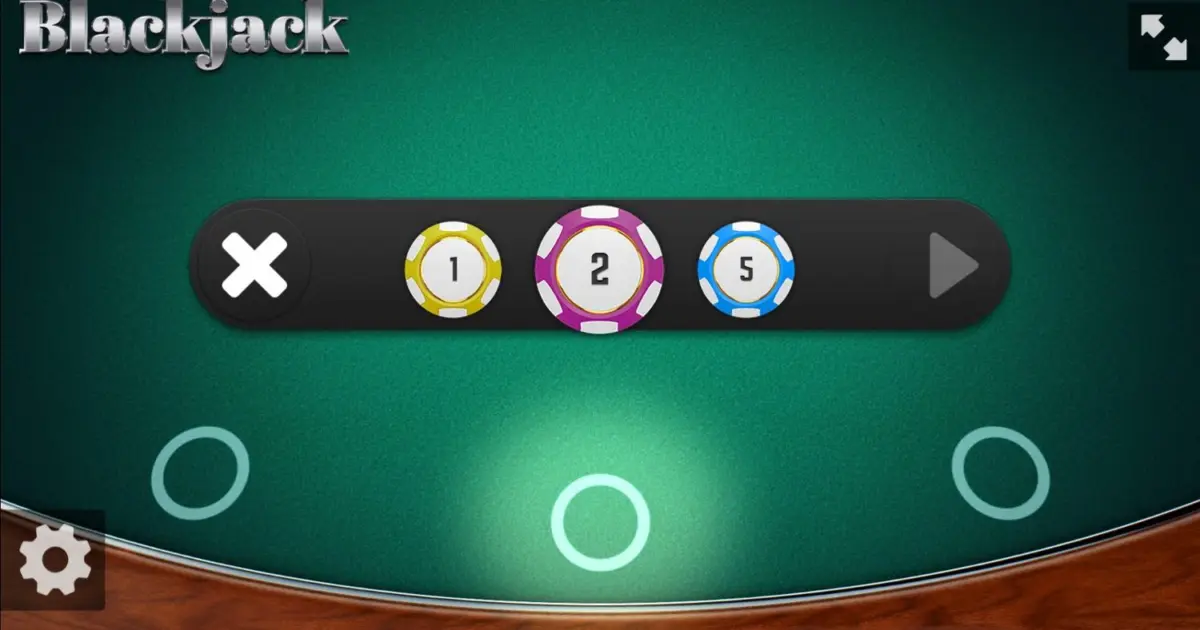
Blackjack (Gluck Games) sits squarely in the upper tier of online blackjack offerings with a published RTP of 99.5%, which translates to a 0.5% house edge. That figure alone puts it level with the best standard blackjack tables available online, and the free demo lets you verify the play experience before committing real money. G Games offers only this single blackjack title in their catalogue, so this table represents their complete entry into the category.
The 99.5% return assumes you play perfect basic strategy on every hand. Deviations—hitting when you should stand, failing to split or double in the correct spots—hand additional edge back to the house, and casual play typically realises a materially lower return than the published figure suggests.
Blackjack (Gluck Games) in one minute
This table delivers a house edge of 0.5%, which corresponds to the 99.5% RTP figure. That edge places it among the most player-friendly options in the online blackjack space, though it matches rather than beats the top-tier standard. G Games has not published the full rule set—deck count, whether the dealer hits or stands on soft 17, the blackjack payout ratio, double-after-split availability, and surrender options are all absent from the available specifications.
Those missing details matter. A shift from 3:2 blackjack payouts to 6:5 alone costs you roughly 1.4 percentage points of edge, turning a competitive table into a poor one. The number of decks in play, the soft-17 rule, and whether you can double after splitting aces each move the house edge by fractions of a percent. Without confirmation, you should check the in-game rules screen or paytable before playing for money.
| Specification | Value |
|---|---|
| RTP | 99.5% |
| House edge | 0.5% |
| Provider | G Games |
| Free demo | Yes |
House edge versus RTP: the numbers explained
RTP is the mirror image of house edge: if the house edge is 0.5%, the RTP is 100% minus 0.5%, which gives you 99.5%. Both figures describe the same underlying maths from opposite perspectives. The house edge tells you what the casino expects to keep from every hundred units wagered over the long run; RTP tells you what you expect to get back.
The critical caveat is that the 99.5% figure assumes perfect basic strategy. Basic strategy is not a betting system or a hunch—it is a solved chart, derived from exhaustive computer simulation, that tells you the mathematically correct play for every possible hand against every dealer upcard. When you deviate from it—standing on 16 against a dealer 7 because you “feel” the next card will be high, or splitting tens because you want action—you increase the house edge beyond the published 0.5%.
Insurance is a common leak. Offered when the dealer shows an ace, insurance is a side bet that pays 2:1 if the dealer has blackjack. At standard odds and typical deck compositions, insurance carries a house edge well above the base game, and taking it every time it is offered erodes your return significantly. The same applies to any side bets this table might offer—Perfect Pairs, 21+3, and similar props come with house edges several percentage points higher than the main game.
How this table compares to other online blackjack
The average RTP across all online blackjack tables in the current market is 99.41%. Blackjack (Gluck Games) sits 0.09 percentage points above that average, which is a modest but real advantage. Over ten thousand hands at a £10 average bet, that 0.09% difference is worth approximately £9 in expected value compared to an average table.
G Games publishes an average RTP of 99.5% across their catalogue, but that figure is based on this single blackjack title—there are no other tables from this provider to compare against. For context, American Blackjack and Blackjack (Mascot Gaming) both match the 99.5% RTP, while Classic Blackjack comes in slightly lower at 99.28%.
Tables offering 99.5% or better typically do so by combining player-friendly rules: 3:2 blackjack payouts, dealer standing on soft 17, permissive doubling and splitting rules, and sometimes late surrender. Tables with lower RTPs—98.5% or worse—often feature 6:5 blackjack payouts, restrictive doubling rules, or no-hole-card European rules without the corresponding dealer-bust compensation. The absence of detailed rule information for this table means you must verify which category it falls into before committing real money.
Basic strategy in practice
Basic strategy minimises the house edge; it does not eliminate it. Even with flawless play, the house retains a 0.5% edge on this table, which means that over the long run you will lose half a unit for every hundred units wagered. Short-term variance will produce winning and losing sessions, but the maths does not bend.
The strategy itself is a fixed chart. You hold 16 against a dealer 10: you hit. You hold a pair of eights against a dealer 9: you split. You hold 11 against a dealer 6: you double if the rules allow it, otherwise you hit. These plays do not guarantee you win the hand—they guarantee you lose the least (or win the most) over hundreds of repetitions of the same situation.
Learning basic strategy takes a few hours of study and a few more of practice. Blackjack (Gluck Games) offers a free demo, which is the correct environment to drill the chart without financial consequence. Mistakes in basic strategy are expensive: standing when you should hit, or failing to split or double in positive-expectation spots, can easily add a full percentage point or more to the house edge, turning a 0.5% game into a 1.5% game.
Card counting does not work here. Online blackjack tables powered by RNG software reshuffle the deck after every hand, which resets the count to neutral and removes any information advantage. Counting requires deck penetration—playing deep into a shoe before the shuffle—and that does not exist in RNG play.
Betting systems and why they do not change the odds
No betting progression alters the house edge. The Martingale system—doubling your bet after every loss until you win—does not overcome the 0.5% edge on this table. Neither does the D’Alembert, the Fibonacci, the Paroli, nor any other system that adjusts bet size based on prior outcomes. They change the shape of your variance, which is to say they change how quickly you might go broke or hit a table limit, but they do not change your expected loss per unit wagered.
The Martingale demonstrates the problem cleanly. You bet £10 and lose, then £20 and lose, then £40 and lose. After seven consecutive losses—unlikely but far from impossible, with a probability of roughly one in 128 even-money trials—you are attempting to bet £1,280 to recover £10 of prior losses. Many tables cap maximum bets well below that figure, and even without a cap, the exponential growth in required bankroll makes the system impractical.
Betting systems feel effective because they produce frequent small wins and infrequent large losses. This emotional asymmetry creates the illusion of control, but the maths remains unchanged: every hand you play faces the same 0.5% house edge, regardless of how you arrived at your current bet size. If you enjoy the structure of a progression, use it for entertainment, but understand it is a variance trade, not an edge.
The free demo
Blackjack (Gluck Games) offers a free demo, and you should use it. The demo lets you confirm the rule set—check whether blackjack pays 3:2 or 6:5, whether the dealer hits or stands on soft 17, which hands you can double on, and whether surrender is available. It also lets you test basic strategy decisions in a zero-risk environment, which is the only way to internalise the chart without paying for mistakes.
Demo play does not predict real-money results. The RNG that powers the demo is the same RNG that powers real-money play, but variance over short sessions is wide enough that a winning demo session tells you nothing about future expectation, and a losing demo session does not mean the table is “cold.” Use the demo to learn the interface and verify the rules, not to forecast outcomes.
Set a budget before you play for money, and treat that budget as the cost of entertainment, not an investment. Blackjack offers one of the lowest house edges in the casino, but it is still a negative-expectation game, and the maths guarantees the house wins over time. If you find yourself chasing losses or playing beyond your predetermined limit, step away. This is entertainment for players aged 18 and over; it is not a source of income.
Verdict
Blackjack (Gluck Games) delivers a competitive 99.5% RTP and a corresponding 0.5% house edge, placing it among the best standard tables available online. The free demo is a meaningful inclusion, and the RTP figure itself is transparent and verifiable. G Games has not published the full rule set, which is a significant omission—deck count, soft-17 treatment, blackjack payout ratio, and doubling rules all materially affect the house edge, and their absence means you must confirm these details in the game itself before playing for real money.
If the underlying rules prove player-friendly—3:2 payouts, dealer standing on soft 17, and permissive splitting and doubling—then this table is a solid choice. If the rules include 6:5 payouts or other restrictive conditions, the 99.5% RTP figure becomes harder to reconcile, and you should seek alternatives. Check the paytable, learn basic strategy, and ignore betting systems. The maths does not change, but disciplined play at a fair table minimises what you give away.
Frequently Asked Questions
Is Blackjack (Gluck Games) available to play for free?
Yes, Blackjack (Gluck Games) offers a free demo. Use it to verify the rule set—especially the blackjack payout ratio and whether the dealer hits soft 17—and to practice basic strategy without risking money. Demo results do not predict real-money outcomes, but the demo is the correct environment to learn the table before committing a bankroll.
What is the RTP of Blackjack (Gluck Games) and what does it assume?
The RTP is 99.5%, which corresponds to a 0.5% house edge. That figure assumes you play perfect basic strategy on every hand. Deviations—standing when you should hit, failing to split or double in correct spots, or taking insurance—increase the house edge and lower your realised return, often by a full percentage point or more.
Does card counting work on this table?
No. Blackjack (Gluck Games) is an RNG-powered online table that reshuffles after every hand, which resets the count to neutral and eliminates any information advantage. Card counting requires deck penetration—playing deep into a shoe—and that does not exist here. The game is solved by basic strategy, not by counting.
How does this table compare to American Blackjack and Classic Blackjack?
Blackjack (Gluck Games) matches the 99.5% RTP of American Blackjack and Blackjack (Mascot Gaming), and sits 0.22 percentage points above Classic Blackjack's 99.28%. All four are competitive tables, but G Games has not published the rule set for this title, so you must verify deck count, soft-17 treatment, and blackjack payouts in-game to confirm it delivers the stated edge.
Will a Martingale or other betting system overcome the house edge?
No. Betting progressions change the shape of variance—how quickly you might double your bankroll or hit a table limit—but they do not change the expected value of any hand. Every bet on this table faces the same 0.5% house edge regardless of prior results. Progressions produce frequent small wins and infrequent large losses, which feels effective but is not.




