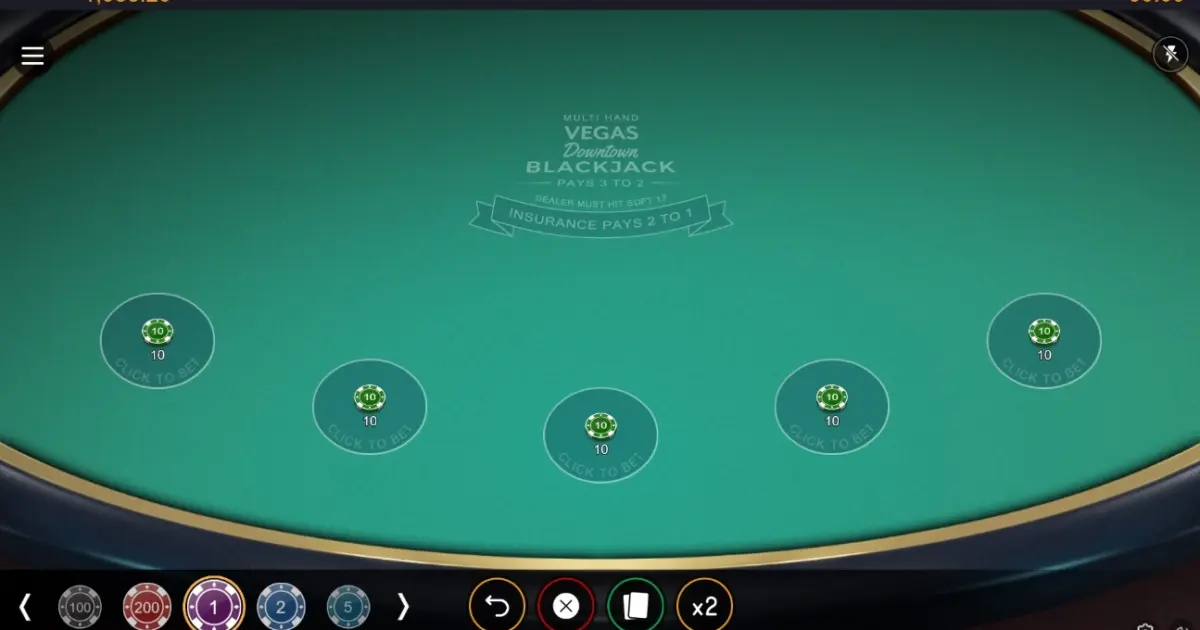
Multihand Vegas Downtown Blackjack sits in the top tier for RTP among Switch Studios tables, matching the provider’s 99.61% average and comfortably clearing the wider market baseline of 99.41%. The 99.6% published figure assumes flawless basic strategy on every decision, and the multihand format means you’ll work through your session budget faster than at a single-hand table, even though the per-hand edge remains unchanged.
How Multihand Vegas Downtown Blackjack plays
The multihand mechanic lets you play between one and five boxes simultaneously against a single dealer hand. Each box is an independent wager and follows its own basic-strategy decision tree, but all resolve against the same dealer upcard and final total. You are not playing five separate shoes; you are playing five positions at one table, which makes the variance choppier and your hourly stake exposure a straight multiple of the box count you choose.
Switch Studios does not publish the exact deck count in its rule screen for this title, though the variant hints indicate a four-deck shoe. A four-deck game typically adds around 0.06% to the house edge compared to single deck, all else equal, but that figure is already baked into the 99.6% RTP. The interface is clean, the dealing animation is fast, and a free demo is available so you can confirm the rules and test unit sizing before committing real money.
Vegas Downtown rules and what the name tells you
The “Vegas Downtown” label historically referred to a rule set common in older downtown Las Vegas casinos: four decks, dealer stands on all seventeens including soft 17, double after split allowed, and no surrender. The variant hints in the publisher’s data confirm this family, which normally means the dealer does not hit soft 17—a rule that by itself saves the player roughly 0.2% compared to the Strip standard where the dealer hits soft 17.
Because Switch Studios has not published every rule explicitly, you should verify in the game’s own paytable whether blackjack pays 3:2 or 6:5, whether you can re-split aces, and whether late surrender is available. A 6:5 blackjack payout alone would add 1.4% to the house edge and render the 99.6% RTP figure impossible, so the math strongly suggests 3:2, but check before you play for money. The name indicates Vegas Downtown, which normally means four decks, dealer stands soft 17, and double after split, but treat these as strong hints rather than confirmed rules until you see the game’s rule screen yourself.
Reading the 99.6% return figure
The 99.6% RTP translates to a house edge of 0.4%, meaning the casino expects to retain 40 cents per hundred dollars wagered over the infinite long run. That figure is excellent—only a handful of blackjack variants offer a lower edge—but it assumes you make the correct basic-strategy play on every single hand. Basic strategy is not a betting system; it is a solved chart that tells you mathematically whether to hit, stand, double, or split for every possible player total versus every dealer upcard.
A casual player who stands on 12 against a dealer three, doubles soft 18 against a nine, or takes insurance will realize a materially lower return, often in the 97–98% range or worse. The gap between the published RTP and your actual result is almost entirely a function of decision accuracy. If you are learning the game or playing for entertainment without memorizing the chart, understand that your real edge will be worse than the 0.4% headline, and budget accordingly.
| Attribute | Value |
|---|---|
| Provider | Switch Studios |
| RTP | 99.6% |
| House edge | 0.4% |
| Variant | Vegas Downtown (four-deck, dealer stands soft 17) |
| Free demo | Yes |
Where the house edge actually comes from
The dealer acts last, which means any hand you bust is lost immediately, even if the dealer subsequently busts. That sequencing asymmetry is the entire structural source of the house edge in blackjack. Every rule variation—deck count, soft-17 treatment, doubling restrictions, blackjack payout—either narrows or widens that built-in advantage, but none eliminate it.
A four-deck shoe versus single deck costs the player roughly 0.06%. Dealer standing on soft 17 instead of hitting saves the player about 0.2%. Allowing double after split returns approximately 0.14% to the player. A 3:2 blackjack payout is the baseline; a 6:5 payout costs the player 1.4% and is the single most damaging rule change you will encounter. Late surrender, where available, returns about 0.08%. European no-hole-card rules, where the dealer does not check for blackjack before you act, cost around 0.11% because you can lose a double or split stake to a dealer natural.
Switch Studios has not published every rule for this table, so the precise breakdown is unavailable. The 99.6% RTP and the Vegas Downtown label together suggest a favorable rule set—likely 3:2 blackjack, dealer stands soft 17, double after split—but without the full list, you cannot independently verify the house-edge math. Check the in-game rules screen for the blackjack payout, doubling rules, and whether re-splitting aces or surrender is allowed before you play for money.
Does card counting work here?
No. This is an RNG table that reshuffles the virtual shoe after every hand, which means the deck composition resets to neutral before you see the next deal. Card counting works by tracking the ratio of high cards to low cards remaining in the shoe; when that ratio favors the player, the counter raises the bet. If the shoe reshuffles every round, no count ever develops, and the strategy has no edge to exploit.
Live-dealer blackjack with a physical shoe and a mid-shoe cut card does allow counting in principle, though penetration is usually shallow and the edge is small. RNG blackjack does not. State this plainly: you cannot count cards against a random-number generator that resets after every hand, and any system or progression that claims otherwise is selling you variance, not edge.
Bankroll and unit sizing
A reasonable rule of thumb for a single-hand session is to bring fifty to one hundred times your base unit, which gives you enough depth to survive a cold run without reloading. If you play five boxes per round, you are effectively playing five separate hands, so a five-unit total bet per round demands five hundred units of session bankroll to achieve the same number of hands. The house edge per box does not change, but the speed at which you cycle through your budget increases in direct proportion to the number of hands you play.
Multihand blackjack does not raise the house edge, but it does compress a hundred-hand session into twenty rounds if you play all five boxes, and short sessions amplify the role of variance. A run of four dealer twenties in five rounds will cost you twenty units instead of four. Budget accordingly, and resist the temptation to chase losses by adding boxes or raising the unit mid-session.
For a comparison within the same provider stable, Classic Blackjack by Switch Studios offers 99.9% RTP and may be a better choice if you want to stretch your bankroll, while Vegas Strip Blackjack at 99.7% sits between the two and typically uses a more familiar Strip rule set. ReDeal Blackjack matches this table at 99.6% but adds a redeal mechanic that changes the decision tree in interesting ways.
Set your session budget in advance, treat it as the cost of entertainment rather than a route to income, and walk away when it is gone. Blackjack offers one of the lowest house edges in the casino, but the edge is always there, and no betting progression or system will eliminate it. If gambling is affecting your finances or well-being, seek help. 18+ only.
Verdict
Multihand Vegas Downtown Blackjack delivers a strong 99.6% RTP under rules that favor the player—dealer stands on soft 17, four decks, and double after split all implied by the Vegas Downtown label. The house edge is a low 0.4% if you play perfect basic strategy, which puts this table in the upper tier for Switch Studios and the wider market. The multihand format is the decision point: it does not change the per-hand edge, but it multiplies your hourly exposure and compresses variance into fewer rounds.
If you want to play multiple boxes and have the bankroll depth to support it, this is a mathematically sound choice. If you are learning basic strategy or prefer to stretch a smaller budget, a single-hand table or a variant with slightly higher RTP will serve you better. Switch Studios has not published every rule explicitly, so confirm the blackjack payout and doubling restrictions in the game’s own rule screen before you commit real money. The free demo is available, and you should use it.
Frequently Asked Questions
Is Multihand Vegas Downtown Blackjack available in free demo mode?
Yes, Switch Studios offers a free demo for this table. The demo lets you test the multihand interface, confirm the rules in the paytable, and practice basic strategy without risking real money. Demo results do not predict real-money outcomes, but the rule set and house edge are identical, so it is a useful tool for learning the game and sizing your units before you play for money.
What RTP does Multihand Vegas Downtown Blackjack offer and does it assume perfect play?
The published RTP is 99.6%, which translates to a 0.4% house edge. That figure assumes you make the correct basic-strategy decision on every hand—hit, stand, double, or split—according to the solved chart for this rule set. A casual player who deviates from basic strategy will realize a materially lower return, often in the 97–98% range or worse, because every incorrect decision hands additional edge to the house.
Can I count cards at this RNG blackjack table?
No. Multihand Vegas Downtown Blackjack is an RNG table that reshuffles the virtual deck after every hand, so no count ever develops. Card counting works by tracking the ratio of high to low cards remaining in a physical shoe; when the shoe resets to neutral before each deal, the strategy has no edge to exploit and cannot overcome the house advantage.
How does Switch Studios' RTP compare across its blackjack range?
Switch Studios publishes an average RTP of 99.61% across its twenty-two blackjack titles, and Multihand Vegas Downtown Blackjack at 99.6% sits fractionally below that mean. The provider's strongest offering is Classic Blackjack at 99.9%, while Vegas Strip Blackjack delivers 99.7% and ReDeal Blackjack matches this table at 99.6%. The differences are small, but a 0.3% gap over a long session adds up, so compare the rule sets and choose accordingly.
Does playing multiple hands per round change the house edge?
No. The house edge remains 0.4% per hand regardless of whether you play one box or five. What changes is your hourly stake exposure: five hands per round means you cycle through your session bankroll five times faster than at a single-hand table, and short sessions amplify variance. A cold run hits harder when you are playing multiple boxes, so you need proportionally more bankroll depth to survive the same number of rounds.




