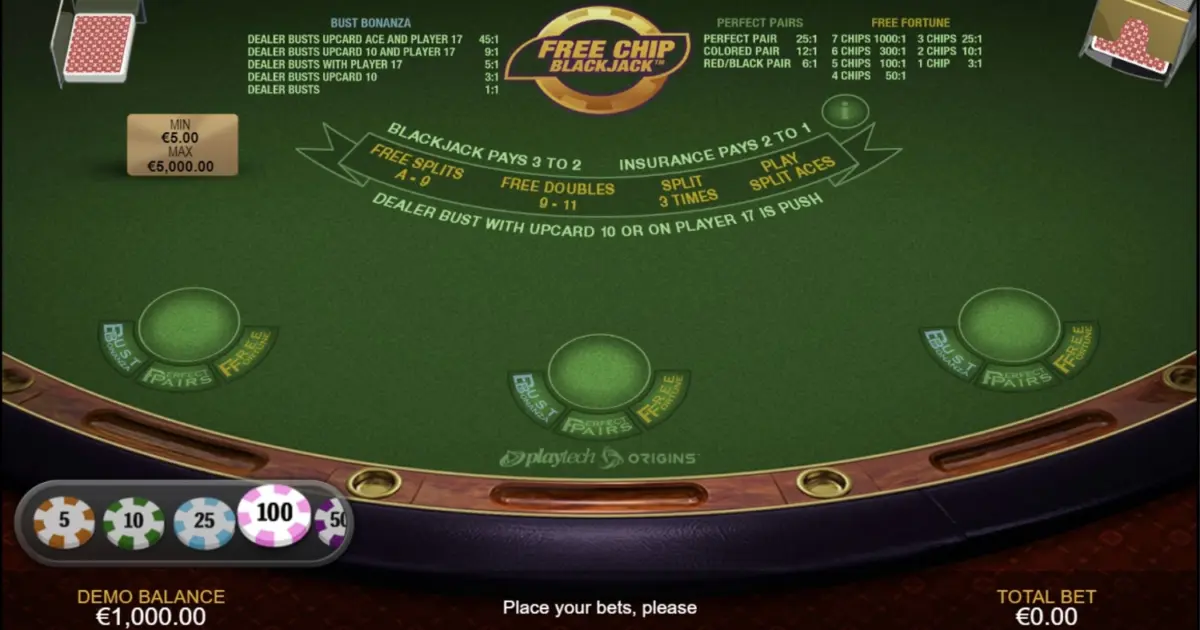
Free Chip Blackjack from Origins (Playtech) sits comfortably in the upper range of online blackjack offerings with a published RTP of 99.58%, which translates to a house edge of 0.42%. That figure alone makes it competitive, but the caveat matters: that return assumes you play perfect basic strategy on every hand, and any deviation from the mathematically correct play increases the house edge you face in practice.
Free Chip Blackjack in one minute
Origins (Playtech) publishes a 99.58% RTP for this table, giving it a theoretical house edge of 0.42% under optimal play. The title suggests a chip-bonus mechanic, though Origins does not provide detailed rule documentation in the source data, so you should check the in-game paytable to confirm exactly which situations award free chips and whether accepting them alters the optimal strategy for that hand. The variant is available in free demo mode, letting you explore the ruleset and test your strategy decisions without risking money.
| Attribute | Value |
|---|---|
| Provider | Origins (Playtech) |
| RTP | 99.58% |
| House Edge | 0.42% |
| Free Demo | Yes |
House edge versus RTP: the numbers explained
RTP and house edge are two sides of the same coin. The 99.58% RTP figure means that for every £100 wagered under perfect basic strategy, the mathematical expectation is that £99.58 returns to the player over the long run, and the house keeps £0.42. That £0.42 per £100 is the 0.42% house edge. Critically, that published RTP assumes you make the correct play on every single decision: hit, stand, double, split. If you deviate from basic strategy—standing on 16 against a dealer 7 because you have a hunch, or splitting tens because you feel lucky—you hand the house a larger edge, sometimes dramatically so. A casual player who guesses at decisions or plays by feel will realise an RTP materially lower than the published figure, often several percentage points worse.
Blackjack RTP is determined by the specific rules in force at the table. The blackjack payout ratio is the single most important: a 3:2 payout is standard, but a 6:5 payout for blackjack costs the player roughly 1.4 percentage points and is the most damaging rule change you will encounter. Whether the dealer hits or stands on soft 17 shifts the edge by about 0.2%, the number of decks in the shoe matters by a few hundredths, and rules around doubling after split, re-splitting aces, and late surrender each move the needle. Origins does not publish the full rules breakdown for free chip blackjack in the available data, so you must verify the specifics in the game’s own rules screen before you play for money.
How this table compares to other online blackjack
The 99.58% RTP places free chip blackjack 0.17 percentage points above the 99.41% average for online blackjack tables in the current market. That gap is modest but meaningful: over 10,000 hands at £10 per hand, the difference between 99.41% and 99.58% is £17 in expected value. It is not a game-changer, but it is real money, and when two tables are otherwise equal, the higher RTP is the rational choice.
Origins (Playtech) operates nine blackjack titles with an average RTP of 99.6%, so free chip blackjack sits fractionally below that provider average. If you want a tighter edge from the same stable, Quantum Blackjack Plus offers 99.68% RTP, a tenth of a point better. Cashback Blackjack comes in at 99.55%, slightly softer than free chip blackjack, while All Bets Blackjack matches the 99.58% figure exactly, so your choice between the two comes down to the specific side bets and rule tweaks each table offers.
When you compare across the entire online blackjack universe, a 99.58% RTP is competitive. You will find a handful of single-deck or premium tables pushing 99.7% or higher, but those often come with restrictive betting limits or compensating rule changes that claw back some of the advertised advantage. A sub-0.5% house edge is about as good as it gets for a widely available online blackjack variant.
Basic strategy in practice
Basic strategy is not a betting system or a hunch; it is the mathematically solved set of decisions for every possible player hand versus every dealer upcard. It is presented as a chart, and it exists because blackjack is a game of incomplete information with fixed probabilities. When you hold 16 and the dealer shows a 10, hitting loses more often than it wins, but standing loses even more often, so the correct play is to hit. Basic strategy tells you which action minimises your loss in that scenario, and it does so for every combination.
Playing perfect basic strategy is the only way to achieve the published 99.58% RTP. Every mistake you make—doubling on 11 against a dealer ace when you should hit, failing to split eights against a dealer 6, taking insurance—adds to the house edge. The strategy chart for free chip blackjack may differ slightly from a standard chart if the free-chip mechanic alters the expected value of doubling or splitting in certain situations, so you must check whether the game provides a modified strategy guide or whether a standard chart applies.
Basic strategy does not eliminate the house edge. Even with perfect play, the casino retains a 0.42% mathematical advantage on this table, which means that over a long series of hands, you will lose more than you win. What basic strategy does is compress that edge to its absolute minimum. It turns blackjack from a guessing game with a 2% to 3% house edge into a disciplined exercise with a sub-0.5% edge, and that difference is the gap between a slow grind and a realistic chance of finishing a session ahead.
Betting systems and why they do not change the odds
Betting progressions—Martingale, D’Alembert, Fibonacci, or any system that adjusts your bet size based on prior results—do not alter the house edge. The edge applies independently to every hand. If the house holds a 0.42% advantage, it holds that advantage whether you bet £10 flat or double your stake after every loss. A progression changes the distribution of outcomes: Martingale, for example, gives you a high probability of small wins and a low probability of catastrophic loss when you hit a long losing streak and exhaust your bankroll or the table limit. The expected value remains negative.
The belief that a hand is “due” after a streak is a cognitive error called the gambler’s fallacy. Each hand is an independent event. If you lose five hands in a row, the probability that you win the sixth is unchanged; the deck or RNG has no memory. Progressions feel like they work because most sessions are short and you will often recover from a small losing streak before the rare disaster hits, but that disaster, when it comes, erases all prior gains and then some.
Card counting, the one technique that does shift the edge in the player’s favour, does not work on RNG-based online blackjack tables that reshuffle after every hand. Counting relies on tracking the changing composition of the remaining deck; when the deck resets after each deal, there is nothing to track. If free chip blackjack uses a continuous shuffle or RNG—and Origins does not specify—card counting is not viable. State that plainly: no counting, no advantage play, and no progression that overcomes the 0.42% edge.
The free demo
Free chip blackjack is available in demo mode, and that is the correct place to start. The demo lets you explore the free-chip mechanic, confirm the rules in the paytable, and drill basic strategy decisions without financial risk. Demo play does not predict real-money results—variance is variance whether you are playing for pennies or pounds—but it does let you determine whether you enjoy the game’s rhythm and whether you can execute basic strategy consistently under the table’s specific rules.
If you move to real-money play, set a budget in advance and treat it as the cost of entertainment, not a path to income. Blackjack, even at 99.58% RTP, has a negative expected value, which means the house wins over time. You may finish ahead in a single session thanks to variance, but the edge grinds in the casino’s favour across thousands of hands. Play only with money you can afford to lose, never chase losses, and recognise when a session stops being fun. This is entertainment for adults aged 18 and over; if gambling is causing you harm, seek support from a recognised service such as GamCare or BeGambleAware.
Verdict
Free chip blackjack earns its place in the upper tier of online blackjack variants with a 99.58% RTP and a corresponding 0.42% house edge, both of which assume you play perfect basic strategy. The title’s chip-bonus mechanic is intriguing, but Origins provides limited rule documentation, so you must verify the specifics in-game. The RTP sits above the 99.41% market average and matches the best offerings from the same provider, making it a rational choice for a player who values a tight edge.
The absence of detail around deck count, dealer soft-17 rules, and the exact conditions that trigger free chips is a drawback for a mathematically literate player. You want full transparency before you commit money, and you should not have to reverse-engineer the rules from observation. If you can confirm those details in the paytable and they align with player-friendly standards—3:2 blackjack payout, dealer stands on soft 17, double after split allowed—this table is worth your time. If the rules screen is vague or the free-chip mechanic introduces complexity that obscures the optimal play, you lose the benefit of that 99.58% figure.
For a player who knows basic strategy cold and wants a demo environment to explore a variant with a novel twist, free chip blackjack is a solid option. For a casual player still learning the fundamentals, the standard game is a better teacher. Either way, the 99.58% RTP is competitive, and the house edge is about as low as you will find outside a handful of premium tables. Confirm the rules, play the demo, and decide whether the free-chip mechanic adds value or just noise.
Frequently Asked Questions
Is free chip blackjack available to play for free?
Yes, free chip blackjack offers a free demo mode. The demo lets you explore the game's free-chip mechanic and test your basic strategy decisions without risking real money, though demo results do not predict real-money outcomes due to variance.
What RTP does free chip blackjack offer and does it require perfect play?
Free chip blackjack posts a 99.58% RTP, which translates to a 0.42% house edge. That figure assumes you play perfect basic strategy on every hand; any deviation from optimal play increases the house edge and lowers the actual return you will experience over time.
How does free chip blackjack compare to other online blackjack games?
With a 99.58% RTP, free chip blackjack sits 0.17 percentage points above the 99.41% average for online blackjack tables. It matches All Bets Blackjack from the same provider and trails Quantum Blackjack Plus by a tenth of a point, placing it comfortably in the top tier of widely available variants.
Can I use card counting or a betting system to beat free chip blackjack?
No. Card counting does not work on RNG-based blackjack tables that reshuffle after every hand, and betting progressions like Martingale change the shape of variance but not the house edge. The 0.42% edge applies to every hand independently, and no system overcomes it.
Who provides free chip blackjack and how reliable is the RTP figure?
Origins (Playtech) provides free chip blackjack. Playtech is an established developer in the online casino space, and the 99.58% RTP is a published figure that assumes the game operates as specified and you play optimal basic strategy throughout.




