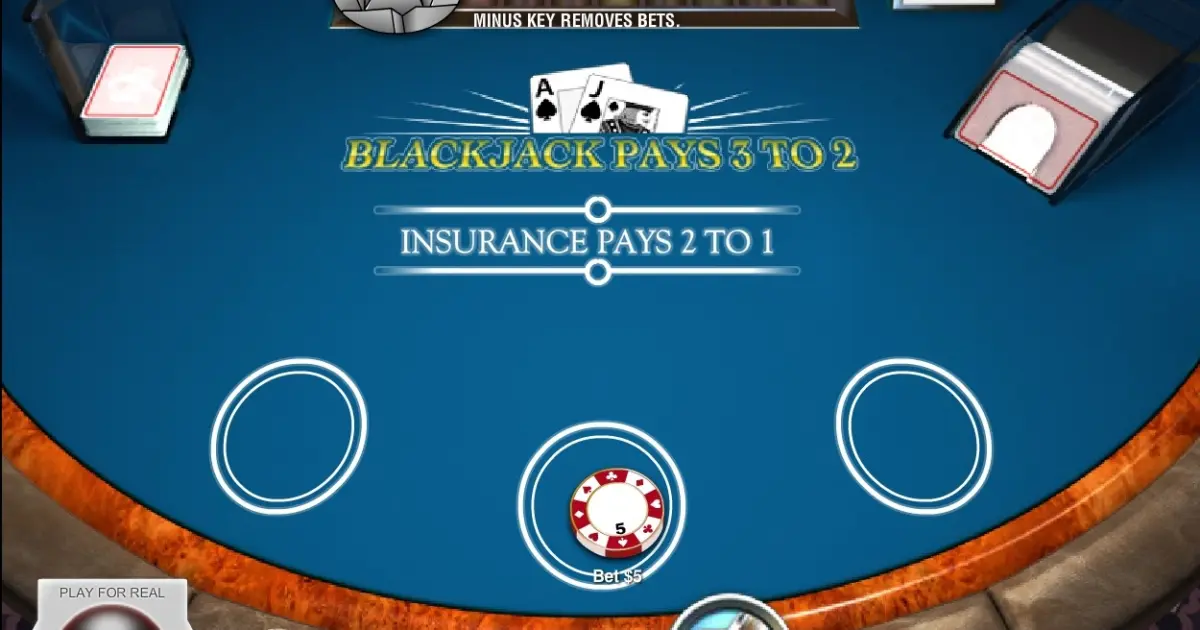
Multi-hand Blackjack is Rival’s only table game, and its 99.27% RTP is marginally below what you would find on comparable titles here. Whether that small gap matters depends entirely on how many hands you play per hour and whether you stick to basic strategy without deviation.
The free demo is available so you can see whether the pace of multiple simultaneous hands suits your bankroll before risking anything. If you want a closer read on the maths behind this return figure, keep going.
How Multi-hand Blackjack plays
Each round deals you several separate hands, all competing against a single dealer hand. You receive the same dealer card and make independent decisions on each of your own hands: hit, stand, double, or split, according to the table’s specific rule set.
That structure changes the feel of the game. You see more cards per minute, make more decisions per shoe, and therefore risk more money per hour than at a single-hand table. The outcomes themselves follow the same probabilities, but the speed at which the house edge extracts its share goes up.
The interface from Rival keeps things straightforward: cards are dealt face-up, your active hand is highlighted, and completed hands resolve as the dealer plays out the round. The free demo version lets you learn the layout without wagering.
| Provider | Rival |
|---|---|
| RTP | 99.27% |
| Free demo | Yes |
Multi-hand blackjack rules and what the name tells you
The variant label “Multi-Hand” confirms that you play several hands per round against one dealer. This is a format descriptor, not a rule set, so it tells you nothing about the deck count, whether the dealer hits soft 17, or the blackjack payout.
Rival does not publish those details in a way this review can verify, so you must check the in-game rules screen before playing for money. The three figures that matter most for your expected return are the deck count, the soft-17 rule, and the blackjack payout. A 6:5 payout, for example, costs roughly 1.4% compared to 3:2 and is the single most damaging rule change any table can carry.
If you want to compare a table with confirmed rules, Classic Blackjack publishes a 99.28% RTP on this site, making it a useful reference point.
Reading the 99.27% return figure
The 99.27% RTP means the table returns 99.27 cents for every dollar wagered over millions of hands. The critical caveat: this assumes perfect basic strategy on every single decision. A player who occasionally stands on 16 versus a 10, or doubles hands that should not be doubled, will realise materially less than 99.27%.
On this site, the corpus average across reviewed blackjack titles is 99.41%. That places Rival’s table 0.14 percentage points below average. In practical terms, the difference between 99.27% and 99.41% is small per hand, but over thousands of hands and multiple simultaneous hands per round, it accumulates.
The figure also does not account for side bets, which Rival’s rules screen would list separately. Side bets carry their own, much higher, house edges and drag blended RTP down if you use them.
Where the house edge actually comes from
At 99.27% RTP, the implied house edge is 0.73% under perfect play. For context, single-deck tables with favourable rules can reach 0.4% or below, while 6:5 payout tables with hit-soft-17 rules can push past 2%. The exact composition of this 0.73% depends on the specific rules Rival has set, which you should confirm in-game.
The edge exists because the player acts first. If you bust, you lose your stake regardless of whether the dealer later busts. The house compensates for that structural disadvantage through rule choices: the dealer’s position to play the hand last, restrictions on splitting, and the payout ratio on a natural 21.
Basic strategy minimises the portion of the edge you add yourself through suboptimal decisions. It does not eliminate the structural component. No chart, system, or pattern removes it.
Does card counting work here?
No. Rival’s Multi-hand Blackjack runs on a random number generator, which means the deck is reshuffled before every hand or on a cycle too short to exploit. The shuffle randomises card composition completely, making it impossible to track any meaningful count.
Even if you could maintain a running count mentally, the RNG gives you no information about upcoming cards. Each hand is statistically independent of the last. The multi-hand format does not change this: you still cannot predict the next card from the previous round’s outcomes.
If you want to compare a table where rules are at least transparent, American Blackjack lists a 99.5% RTP on this site, making it worth checking for rule clarity.
Bankroll and unit sizing
Multi-hand play increases your hourly risk simply because you have more bets in the water each round. If you play three hands per round at $5 each, your per-round stake is $15. The same table speed that gives you three times the action also triples the rate at which variance swings your bankroll.
A reasonable approach: decide your session budget in advance, divide it into units where one unit equals the minimum you are willing to lose on a single hand. With three simultaneous hands, your worst-case round costs three units. Size accordingly.
Betting progressions such as Martingale or D’Alembert change the shape of your variance, not the expected value. They do not alter the 0.73% house edge. If a strategy cannot beat a single-hand table, it cannot beat a multi-hand one either.
Play for entertainment, not income. Set a hard budget, take breaks, and stop when you reach it. If gambling stops being fun, contact a helpline. You must be 18 or over to play.
Verdict
Rival’s Multi-hand Blackjack is a competent RNG table sitting 0.14% below this site’s average blackjack RTP. The multi-hand format is the game’s defining feature and the reason it will burn through a bankroll faster than single-hand alternatives at the same unit size.
The 99.27% figure is respectable in absolute terms, but only if you play perfect basic strategy. The missing rule details mean you must check the in-game paytable yourself before committing real money. That transparency gap is the table’s main weakness relative to other options here.
Use the free demo to feel out the pace and see whether multiple simultaneous hands suit your concentration level. If they do, and the rules screen confirms a 3:2 payout and stand-on-soft-17, you have a reasonable table. If the rules look unfavourable, the corpus average of 99.41% tells you better options exist.
Frequently Asked Questions
Can I play Multi-hand Blackjack for free?
Yes. Rival's Multi-hand Blackjack is available as a free demo on this site, with no deposit required. You play with virtual credits against the same RNG logic that powers real-money sessions, so you can test the multi-hand pace and interface layout without risk.
What does the 99.27% RTP actually mean for my expected losses?
The 99.27% RTP assumes you play perfect basic strategy on every decision across every hand. For a player who deviates from the chart even occasionally, realised returns will be lower. The figure represents the theoretical long-run return, not a guarantee for any session.
Is the house edge higher at this table than average blackjack?
The implied edge is 0.73%, which is modest for an RNG blackjack table but sits 0.14 percentage points above the corpus average RTP of 99.41% on this site. The exact rule set driving that figure is not published, so verify the in-game rules before playing.
Does card counting help at Rival's Multi-hand Blackjack?
No. This is an RNG table that reshuffles between hands or rounds. Card counting requires tracking a finite shoe's composition, and a randomised generator eliminates that information. No betting system or progression changes the expected value of a table governed by a house edge.
How does Multi-hand Blackjack compare to other tables on this site?
American Blackjack returns 99.5% and Blackjack by Mascot Gaming also returns 99.5%, both above Rival's 99.27%. However, RTP alone does not capture the full picture. Check each game's specific rules and payout structures before deciding which table offers the best value for your play style.




