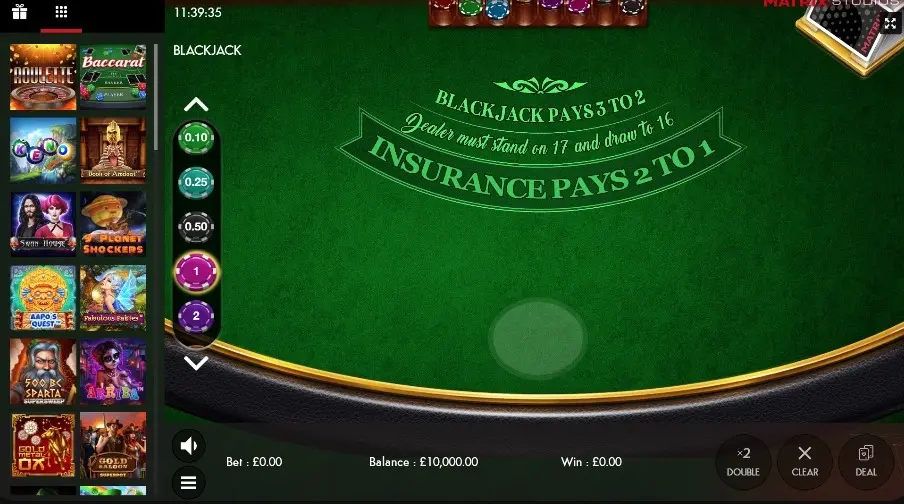
Blackjack (Boldplay) sits in the top quartile of online blackjack tables by return-to-player, and for a provider with just one blackjack title in its catalogue, that 99.75% figure is a strong opening statement. The house edge of 0.25% assumes you play perfect basic strategy on every decision; any deviation from the chart hands that edge back to the house. If you’re looking for a fair table and have the discipline to stick to optimal play, this one merits attention.
Blackjack (Boldplay) at a glance
Boldplay publishes a 99.75% RTP for this table, which translates to a house edge of 0.25% under perfect basic strategy. That figure places it a third of a percentage point above the 99.41% category average in this review corpus, and comfortably ahead of many tables from larger studios. The game offers free demo play, so you can verify the interface and pace before committing real money.
| Attribute | Value |
|---|---|
| Provider | Boldplay |
| RTP | 99.75% |
| House edge | 0.25% |
| Free demo | Yes |
| Provider catalogue size | 1 blackjack table |
Boldplay does not publish granular rule details—deck count, soft-17 treatment, doubling restrictions, or blackjack payout ratio—so the 99.75% RTP is your primary decision input. The absence of a detailed paytable in promotional material means you should check the in-game rules screen before your first hand.
What a 99.75% RTP means at a blackjack table
A 99.75% return-to-player figure is valid only when you play perfect basic strategy on every hand. Basic strategy is a solved chart that tells you the mathematically optimal decision—hit, stand, double, split—for every combination of your hand and the dealer’s up-card. Any time you stand on 16 against a dealer 7 when the chart says hit, or fail to split eights against a 6, you hand equity back to the house and your realized RTP drops below the published figure.
Casual players who play by intuition typically realize an RTP several percentage points lower than the theoretical maximum. The 0.25% house edge at this table is among the lowest available, but it is still a house edge: over the long run, perfect play returns 99.75 units for every 100 wagered, and imperfect play returns less. The edge is never eliminated.
For context, a 99.75% RTP and a 99.5% RTP—the figure posted by American Blackjack—differ by 0.25 percentage points, which costs you an extra 25 cents per hundred dollars wagered. That gap matters to a player logging hundreds of hands per session, but it is dwarfed by the cost of strategy errors.
The rules that move the house edge
Boldplay has not disclosed whether this table uses a single deck, six decks, or eight, and that omission is material: a single-deck game played under otherwise identical rules cuts roughly 0.5% from the house edge compared to an eight-deck shoe. Similarly, whether the dealer hits or stands on soft 17 moves the edge by about 0.2%, and a 6:5 blackjack payout instead of the standard 3:2 adds approximately 1.4%—the single most punishing rule change you will encounter.
Other variables include whether you can double after splitting, re-split aces, or surrender late. Each of these rules shifts the house edge by a few hundredths to a few tenths of a percent. In aggregate, the rule set determines whether you face a 0.25% edge or a 0.8% edge, and the published RTP already bakes those rules in. The 99.75% figure tells you the outcome; the missing rule breakdown tells you how it was reached.
Because Boldplay offers only one blackjack table, there is no sibling variant to compare. Check the game’s internal paytable and rules screen before you play for money, and if the blackjack payout is anything other than 3:2, walk away regardless of the stated RTP.
Basic strategy, and what it can and cannot do
Basic strategy is not a betting system. It is a fixed decision chart derived from combinatorial analysis of every possible hand outcome. It tells you when to hit 12 against a dealer 3, when to double 11 against a 10, and when to split 9s against a 7. The chart does not change based on prior hands, and it does not require you to track cards.
Following basic strategy minimizes the house edge to the published 0.25% at this table, but it does not turn the edge in your favor. You will still lose 0.25% of total money wagered over a sufficiently large sample. What basic strategy does is ensure you are not giving away additional equity through incorrect plays.
Card counting—the practice of tracking the ratio of high to low cards remaining in the shoe—does not work against an RNG blackjack table. These games reshuffle a virtual deck after every hand, so no count ever develops. If you are looking for an edge through card counting, you need a live dealer table with deck penetration, not an RNG game.
Betting progressions such as Martingale (doubling your bet after each loss) or D’Alembert (incrementing by one unit after a loss) change the shape of your session variance but do not change the expected value. You are still playing into a 0.25% house edge on every hand; the progression only determines whether you experience that edge as frequent small losses or infrequent large losses.
Side bets and insurance
Boldplay does not disclose whether Blackjack (Boldplay) offers side bets such as Perfect Pairs or 21+3. If they are present, treat them as separate wagers with a materially higher house edge than the base game. Perfect Pairs typically carries a house edge between 4% and 6%, and 21+3 runs between 2% and 4%, depending on paytable. Compare that to the 0.25% edge on the main hand, and the side bet is giving away equity at twenty times the rate.
Insurance is offered when the dealer shows an ace, paying 2:1 if the dealer has blackjack. At standard odds and a multi-deck shoe, insurance has a house edge around 7%, making it one of the worst bets on the table. Basic strategy says decline insurance every time, even when you hold a strong hand or a blackjack yourself. The two events are independent, and the insurance line is priced to the house’s advantage.
If you are playing for the lowest possible house edge, ignore side bets and insurance entirely. They exist to increase hold, not to offer you value. For comparison, Classic Blackjack posts a 99.28% RTP and includes Perfect Pairs and 21+3; the base game edge is lower without them.
Playing the Blackjack (Boldplay) demo
The free demo is available without registration and runs on the same RNG as the real-money version, so the dealing pattern and frequency of each outcome are identical. Demo mode lets you test the interface, confirm the rules, and practice basic strategy without financial risk. It does not, however, predict your real-money results: variance ensures that twenty demo hands have no bearing on the next twenty hands played for money.
Use the demo to verify the blackjack payout ratio, check whether the dealer hits or stands on soft 17, and confirm which doubling and splitting options are available. If the game does not display these rules clearly, that lack of transparency is itself a data point. A fair table will publish its rules prominently.
Set a budget before you play for real money, treat that budget as the cost of entertainment rather than a route to income, and stop when it is spent. Blackjack has one of the lowest house edges in the casino, but it is still a negative-expectation game over time. If you find yourself chasing losses or playing beyond your predetermined limit, step back. This is entertainment for players aged 18 and over, and it should stay that way.
If you want to explore similar tables, Blackjack (Mascot Gaming) also posts a 99.5% RTP, half a point below Boldplay’s figure, and may offer a different rule mix worth comparing.
Verdict: who should sit at this table
Blackjack (Boldplay) is built for the player who knows basic strategy, respects the house edge, and wants the fairest available game. That 99.75% RTP is legitimate, but only if you play correctly on every hand. If you deviate from the chart, you are playing a different game with a different edge, and the published return no longer applies to you.
The lack of detailed rule disclosure is the table’s main drawback. You are choosing this game on RTP alone, trusting that the underlying rule set is sound. That trust is reasonable given the headline figure, but it is not a substitute for transparency. Before you commit real money, open the rules screen and confirm the blackjack payout is 3:2, not 6:5.
For the player who already has a basic strategy chart memorized or open in a second window, this table offers a house edge that only a handful of online blackjack games can match. For the casual player betting by feel, the edge you actually face will be measurably higher, and the RTP advantage over a 99.5% table evaporates. Know which player you are before you sit down.
Frequently Asked Questions
Is there a free demo version of Blackjack (Boldplay)?
Yes, the game offers free demo play without registration. The demo uses the same RNG as the real-money version, so dealing patterns and outcome frequencies are identical, making it a useful tool for learning the interface and verifying rules before wagering.
What does the 99.75% RTP mean for my actual returns?
The 99.75% return-to-player figure applies only when you play perfect basic strategy on every hand. Any deviation from optimal play—standing when you should hit, or failing to split when the chart says split—lowers your realized RTP, often by several percentage points for casual players.
Can I count cards or use a betting system to beat this table?
No. Blackjack (Boldplay) uses an RNG that reshuffles after every hand, so no card count develops. Betting progressions like Martingale change the variance profile of your session but do not reduce the 0.25% house edge; you are still playing a negative-expectation game over time.
How does Boldplay compare to other blackjack providers?
Boldplay's single blackjack table posts a 99.75% RTP, which is 0.34 percentage points above the category average and matches or exceeds the return from much larger studios. The provider average RTP is also 99.75%, as this is their only blackjack offering.
Should I take insurance when the dealer shows an ace?
No. Insurance pays 2:1 but carries a house edge around 7% at standard multi-deck odds, making it one of the worst bets available. Basic strategy says decline insurance every time, even when you hold a blackjack yourself, because the two events are independent and the line is priced against you.




