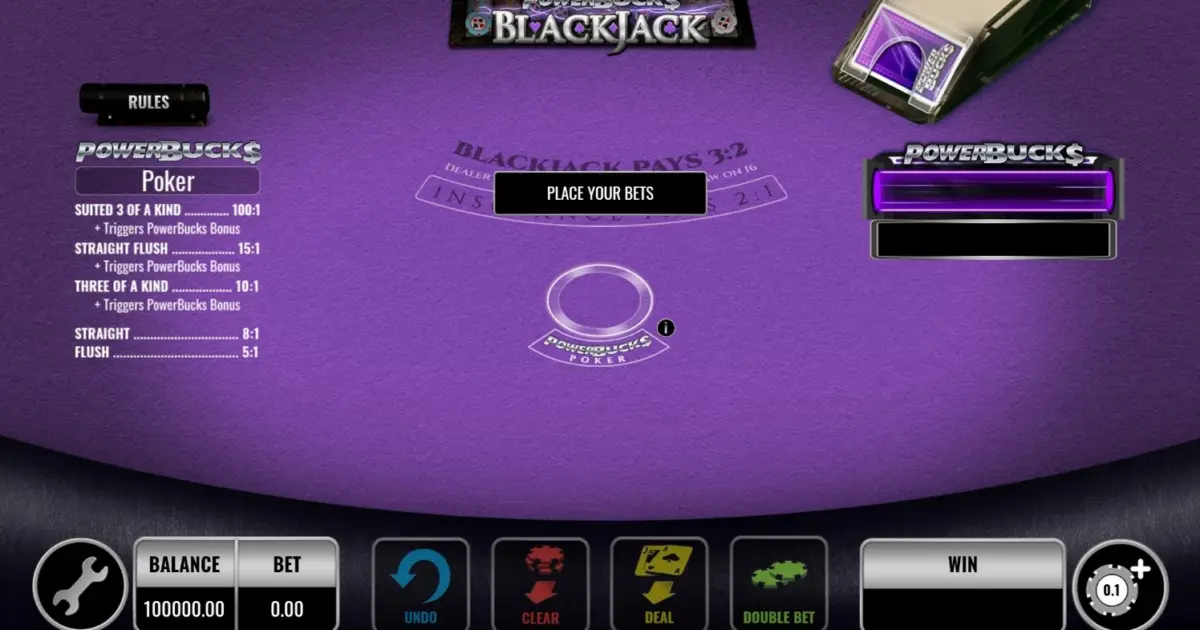
PowerBucks Blackjack is the sole blackjack entry IGT currently lists in this catalogue, which limits what you can verify before you sit down. The game carries no confirmed RTP figure of its own, so the corpus average of 99.41% serves as the only reference point. If you are looking for a table with transparent rules and published edge data, this one will frustrate you until you open its internal paytable screen and read every line yourself.
PowerBucks Blackjack in one minute
The name suggests a tournament or multiplier mechanic layered onto standard blackjack, but IGT publishes no rule sheet for this table in the data available to us. What is confirmed: the provider is IGT, the subcategory is Black Jack, and a free demo is available. What is not confirmed: deck count, blackjack payout ratio, dealer soft-17 behaviour, doubling rules, surrender availability, side bets, or table limits. Every one of those variables shifts the house edge by tenths or hundredths of a percent, so the absence of published data is itself a meaningful fact. You cannot treat an unknown-edge table as equivalent to a well-documented one. If you decide to play for real money, open the rules screen first and note each figure before placing a single chip.
| Provider | IGT |
|---|---|
| Free demo | Yes |
House edge versus RTP: the numbers explained
RTP and house edge are the same number viewed from opposite sides. RTP of 99.41% means a theoretical house edge of 0.59% — but that figure only materialises if you play every hand with perfect basic strategy. Deviate even once per round on average, and your realised return drops materially, often by 0.5% or more over a long session. More importantly, 99.41% is not PowerBucks Blackjack’s stated RTP; it is the average across all blackjack tables in this site’s corpus. IGT has not published a specific return figure for this game. Until they do, you are playing against an unknown edge that could be better or worse than the average. The rule-of-thumb relationships between individual rule changes and the edge still apply once you confirm them in-game: a 6:5 payout instead of 3:2 costs roughly 1.4%, dealer hits soft 17 adds about 0.2%, and each additional deck adds a few hundredths of a percent.
How this table compares to other online blackjack
IGT carries only one blackjack title in this database, so there are no sibling tables to benchmark against within the provider. Against the wider field, the closest reference points are tables with clearly documented rules. American Blackjack sits at 99.5% RTP with well-known rule conventions, making it easier to evaluate your expected return before you press deal. Classic Blackjack at 99.28% offers a transparent structure where every variable — deck count, payout ratio, soft-17 rule — is stated up front. If you value knowing exactly what you are playing against, those two tables give you more information than this IGT entry does. The corpus average of 99.41% tells you where the middle of the market sits, not where PowerBucks Blackjack individually falls. Blackjack from Mascot Gaming at 99.5% shows that well-published tables can exceed that average comfortably.
Basic strategy in practice
Basic strategy is a solved decision chart, not a system or a hunch. For any given combination of your hand and the dealer’s upcard, exactly one action — hit, stand, double, split, or surrender — carries the highest expected value. Playing it correctly minimises the house edge to whatever the underlying rules permit, but it never reduces the edge to zero. That distinction matters because many players conflate “optimal play” with “profitable play.” You will still lose in the long run; you will simply lose more slowly.
The complication here is that a basic-strategy chart depends on the rules in effect. Whether the dealer hits soft 17 changes the correct play on A-7 versus a dealer 2 through 6. Whether you may double after splitting changes whether to split certain pairs. If you confirm the deck count and payout ratio in the PowerBucks Blackjack paytable, you can map the correct chart. Without those facts, you are guessing which variant of the chart applies, and guessing costs money.
Betting systems and why they do not change the odds
No sequence of bet sizes can transform a negative-expectation game into a positive-expectation one. Martingale, D’Alembert, Fibonacci, and their variants redistribute when your wins and losses occur; they do not alter the house edge. Martingale produces frequent small gains and occasional catastrophic losses that wipe out many sessions of profit. The math is unavoidable: if the edge is 0.59% per hand and you are betting larger amounts after losses, you are simply risking more on each negative-expectation decision. In PowerBucks Blackjack specifically, the absence of a published edge means you cannot even calculate the expected rate at which your bankroll will erode. Progressions also interact badly with table maximums — if you reach the cap before a win resets your sequence, the whole structure collapses in a single hand.
The free demo
A free demo is available, and you should use it for one specific purpose: read the in-game rules screen and record the deck count, blackjack payout, soft-17 rule, doubling and splitting permissions, and any side bets offered. The demo lets you observe these details without financial risk, but it does not tell you whether real-money play will behave identically. Demo outcomes do not predict real-money outcomes, and the psychological experience differs because you carry no loss anxiety. Set a budget before you transition to real play if you choose to do so, and treat the game as paid entertainment, not income. You must be 18 or older to play for money, and only wager what you can comfortably afford to lose entirely.
Verdict
PowerBucks Blackjack is a workable entry point if you are curious about IGT’s take on the game, but it is not a table you should play real money on without first verifying every rule in its paytable. The lack of a published RTP or house-edge figure places you at an information disadvantage compared to playing American Blackjack or Classic Blackjack, where the numbers are stated and you can build a strategy with confidence. Use the free demo to map the rules, then compare what you find against a chart for a similar configuration. If the payout turns out to be 6:5 or the dealer hits soft 17 on six decks, the edge may be well above the corpus average and you will know before you commit any real funds.
Frequently Asked Questions
Is PowerBucks Blackjack available to play for free?
Yes, a free demo is available for this IGT blackjack table. You can play without wagering real money, which is useful for reading the in-game rules screen and confirming the deck count, payout ratio, and dealer rules before deciding whether to play for money. The demo does not guarantee identical outcomes to real-money sessions.
What is the RTP of PowerBucks Blackjack?
IGT has not published a specific RTP figure for this table. The corpus average across all blackjack games in this database is 99.41%, but that number may overstate or understate PowerBucks Blackjack individually. Any RTP figure assumes perfect basic strategy on every hand; a casual player will realise a lower return regardless of the stated number.
Does card counting work on PowerBucks Blackjack?
No. This is an RNG-based online table that reshuffles every hand, so there is no deck composition to track. Card counting requires a penetration of real physical cards where the ratio of high to low cards shifts meaningfully between shuffles. None of those conditions exist here. Basic strategy remains the only way to minimise the edge.
How does PowerBucks Blackjack compare to other IGT blackjack games?
This is the only blackjack title IGT currently lists in this database, so there are no sibling IGT tables for direct comparison. Against other providers, American Blackjack and Blackjack by Mascot Gaming both sit at 99.5% RTP with published rules, offering more transparency than this table currently does.
Can I trust the betting rules shown in the PowerBucks Blackjack demo?
The demo lets you observe the rules screen, but you should confirm each detail in the in-game paytable before wagering real money. Key items to verify include the blackjack payout ratio (3:2 versus 6:5), the dealer's soft-17 behaviour, number of decks, and whether surrender or double-after-split is permitted. Each of these shifts the house edge.




