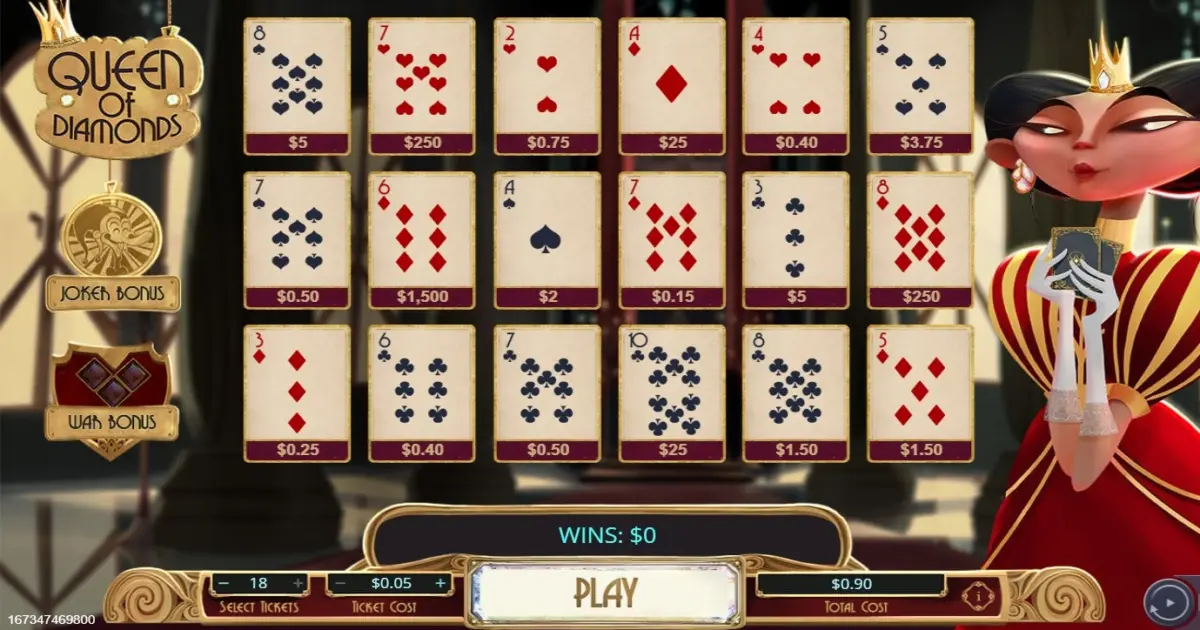
Queen of Diamonds Scratch Card is a one-reveal ticket from NeoGames that suits you if you want an instant result with no reels or rounds to follow. It is worth a try in free demo if you enjoy low-friction scratch play and want to see the paytable structure for yourself, but like every scratch ticket it offers no way to influence the outcome once you buy in. The queen of diamonds scratch card is decided the moment it is generated, so your only decision is whether and when to purchase the next ticket.
What kind of scratch card is queen of diamonds scratch card?
Queen of Diamonds is listed as a Scratch cards title from NeoGames, a studio with 33 games in this corpus and a strong focus on lottery-style products. It sits at rank 23 in the current popularity ordering, placing it in the 92.3rd percentile, which suggests many players have at least sampled it in demo or real-money lobbies where NeoGames is distributed. That placement does not tell you anything about its generosity, only that it sees regular traffic.
As a digital scratch card, it works like a printed ticket. You buy in once, you reveal the panel or panels on screen, and the result is already determined. There is no spin to watch, no hand to play out, and no decision to hold or cash out mid-round. The scratching animation is a presentation layer over a pre-generated outcome, exactly as physical tickets are printed before they are sold.
The FACTS block for this review does not include a theme label, ticket price, number of reveal zones, top prize, or a description of the artwork beyond the name itself. That limits what can be said specifically about presentation. You should not assume a crown-and-gem visual treatment or a bonus pick game just because the title suggests royalty and diamonds; unless the in-game rules or paytable screen shows extra features, treat the product as a plain ticket with a single reveal.
What is confirmed is availability. A free demo version is listed as available, so you can open the ticket, read its own rules screen, and see how many panels it uses and how winners are defined without spending. Use that preview to confirm the mechanics that matter: how many matching symbols are needed, whether there are multiple ways to win on one ticket, and what the buying-in cost will be when you switch to real money.
The maths behind a single ticket
Every digital scratch ticket is independent and pre-generated. When you click to buy, the system has already selected whether that ticket is a winner and, if so, which prize tier it belongs to. Scratching the surface does not change anything and does not create suspense in a mathematical sense; it only reveals what was chosen a moment earlier.
The return to player for a scratch product is fixed at design time. The studio decides how many tickets in a very large batch fall into each prize tier, from small returns up to the top award, and the aggregate of all those tiers produces the overall RTP for the batch as a whole. This is lottery-style maths, not a spinning-reel model where hit frequency and reel weights create volatility around a separate RTP. For scratch cards the two concepts are the same thing: the distribution of prizes is the RTP.
That matters because there is no way to nudge the odds on the ticket you are about to buy. There is no bet sizing within the ticket, no hold, no bonus gamble, and no timing trick that makes the next purchase more likely to win. Because each ticket is independent, a run of losing tickets does not make the next one more likely to pay, and a win on the previous ticket does not make the next one less likely. The batch design is statistical, not sequential.
For you as a player, the practical effect is session-based, not ticket-based. Your experience in a short session is dominated by variance around the published design. You might see nothing for many tickets, or you might hit a mid-tier prize quickly; neither outcome says anything about the theoretical return, which only emerges over a very large number of tickets.
Where the RTP comes from
This provider has not published a return-to-player figure for this ticket, which is common for scratch cards since it depends on the whole prize-tier design — check the game’s own rules or paytable screen before you buy in. The FACTS block carries no RTP for Queen of Diamonds, and no ticket price or prize ladder to infer it from, so no specific percentage can be quoted here.
When a figure is published, it should be read as the average return across an enormous batch of tickets, not as a promise for your next purchase. If a batch is designed to return 85% overall, that means for every 100 units staked across many thousands of tickets, 85 units are returned as prizes in aggregate. It does not mean you will get 85 back from a single ticket, or that you will approach that average in a single sitting.
Where figures are unpublished, the best proxy is the information screen inside the game itself. Regulated markets usually require the ticket’s rules or help file to disclose the theoretical RTP, the prize table, and the odds of each tier. Open the demo and look for that page first. If it is not there, the operator’s game information sheet should list it before you deposit.
A house average helps frame expectations while you look. Across the broader corpus of games referenced here, the average RTP is 87.84%. That number does not apply to this specific ticket and should not be quoted as its return; it is only context for how lottery-style instant games typically price compared with video slots, which often publish higher theoretical returns but deliver them through very different volatility models. The honest position for Queen of Diamonds is that its own batch design is unquoted in the data supplied for this review.
Reading the rules before you buy in
Because the purchase is the only decision, reading precedes playing. Open the demo and find the paytable. It should state the ticket cost, the number of reveal zones or panels on the card, how winners are determined, and whether more than one prize can be won on the same ticket. Where FACTS gives a reel-like count for some games, treat it here as the count of reveal zones on the card rather than borrowing slot language.
For Queen of Diamonds, the number of reveal zones is not included in the facts supplied, so you will need to count them on screen. Note whether the win condition is matching three symbols, revealing a specific icon, or accumulating a total; different scratch products define this differently, and the paytable is the only reliable source.
Check also for any secondary reveal described as a bonus. Many digital scratch products layer a small pick-a-prize or bonus reveal on top of the base ticket for presentation — treat this as something some scratch games do in general, never as a feature of this specific card unless the theme, description or FACTS supports it. For this title, no such feature is documented in the facts, so do not expect one until the rules confirm it. Assuming a bonus exists because other scratch cards have one leads to misreading the ticket.
Finally, confirm currency, stake, and auto-play behaviour if offered. Some lobbies allow rapid re-buys that make it easy to work through tickets faster than intended. Setting a viewing distance from the game, confirming the stake denomination, and deciding in advance how many tickets constitute a session keeps the format’s speed from running ahead of your budget.
How Queen of Diamonds compares to other tickets
Comparison is most useful within the same provider, because NeoGames tends to reuse batch structures and interface patterns across its catalogue. If you have played Shamrock Winnings you will recognise the purchase-and-reveal loop, though Shamrock Winnings has its own prize distribution and should not be assumed to pay the same as Queen of Diamonds. Use familiarity with the interface to read the new paytable faster, not to predict results.
Fiesta Payout is another NeoGames ticket that helps illustrate the range. Even when two tickets look similar on the surface, their batch maths can differ materially in how many small tiers exist, whether the top prize is rare or relatively reachable, and what proportion of the return is concentrated in low-tier wins. Only the rules screen inside each game answers that.
A third point of reference in the same stable is Sunset Winnings, which again shares the studio’s scratch format while carrying its own undisclosed RTP in the data supplied here. Putting Queen of Diamonds alongside these siblings makes the right point: the differentiator between scratch cards is not strategy or feature depth but price point, prize ladder, and published return, all of which you verify per ticket rather than per studio.
Because there is no theme count matched to this title and no published RTP to rank it against peers on value, the comparison stays at the format level. If you prefer a ticket with an explicitly published return, filter the lobby for NeoGames scratch cards that disclose their figure up front and compare that disclosure with what Queen of Diamonds shows in its own help file. Popularity ranking — 23rd in this set — reflects sampling, not generosity, and should not be used as a value signal.
| Detail | Value |
|---|---|
| Game name | Queen of Diamonds |
| Provider | NeoGames |
| Category | Scratch cards |
| Provider catalogue size | 33 games |
| Popularity rank | 23 (92.3rd percentile) |
| Free demo | Available |
| RTP | Not published in supplied facts — check in-game rules |
Free demo and staying in control
The free demo listed for Queen of Diamonds is the sensible place to start. It lets you confirm the ticket price, the win lines, and the prize table without commitment, and it shows you the reveal pace so you know how quickly tickets resolve. Remember that demo play uses the same visual presentation but does not predict real-money outcomes; the random generation in demo is for illustration and learning the paytable, not a forecast of what a paid batch will deliver.
The scratch format is fast and inexpensive to repeat, which is precisely why a budget plan matters. Decide before you open the lobby how many tickets you will buy, what each ticket may cost, and when you will stop regardless of results. That is not strategy in the sense of changing the odds — nothing you do changes the odds of the next ticket — it is session management to keep entertainment costs within a limit you set in advance.
Only play with money you can afford to lose, treat each purchase as paying for entertainment rather than investing toward a win, and keep it 18+ at all times. Take breaks, avoid chasing losses, and use deposit and session limits where they are available. If you ever feel play is no longer fun, pause and seek support from the responsible-gambling tools offered by the operator or from an independent advice service in your jurisdiction.
Final verdict
Queen of Diamonds does what scratch cards do: one purchase, one instant outcome, no decisions in between. Its appeal will be the simplicity of that loop and the convenience of a NeoGames ticket that many players already know how to read. The popularity rank in the 92nd percentile suggests it is easy to find and frequently sampled, but that is not a statement about value.
The limitation for a reviewer is the lack of published specifics. Without an RTP, prize ladder, or ticket price in the supplied facts, the only honest verdict is conditional. If the in-game rules disclose a return and prize structure you are comfortable with, and the ticket price fits the budget you set before you play, it can serve as a straightforward instant ticket to try in short sessions. If the rules screen is vague or the batch return is not stated where you can see it, hold off until you can verify it.
Try the free demo first, read the paytable carefully, and measure the game by what that screen actually promises rather than by the name on the card. In a category where every ticket is independent and pre-generated, that single check is the most useful evaluation you can make.
Frequently Asked Questions
Is there a free demo for Queen of Diamonds Scratch Card?
Yes, the facts list a free demo as available. Use it to open the ticket, count the reveal zones, read the paytable and see how winners are defined before staking real money. Demo outcomes do not predict paid results; they are for learning the ticket structure.
What is the RTP of Queen of Diamonds and what does it mean for a scratch card?
No RTP is published in the supplied facts, so no figure can be quoted here — check the in-game rules screen. For scratch cards the RTP is the average return across a very large batch of tickets determined by the prize-tier distribution, not a per-ticket guarantee.
Can I use strategy or timing to improve my odds on Queen of Diamonds?
No. Each ticket is independent and the outcome is generated when you buy in; scratching only reveals it. There are no holds, cash-outs or mid-round choices that change the odds. The only useful plan is bankroll management: set a ticket limit and stop point in advance.
Who makes Queen of Diamonds Scratch Card?
NeoGames, a provider with 33 games in the referenced corpus and a specialty in lottery-style instant products. Queen of Diamonds is categorised as Scratch cards and ranks 23rd by popularity, in the 92.3rd percentile for sampling.
How does Queen of Diamonds compare with Fiesta Payout?
Both are NeoGames scratch tickets with the same one-purchase, instant-reveal loop, but each has its own undisclosed prize distribution and ticket price. Fiesta Payout is useful for learning the interface pattern, but its paytable does not predict Queen of Diamonds outcomes — compare their published rules side by side.