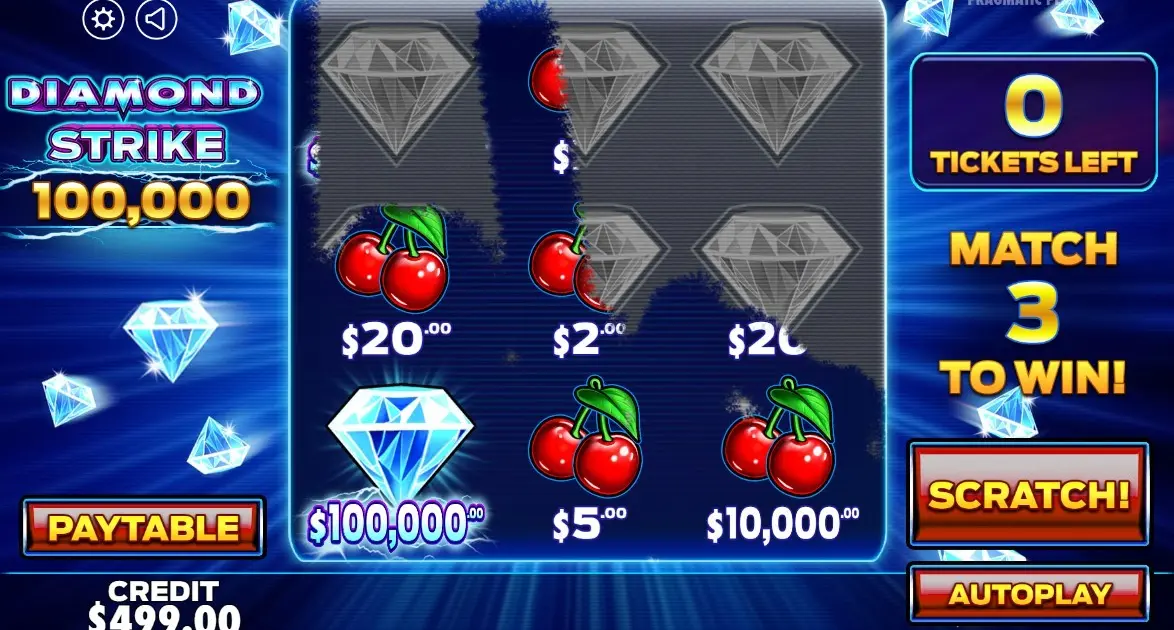
Diamond Strike Scratchcard is worth a try if you want the fastest possible casino format with no learning curve — you buy a ticket, reveal, and you either win or you do not. There are no reels to follow and no decisions after purchase, which makes it easy to sample in demo before you decide anything. The diamond strike scratchcard scratch card comes from Pragmatic Play in a Gems and diamonds theme, and like most digital scratch products its appeal is simplicity, not depth.
diamond strike scratchcard scratch card at a glance
Diamond Strike Scratchcard is a digital scratch card from Pragmatic Play, listed under the Scratch cards subcategory with a Gems and diamonds theme. It sits at rank 12 in its current sorting with a popularity percentile of 96.1, which suggests it is one of the more frequently encountered scratch products in lobbies despite the format being far smaller than slots. Pragmatic Play lists 7 titles in this scratch format in the available data, and this is one of 3 games sharing the Gems and diamonds theme, so you will see familiar visual cues carried across the studio’s scratch range.
No return-to-player figure, ticket price, top prize or prize-tier breakdown has been published in the FACTS for this specific card. That absence is normal for scratch cards, where the RTP is a property of the entire prize distribution across a large batch of tickets rather than a single spin mechanic, and some providers surface it only on the in-game rules screen. Similarly, the number of reveal zones or panels on this card is not listed in the available data, so treat any panel count you see in a lobby thumbnail as presentation until you open the actual paytable. Free demo is available, which lets you see the reveal flow, check the help screen for any RTP or odds information the studio has included, and decide if the one-reveal pace suits you without any purchase.
| Detail | Value |
|---|---|
| Game name | Diamond Strike Scratchcard |
| Provider | Pragmatic Play |
| Type | Scratch cards |
| Theme | Gems and diamonds |
| Free demo | Available |
| RTP | Not published in available data |
If you like the same studio’s instant format, you can compare it quickly with Wolf Gold Scratchcard to feel how Pragmatic Play handles pacing and presentation across its scratch range, or look at Diamond Rush if you want another Gems and diamonds option with a different prize structure.
How a digital scratch card actually works
A digital scratch card works like a printed ticket. The outcome is generated the instant you buy in. Everything you do on screen afterwards — dragging to scratch, tapping to reveal, watching panels clear — is just animation over a result that already exists. You are not uncovering numbers that are still being decided, and you are not influencing anything by the order or speed of the scratch.
That makes the format different from a slot. A slot uses a reel RNG on every spin and builds features such as free spins or hold-and-win around ongoing random events. A scratch card uses a lottery-style batch model. The studio designs a very large set of virtual tickets with a defined distribution of winners, losers and prize levels, and the published or unpublished RTP is the average return across that whole batch. Your single purchase is a draw from that distribution, independent of every other ticket.
There is exactly one decision per play: whether to buy the next ticket and at what stake the game offers. There is no hold, no cash-out, no bet adjustment mid-round and no choice that changes the odds of the ticket you just bought. Some digital scratch products add a small bonus reveal or pick-a-prize moment for presentation, but treat that as something the format sometimes does in general, not a feature of this specific card unless the rules screen shows it. Because each ticket is independent and pre-generated, a run of losses or wins on previous tickets tells you nothing about the next one — there is no reel pattern or shoe to read.
What RTP means for a one-reveal game
This provider has not published a return-to-player figure for this ticket in the available data, which is common for scratch cards since the figure depends on the whole prize-tier design — check the game’s own rules or paytable screen before you buy in. Where a scratch RTP is published, it describes the theoretical average returned to players across the entire batch of tickets over a very large number of purchases, not what will happen in your session.
For a one-reveal game that distinction matters more than usual. In a slot, RTP is realized over millions of spins with many small hits and occasional features smoothing the experience. In a scratch card, the distribution is more binary: many tickets return zero and a smaller number return a prize tier. The average only emerges across the batch, so short-term results swing widely around it. You cannot use the figure to predict whether the next three or thirty tickets will win.
For comparison, the broader corpus average RTP in the data set sits at 87.84, and related Gems and diamonds scratch cards such as Diamond Rush and Ruby Rush are listed at 59.21 and 59.2 in the available reference data. Those numbers are not the figure for Diamond Strike Scratchcard and should not be read as a proxy for it. They simply illustrate that scratch batches often carry a lower theoretical return than many video slots, reflecting the lottery-style prize funding. Until you see a figure on the official help screen for this exact card, assume you are playing without a published average and weigh the ticket purely as paid entertainment with a fixed cost per reveal, not as a value calculation you can optimize.
Prize tiers and what a win looks like here
No prize tiers, paytable values or top prize amount are listed for Diamond Strike Scratchcard in the available FACTS, so this section cannot describe its specific winning combinations without inventing detail. In general, a digital scratch card defines wins by matching symbols or revealing a set number of identical icons across its panels, with each prize tier funded from the batch design. The game then pays the tier that corresponds to the pre-generated result.
What you will see on screen is therefore a reveal of that result, not a contest you can influence. If the ticket is a winner, the paytable highlights the tier you have hit; if it is not, the panels simply show a non-winning combination and the round ends. There is no second chance within the same ticket unless the rules screen explicitly describes a bonus reveal, and you should not assume such a mechanic exists for this card because the data does not confirm it. The ticket price, where it is variable, is set before purchase and does not change the underlying tier structure except to scale the prize if the rules say so.
The most useful step before you play is to open the in-game rules and paytable. That screen is the only reliable place to confirm how many matching symbols are needed, whether any instant-win symbol exists, how many tiers are paid, and what each tier returns at your chosen stake. Without that, any discussion of high versus low wins would be guesswork. Treat the ticket as a single-outcome purchase: you pay to reveal, you see the tier or a loss, and you decide whether to buy another.
Why there is no real strategy, and that is fine
There is no strategy that changes the odds of the ticket you are about to buy. The outcome is pre-generated when you purchase, the prize distribution is fixed at design time across the batch, and there are no in-round choices such as holding symbols, adjusting bets or timing a cash-out that alter the result. Buying more tickets does not make the next ticket more likely to win, buying quickly or slowly does not influence the generator, and switching stake does not change the randomness — it may only scale prizes if the paytable is stake-proportional.
That leaves only bankroll and session management, which is honest but limited. Decide in advance how many tickets fit the entertainment budget you have set, treat the cost as the price of the reveal rather than an investment expected to return, and stop when that budget is reached regardless of whether the last ticket won or lost. Because the loop of purchase and instant reveal is fast and inexpensive to repeat, it is easy to lose track of how many tickets you have bought — setting a count or time limit before you start is more effective than any in-game tactic.
The lack of depth is not a flaw in the format; it is the point. Scratch cards are designed for players who want an immediate outcome without learning paylines, volatility models or bonus rules. If you enjoy studying mechanics, comparing feature frequencies or adjusting play based on what happened last spin, a slot will offer more to analyze. If you prefer a clean buy-and-reveal interaction where the result is known in a second and you move on, the format delivers exactly that. You might sample Gold Rush Scratchcard alongside this one to see how little the core interaction varies from card to card, which helps keep expectations realistic about what any single ticket can provide.
Playing the Diamond Strike Scratchcard demo
Playing the Diamond Strike Scratchcard demo is straightforward and requires no download where free play is offered. The demo loads the same reveal presentation you would see in the paid version, letting you check the theme, the speed of the scratch animation and the location of the rules or paytable button. It is the best place to verify whether an RTP figure, prize tiers or help text are shown inside the game itself when the external data does not list them.
Use the demo to answer practical questions: how many taps or drags to reveal, whether you can reveal instantly, where wins are highlighted, and how the stake selector works if the lobby offers one. This is also where you confirm any bonus-style reveal — if the help screen does not describe one, assume the ticket is a single reveal with no extra round. Demo play is useful for familiarity, but it does not predict real-money outcomes. Each ticket’s result is independent, and seeing a cluster of wins or losses in free play tells you nothing about the next paid ticket.
Set a budget in advance and treat scratch play as entertainment you pay for, not a way to make money. Only spend what you can afford to lose, decide how many tickets that covers before you start, and take regular breaks — the rapid purchase-and-reveal cycle can make spending feel faster than it is. You must be 18+ to play. If you ever feel you are chasing results or spending beyond your plan, use the deposit limits or timeout tools offered by the casino and seek support from a responsible-gambling service in your jurisdiction.
Verdict: who should try Diamond Strike Scratchcard
Diamond Strike Scratchcard suits players who want instant outcomes, a clear Gems and diamonds presentation from a well-known scratch provider, and no mechanics to learn. If that one-reveal simplicity appeals to you, it is worth a few tickets in demo first to see the pacing and to check the in-game help for any missing details such as RTP or prize tiers before you consider paid play.
It is less suited to players looking for strategic decisions, evolving features or long session depth. There is no way to influence the odds, no reel set to study, and no in-round choices that reward practice. The value is in the immediacy, not in optimizing play.
Compared with other instant games in the same lobby, this card stands on the same fundamentals as any scratch product from Pragmatic Play — the difference between cards is mostly theme and prize distribution, not how you interact with them. Sampling 7 Piggies Scratchcard can show how the studio re-skins the format while keeping the purchase-and-reveal loop identical, and Ruby Rush offers another Gems and diamonds reference point if you want to compare presentation. Overall, try Diamond Strike Scratchcard in demo if you enjoy low-friction, lottery-style play and are comfortable buying entertainment one ticket at a time with no expectation of return.
Frequently Asked Questions
Can I play Diamond Strike Scratchcard for free?
Yes, free demo is listed as available for this card and no download is required where your casino offers it. Demo lets you see the reveal animation and open the in-game rules to check for any RTP or prize-tier details that are not published externally, but it does not predict real-money results.
What RTP does Diamond Strike Scratchcard have and what does it mean for a scratch card?
No RTP is published for Diamond Strike Scratchcard in the available data, which is common for scratch batches. When a scratch RTP is shown, it is the theoretical average return across a very large batch of tickets with a defined prize distribution, not a prediction for your next ticket. Check the in-game help screen for any figure the provider displays.
Is there any strategy or timing that improves my odds on Diamond Strike Scratchcard?
No. The outcome is generated the instant you buy the ticket and the reveal is just animation over that result. There are no in-round decisions, and buying more tickets, changing speed or switching stake does not change the odds of any single ticket. Your only controls are bankroll and session limits.
Who makes Diamond Strike Scratchcard?
Diamond Strike Scratchcard is by Pragmatic Play, a studio with 7 scratch cards in the referenced data set. It uses a Gems and diamonds theme and sits in the Scratch cards subcategory. The studio's scratch products share the same one-reveal lottery model, differing mainly in presentation and prize distribution.
How does Diamond Strike Scratchcard compare to Diamond Rush?
Both share a Gems and diamonds theme, but Diamond Rush is listed with an RTP of 59.21 in the related data while Diamond Strike Scratchcard has no published RTP in the available facts. Mechanically both are one-reveal scratch cards, so the comparison is mostly visual and prize-structure based — check each game's paytable directly.