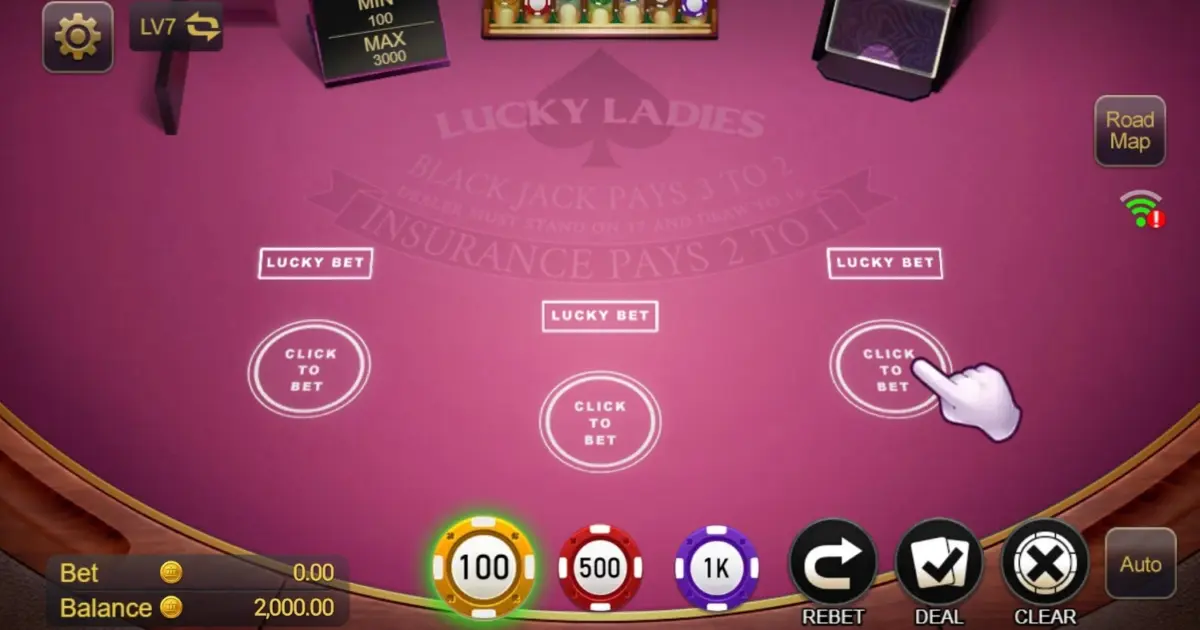
Blackjack Lucky Ladies from TaDa Gaming occupies an odd slot: a single-table entry whose name points to a well-known side bet rather than a rule variant. The base-game mathematics are the same as any blackjack, but the missing return figure and undocumented core rules are genuine gaps you need to navigate before playing for money.
How Blackjack Lucky Ladies plays
You start each hand as you would at any standard blackjack table: you are dealt two cards, the dealer reveals one, and your objective is to beat the dealer’s total without busting past 21. TaDa Gaming has not published the number of decks in use here, the blackjack payout ratio, or whether the dealer hits or stands on soft 17. Each of those three variables can shift the house edge by roughly 0.2 to 1.4 percentage points depending on the setting chosen, so their absence is not academic.
The game is available as a free demo, which means you can spend time in the rules screen and the paytable before committing any budget. Visual presentation and interface details are not specified in our data either. What is clear is that this sits in the Black Jack subcategory and runs as a table game against an RNG rather than a live dealer stream. If you are familiar with any other digital blackjack, the core loop will feel the same; the open questions are in the rules that govern the edge. For comparison, Classic Blackjack lists its own rule set openly, which makes evaluating that table far more straightforward.
Lucky Ladies rules and what the name tells you
The name “Lucky Ladies” is not a rule variant in the way “European Blackjack” or “Single Deck” names a structural family. It is the trademarked title of a specific side bet that originated in the Shuffle Master portfolio and has since been licensed to multiple game studios. In its classic form, the Lucky Ladies side bet pays a large fixed payout when your first two cards total 20 and include at least one queen of hearts; lesser payouts apply for other 20-value hands and for paired tens.
If this is what TaDa Gaming has implemented—and the name strongly implies it is—the side bet carries a house edge typically in the 20 to 25% range. That is severe. The base game’s edge remains unaffected; the side bet is a separate wager placed alongside your main bet. Because our available data does not confirm which side bets are actually live at this table, you should treat the name as a strong hint and verify in the game’s own paytable before staking any money. If you cannot find the paytable before playing, the safest assumption is that the side bet exists and you should simply not place it.
Reading the return-to-player figure
TaDa Gaming does not publish a specific RTP for this table. The figure of 99.41% that appears alongside blackjack games on this site is a corpus average across all tables in the category, not a measured return for this game. Do not use it as a substitute. A real RTP tells you what a theoretically perfect player earns back over millions of hands; an average across many different games tells you nothing about the one you are about to sit down at.
In the absence of a game-specific figure, your best approach is to identify the base rules from the in-game information screen—deck count, blackjack payout, dealer soft-17 behaviour, surrender availability—and calculate the implied house edge yourself using published strategy references. If the game offers only standard rules (four to eight decks, 3:2 blackjack, dealer stands on soft 17, double after split allowed), the house edge sits near 0.5% and the RTP is approximately 99.5%. If it uses 6:5 blackjack or lets the dealer hit soft 17, those numbers deteriorate by roughly 1.4% and 0.2% respectively. The critical caveat applies to every figure: it assumes perfect basic strategy on every hand. A casual player making even occasional errors will realise a materially lower return.
Where the house edge actually comes from
The house edge in blackjack is not a single number—it is the sum of several independent rule choices. The table below shows what our available data confirms and does not confirm about this specific entry. Where a field is absent, you must fill it in from the game’s own rules screen before you can calculate a reliable edge.
| Parameter | Status in published data |
|---|---|
| Provider | TaDa Gaming |
| Game-specific RTP | Not published |
| Number of decks | Not published |
| Blackjack payout | Not published |
| Dealer soft-17 rule | Not published |
| Side bets offered | Not published (name implies Lucky Ladies) |
| Free demo | Available |
The most damaging single omission is the blackjack payout ratio. A 6:5 return on blackjack instead of the standard 3:2 costs the player roughly 1.4 percentage points of edge in one stroke. The next most significant unknowns are the deck count (more decks slightly increase the edge, typically by a few hundredths of a percent) and whether the dealer hits soft 17 (worth about 0.2 percentage points). For a table where these details are absent, American Blackjack provides a useful benchmark with a published 99.5% RTP, allowing you to compare what transparent documentation looks like.
Does card counting work here?
No. This is an RNG-based table, which means the software reshuffles the shoe—or equivalently, assigns each hand independently—after every single deal. Card counting works by tracking the ratio of high to low cards remaining in a finite shoe and raising your bet when that ratio favours the player. When the shoe resets every hand, that ratio resets to the uncut average, and the count never carries forward. There is no strategy, system, or betting progression that changes this fundamental fact about RNG blackjack.
If you see any product marketed as a “winning system” for online blackjack, it is selling you something that mathematics does not support. Betting progressions like Martingale or D’Alembert change the shape of your variance—you will experience longer sequences of small losses punctuated by rare large swings—but they do not change the expected value, which is set by the house edge. Blackjack by Mascot Gaming carries the same RNG limitation, and its published 99.5% RTP is not an opening for counting either.
Bankroll and unit sizing
Because the core rules of this table are undocumented, you should treat its variance as uncertain until you have read the in-game rules screen. Once you have, standard bankroll principles apply. For a blackjack table where you will make your own decisions, a session bankroll of 50 to 100 betting units is reasonable at basic-strategy level: low enough that a normal swing does not wipe you out, high enough that you will see the game’s character over an evening. A unit is typically 1 to 2% of your total gambling budget for the month.
Set a hard loss limit and a hard win target before you begin each session, and stop when you hit either one. Blackjack Lucky Ladies is a game for 18 and over. It is entertainment with a cost, not a source of income. If you find yourself chasing losses or extending a session past your intended end point, that is a signal to step away. Many jurisdictions provide free helplines; using them is a sign of competence, not weakness.
Verdict
Blackjack Lucky Ladies is a playable base-game blackjack wrapped in significant transparency gaps. TaDa Gaming has not published the deck count, the blackjack payout, or the soft-17 rule, and the name signals a side bet that carries a house edge far exceeding the base game. None of that means the table is rigged or deliberately hostile—it may well use standard rules under the surface—but it does mean you cannot verify the edge from the outside. If you decide to play, do so at the free demo first, document every rule you find in the paytable, calculate your own implied edge, and treat the side bet as a separate wager with odds no better than a slot. For players who want full transparency before committing money, the related tables linked above publish their RTPs and rule sets openly.
Frequently Asked Questions
Can I play Blackjack Lucky Ladies for free?
Yes. TaDa Gaming offers a free demo version of this table, which means you can play through the rules screen, test the interface, and observe the game's behaviour without risking any money. The demo is available directly on this review site.
What is the RTP for Blackjack Lucky Ladies?
TaDa Gaming does not publish a table-specific RTP for this game. The 99.41% figure shown on this site is a corpus average across all blackjack tables and does not represent this game's return. Any RTP figure assumes perfect basic strategy on every hand, so a casual player's realised return will be materially lower.
Is the Lucky Ladies side bet worth playing?
Almost certainly not. The name signals a Lucky Ladies side bet, which in its classic form carries a house edge in the 20 to 25% range. That is roughly 40 times costlier than playing the base game with basic strategy. Unless you specifically want the variance of that single wager, skip it and play the base game alone.
Does card counting work at Blackjack Lucky Ladies?
No. This is an RNG-based table that resets its deck composition after every hand, so there is no running count to exploit. No betting system, progression, or strategy changes the expected value set by the house edge. Card counting requires a finite shoe that is not reshuffled between hands.
How does Blackjack Lucky Ladies compare to American Blackjack?
American Blackjack by the same category lists a published 99.5% RTP, while Blackjack Lucky Ladies has no specific RTP disclosed. Both are RNG tables where card counting is ineffective. The key practical difference is transparency: with American Blackjack you can verify the edge from published data, whereas with this table you must read the in-game rules screen yourself.




