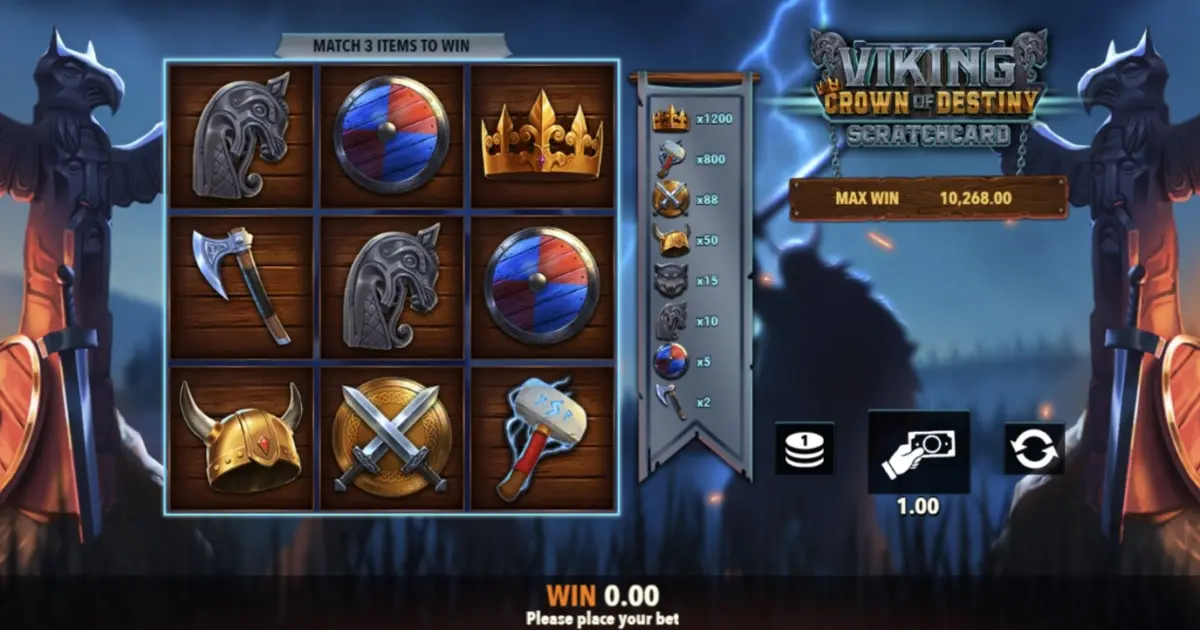
Viking Crown Scratchcard is a FlipLuck Games ticket that sits near the lower end of the RTP spectrum for digital scratch products, with a published 70.24% figure that tells you upfront how the prize pool is distributed across the batch. The free demo lets you test the reveal animation and theme without staking real money, which matters here because the 70.24% RTP is 17.6 percentage points below the corpus average of 87.84% and firmly below what most slot players expect. If you are deciding whether this card is worth a try, the RTP is the single most decision-relevant number, and this one is honest about the fact that scratch cards as a format typically return less to players than spinning-reel games do.
Viking Crown Scratchcard and the FlipLuck Games ticket range
FlipLuck Games publishes twenty scratch card titles, and Viking Crown Scratchcard sits squarely in the middle of that range with its 70.24% RTP, just three hundredths of a point above the provider’s 70.21% average. That consistency tells you FlipLuck designs its entire ticket catalogue around the same prize-tier philosophy—none of their cards are significantly more generous than the others. Within the same stable you will find Journey of Ra Scratchcards, which publishes a 95.5% RTP and stands as an outlier in the FlipLuck range, and Kings of War Scratchcard at 69.84%, which runs even tighter than Viking Crown. If you are considering a FlipLuck card, compare the RTP figures directly—the gameplay and reveal structure are broadly similar across the range, so the payout percentage becomes the primary differentiator.
| Detail | Value |
|---|---|
| Provider | FlipLuck Games |
| RTP | 70.24% |
| Theme | Viking / Norse |
| Free demo | Yes |
| Provider average RTP | 70.21% |
The 70.24% figure and how it was built
The 70.24% return-to-player is not a spin-by-spin hit frequency the way a slot’s RTP works—it is the percentage of all stakes, across a very large batch of virtual tickets, that the studio has allocated to prizes. When FlipLuck Games designed Viking Crown Scratchcard they decided how many tickets in the batch would be losers, how many would pay small wins, and how many would hit mid-tier or top-tier prizes, then published the 70.24% figure as the weighted average payout. That number is fixed at design time and applies to the batch as a whole, not to any individual session. A scratch card is a lottery-style product: your ticket’s outcome was generated the instant you bought in, and the on-screen scratching animation is just a reveal of a result that already exists.
The 70.24% RTP is 17.6 percentage points below the 87.84% corpus average for digital casino games, which reflects the fact that scratch cards as a format typically return less than slots or table games do. FlipLuck has published the figure, which is more transparent than many scratch card studios manage, but the number itself is low enough that you should treat every ticket as entertainment you pay for rather than a realistic path to profit. The prize-tier structure that produces this RTP is not disclosed in the FACTS available, so you cannot see exactly how the 70.24% is distributed across winning ticket tiers—check the game’s own rules or paytable screen before you buy in if you want to understand where the big prizes sit and how rare they are.
What actually happens when you buy a ticket
When you buy a Viking Crown Scratchcard ticket, the outcome is generated the instant the transaction completes—there is no spin, no reel set, no round-by-round decision to make. The game server draws a result from the batch of virtual tickets according to the prize-tier structure FlipLuck Games designed, assigns it to your purchase, and sends it to your screen. What you see next is a reveal animation that layers the Viking Crown theme over the result. The scratching motion, the panel-by-panel uncover, the sound effects—all of this is presentation, not a process that determines the outcome. Your ticket is a winner or a loser the moment you buy it, exactly like a physical printed scratch card you would pick up at a shop counter.
This structure means there is no strategy that changes the odds of the ticket you are about to buy. You cannot time your purchase to hit after a losing streak, you cannot read the previous ticket’s result to predict the next one, and you cannot alter the outcome by scratching panels in a particular order. Every ticket is independent, drawn from the same batch, governed by the same 70.24% RTP. The only purchase decision you make is whether to buy in at all, and that decision should rest entirely on whether the published RTP and the ticket price fit the entertainment budget you set before you started.
Reveal zones, panels and what they mean here
The FACTS available for Viking Crown Scratchcard do not specify how many panels or reveal zones appear on the ticket face, which is common for scratch card products since the reveal structure varies widely from one title to the next and the count does not affect the RTP or the odds. A digital scratch card’s panels are visual zones that uncover symbols, numbers or prize amounts when you click or swipe them—the count and layout are part of the theme presentation, not the payout maths. Whether a card has three panels or twelve, the outcome is still generated at purchase time and the RTP is still fixed by the batch’s prize-tier design.
For Viking Crown Scratchcard specifically, the panel count and reveal structure will be visible the moment you load the free demo, and that is the best way to see exactly how the ticket presents itself. If the card layers a bonus mini-game or pick-a-prize round on top of the base ticket—something many digital scratch products do for presentation—treat that as a themed reveal animation rather than a second chance to change your result. The mini-game is still showing you the outcome that was generated when you bought in, just dressed up in an extra step.
Variance in scratch cards versus slots
Variance as a concept applies differently to scratch cards than it does to spinning-reel slots. A slot’s variance describes how the game distributes its RTP across frequent small wins and rare big wins over many spins within a single session—high-variance slots pay less often but hit harder, low-variance slots pay more often but lighter. A scratch card, by contrast, is a one-reveal product: you buy a ticket, you see the result, the round is over. There is no spin-by-spin rhythm to describe, no hold or cash-out decision to make, no bonus trigger you build toward across multiple rounds. The variance that matters for a scratch card is the prize-tier structure across the entire batch of tickets, not the rhythm of a single session.
For Viking Crown Scratchcard, the 70.24% RTP tells you that 70.24% of all stakes across the batch go into prizes, but it does not tell you whether that 70.24% is spread across many small wins or concentrated in a few large ones. FlipLuck Games has not disclosed the prize-tier breakdown, so you cannot see whether this card skews toward frequent modest payouts or rare top-tier hits. The practical difference for you as a player is that a card with most of its RTP in small prizes will deliver more winning tickets but lower individual returns, while a card with most of its RTP in large prizes will deliver mostly losing tickets but occasional big wins. Either structure can produce the same 70.24% RTP—the batch maths work out the same way—but the session experience feels very different. Check the paytable screen or rules before you buy in if you want to understand where the prizes sit.
Playing responsibly
Set a scratch card budget in advance and treat it as entertainment spending, not income. The 70.24% RTP means the batch as a whole returns less than three-quarters of stakes as prizes, and because each ticket’s outcome is independent and pre-generated, a losing streak does not make the next ticket more likely to win. The purchase-and-reveal loop is fast and cheap to repeat, which makes it easy to spend more than you planned if you chase losses or buy in after every losing ticket hoping the next one will hit. Walk away when you hit your budget limit, and never stake money you need for bills, savings or other commitments. This is entertainment you pay for, 18+, and the free demo lets you test the card without risking real money—use it.
Verdict on Viking Crown Scratchcard
Viking Crown Scratchcard is a FlipLuck Games ticket with a 70.24% RTP that sits firmly below the corpus average and reflects the lottery-style payout maths that govern scratch cards as a format. The free demo is available, which matters because the RTP is low enough that you should see the reveal structure and theme before you stake real money. If you are deciding whether this card is worth a try, the 70.24% figure is the most decision-relevant fact—it tells you upfront that the batch returns less than three-quarters of stakes as prizes, and FlipLuck’s consistent RTP across their twenty-card range means this is the payout percentage you can expect from most of their products. Play Symbols of Luck if you want a FlipLuck card with an even lower RTP, or look to Journey of Ra Scratchcards if you want the provider’s highest published figure. Viking Crown Scratchcard is a middle-of-the-range ticket from a studio that designs its entire catalogue around similar payout structures, and the 70.24% RTP is the number you should weigh against your entertainment budget before you buy in.
Frequently Asked Questions
Is there a free demo for Viking Crown Scratchcard?
Yes, Viking Crown Scratchcard offers a free demo that lets you test the reveal animation and theme without staking real money. The demo is the best way to see exactly how many panels appear on the ticket and whether any bonus mini-game layers on top of the base reveal. Because the published RTP is 70.24%—firmly below typical slot standards—the free demo is especially useful here, as it lets you preview the card before deciding whether the payout structure fits your entertainment budget.
What does the 70.24% RTP mean for this scratch card?
The 70.24% RTP means that across a very large batch of Viking Crown Scratchcard tickets, 70.24% of all stakes have been allocated to prizes and 29.76% is retained by the house. This figure is fixed at design time by how FlipLuck Games distributed winning tickets across the batch—it is a lottery-style payout structure, not a spin-by-spin hit frequency. For context, the 70.24% RTP is 17.6 percentage points below the 87.84% corpus average for digital casino games, which tells you this card returns less than three-quarters of stakes as prizes.
Can I improve my odds by timing when I buy a ticket?
No. Every Viking Crown Scratchcard ticket's outcome is generated the instant you buy in, drawn independently from the same batch according to the same 70.24% RTP. A losing streak on previous tickets does not make the next ticket more likely to win, and you cannot read earlier results to predict what comes next. There is no timing, no hold decision, no bet adjustment—the only choice you make is whether to buy in at all, and that choice should rest entirely on whether the RTP and ticket price fit your budget.
How does FlipLuck Games compare to other scratch card providers?
FlipLuck Games publishes twenty scratch card titles with an average RTP of 70.21%, and Viking Crown Scratchcard sits right in the middle of that range at 70.24%. The consistency across the provider's catalogue tells you FlipLuck designs all their cards around the same prize-tier philosophy—none are significantly more generous than the others. Journey of Ra Scratchcards is the outlier at 95.5%, while most of the range clusters near 70%. If you are considering a FlipLuck card, compare the RTP figures directly, since the gameplay and reveal structure are broadly similar across the range.
How is a digital scratch card different from a physical one?
A digital scratch card like Viking Crown Scratchcard works the same way a physical printed ticket does: the outcome is generated at the moment of purchase, not revealed progressively. The on-screen scratching animation is just a reveal of a result that already exists, layered over with the Viking Crown theme. The difference is that a digital card can add bonus mini-games or pick-a-prize rounds for presentation, but these are still showing you the outcome that was generated when you bought in—they do not give you a second chance to change the result or improve the 70.24% RTP.