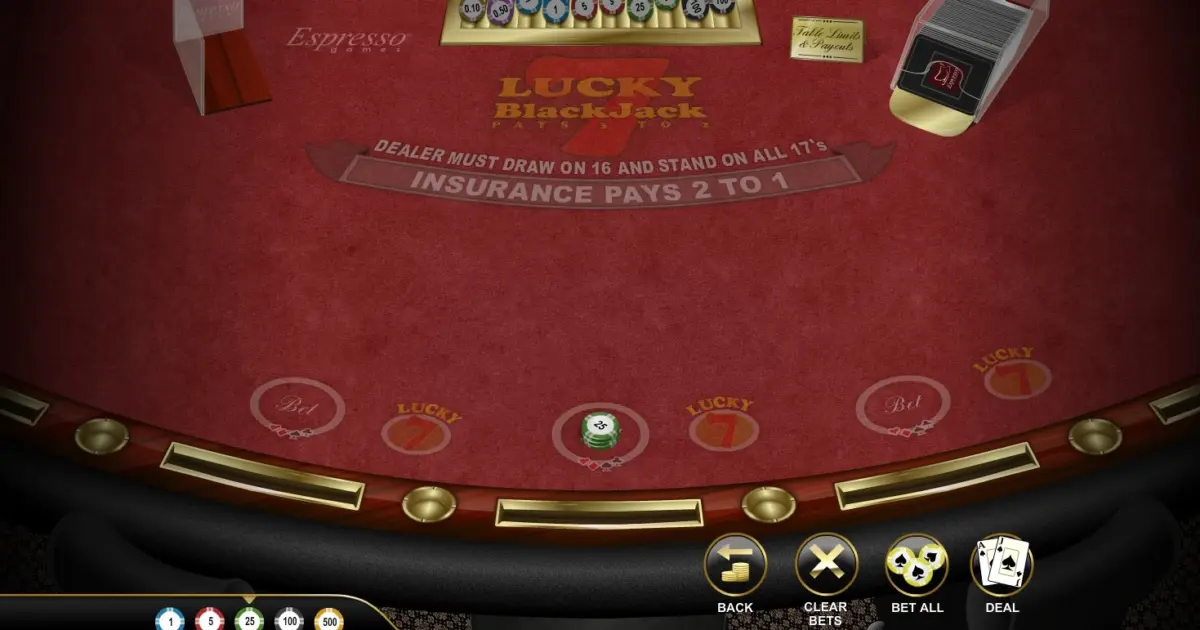
Lucky 7 Blackjack (Espresso) is worth your time if you want a straightforward table with an RTP that holds its own against the field. At 99.57%, it ties with Classic Blackjack (Espresso) and sits 0.16 percentage points above the average for all blackjack tables surveyed. Espresso Games does not publish granular rule details—deck count, soft-17 treatment, or exact side-bet offerings—so you will need to check the in-game paytable before committing real money, but the headline figure is competitive.
Lucky 7 Blackjack (Espresso) in one minute
This is an RNG-driven online blackjack table that reshuffles after every hand, meaning card counting delivers no edge. The 99.57% return to player assumes you execute perfect basic strategy on every decision; any departure from the chart—standing on 16 against a dealer 10 when you should hit, or taking insurance—will push your realized return materially lower. Espresso Games has not disclosed whether the dealer hits or stands on soft 17, the number of decks in the virtual shoe, or the blackjack payout ratio, all of which move the house edge by tenths or even whole percentage points. The title “Lucky 7” may hint at a side bet or bonus feature tied to sevens, but no such mechanic is confirmed in the available data. Treat the name as branding until you see the rules screen.
| Attribute | Value |
|---|---|
| RTP | 99.57% |
| House edge | 0.43% |
| Provider | Espresso Games |
| Free demo | Yes |
House edge versus RTP: the numbers explained
RTP is the flip side of the house edge: 99.57% RTP means a 0.43% house edge, the casino’s long-run profit margin when you play perfectly. That 99.57% figure is a theoretical return calculated over millions of hands and assumes you make the mathematically optimal decision every time—hitting 12 against a dealer 3, doubling 11 against a 10, splitting 8s against a 9. In practice, recreational players deviate from basic strategy several times per session, and each mistake hands a few more basis points to the house. A player who guesses or goes by feel will realize a return closer to 97% or 98%, turning that 0.43% edge into 2% or 3%. The published RTP is a ceiling, not a promise.
Blackjack rules can swing the house edge by more than a full percentage point. A 6:5 payout on blackjack instead of 3:2 costs you roughly 1.4%. Whether the dealer hits or stands on soft 17 is worth about 0.2%. The number of decks—single, double, six, or eight—moves the edge by a few hundredths each step. Espresso Games has not published these specifics for lucky 7 blackjack (espresso), so the 99.57% RTP is your anchor, but the realized edge will depend on the rules you find when you load the table.
How this table compares to other online blackjack
The 99.57% RTP places this table 0.16 percentage points above the 99.41% average across all blackjack tables in the dataset. That gap is modest but real: over 10,000 hands at £5 each, the difference between 99.41% and 99.57% is £80 in expected value. Espresso Games’ own catalog shows a tight range: Single Deck BJ (Espresso) leads at 99.86%, European Blackjack (Espresso) sits at 99.55%, and this table ties Classic Blackjack at 99.57%. If you have access to the single-deck variant and its rules suit your style, the extra 0.29 percentage points make it the sharper choice, but all four tables are bunched within half a percent.
Across the wider market, any blackjack table above 99.5% RTP is competitive, and anything above 99.6% is in the top quartile. This table clears the first threshold and sits just shy of the second. The key variable you cannot assess from the RTP alone is the blackjack payout: if this table pays 6:5 on naturals rather than 3:2, the effective edge will be closer to 2%, and the published 99.57% becomes misleading. Always confirm the payout in the game client before you play for money.
Basic strategy in practice
Basic strategy is a solved decision chart that tells you the mathematically correct play for every combination of your hand and the dealer’s upcard. It is not a betting system, and it does not promise profit—it minimizes the house edge to the published figure, in this case 0.43%, without ever eliminating it. The strategy is rigid: you always hit 16 against a dealer 10, you always split 8s, you always double 11 against anything except an ace, and you never take insurance at standard 2:1 odds because it carries a higher house edge than the base game.
Learning the full chart takes a few hours of study, but the bulk of the edge comes from a dozen core rules: never hit a hard 17 or higher, always hit a hard 11 or lower, stand on hard 12 through 16 against a dealer 2 through 6, hit the same hands against 7 or higher, double on hard 9, 10, or 11 when the dealer shows a weak card, and split aces and 8s. The exact strategy for soft hands—those containing an ace counted as 11—depends on whether the rules allow doubling after a split and whether the dealer hits soft 17, neither of which is confirmed for this table. If you are serious about minimizing the edge, print or memorize the chart that matches the in-game rules, or keep it open on a second screen during your session.
Betting systems and why they do not change the odds
No betting progression—Martingale, Fibonacci, D’Alembert, or any other—can overcome the house edge. A Martingale system, where you double your bet after every loss, changes the shape of your session variance: you will book many small wins and occasionally suffer a catastrophic loss that wipes out all previous profit and more. Over the long run, you still lose 0.43% of total money wagered, because the system cannot alter the expected value of any individual hand. The same logic applies to every other progression. They are not strategies; they are variance repackaging.
Card counting, the one technique that can flip the edge in the player’s favor at a live shoe game, does not work here. Lucky 7 Blackjack (Espresso) is an RNG table that reshuffles the virtual deck after every hand, so no count ever becomes favorable. The deck composition resets before you can act on the information. If a site or video claims a system that “beats” RNG blackjack, it is either selling something or confusing short-run variance with long-run edge. The 99.57% RTP is the ceiling, and the only way to reach it is through correct basic-strategy play on every hand, bet flat or varied to taste, and accept that the house still wins 0.43% over time.
The free demo
Espresso Games offers a free-play version of this table, and it is the right place to start. The demo uses the same RNG and the same rules as the real-money game, so you can verify the blackjack payout, the dealer’s soft-17 behavior, which doubles and splits are allowed, and whether any side bets are present. You can also drill basic strategy without risking your bankroll: load the chart, play fifty hands, and track how often your instinct matches the correct decision. The demo will not predict your real-money results—variance over a hundred-hand session can swing several percent in either direction—but it will show you whether you are comfortable with the interface and the pace.
If you do move to real money, set your budget in advance and treat it as the cost of entertainment, not a route to income. The 0.43% house edge is small, but it is persistent, and it will grind down any bankroll given enough hands. Never chase losses, never bet money you cannot afford to lose outright, and never believe a hand is “due” after a string of losses. Blackjack is a negative-expectation game; basic strategy minimizes the cost, but it does not eliminate it. This is entertainment with a known price. Play only if you are 18 or older and in a jurisdiction where online gambling is legal.
Verdict
Lucky 7 Blackjack (Espresso) is a solid mid-pack option. The 99.57% RTP is better than average, the free demo lets you confirm the rules before committing money, and Espresso Games’ small catalog suggests focused development rather than scattergun releases. The absence of published rule detail is a frustration—deck count, soft-17 handling, and blackjack payout ratio all matter—but that information exists in the game client, and checking it takes thirty seconds. If the in-game rules show a 3:2 blackjack payout and dealer-friendly policies elsewhere, this table is worth your time. If the payout is 6:5, walk away and try the single-deck variant instead.
This is not the lowest-edge blackjack you will find online, but it is competitive, and the free demo removes any guesswork about what you are sitting down to. Play it with basic strategy, accept the small house edge as the cost of the game, and keep your session budget fixed. That approach works here as well as it works anywhere.
Frequently Asked Questions
Is Lucky 7 Blackjack (Espresso) available in free demo mode?
Yes, Espresso Games offers a free-play version of this table. The demo runs on the same RNG and rule set as the real-money game, so you can verify the blackjack payout ratio, the dealer's soft-17 behavior, and any side bets before risking your bankroll. Use it to drill basic strategy and confirm you are comfortable with the interface.
What is the RTP for Lucky 7 Blackjack (Espresso), and what does it assume?
The RTP is 99.57%, which translates to a 0.43% house edge. That figure assumes perfect basic-strategy play on every hand. Any deviation from the mathematically optimal decision—hitting when you should stand, taking insurance, or guessing—will lower your realized return, often by one to two percentage points for casual players.
How does the 99.57% RTP compare to other blackjack tables?
It sits 0.16 percentage points above the 99.41% average for all online blackjack tables surveyed, placing it in the better half of the market. Within Espresso Games' own range, Single Deck BJ (Espresso) leads at 99.86%, while this table ties Classic Blackjack (Espresso) at 99.57%. Any table above 99.5% is competitive; above 99.6% is top-quartile.
Can I count cards or use a betting system to beat this table?
No. Lucky 7 Blackjack (Espresso) is an RNG table that reshuffles after every hand, so card counting provides no edge—the deck composition resets before you can act on any count. Betting progressions like Martingale change the shape of your session variance but do not alter the 0.43% house edge. Basic strategy minimizes the edge; no system eliminates it.
Why does Espresso Games not publish the deck count or blackjack payout for this table?
The provider has not disclosed granular rule details such as the number of decks, whether the dealer hits soft 17, or the blackjack payout ratio, all of which move the house edge by tenths or whole percentage points. The 99.57% RTP is reliable, but you must check the in-game rules screen to confirm how that figure was reached and ensure the payout is 3:2, not 6:5.




