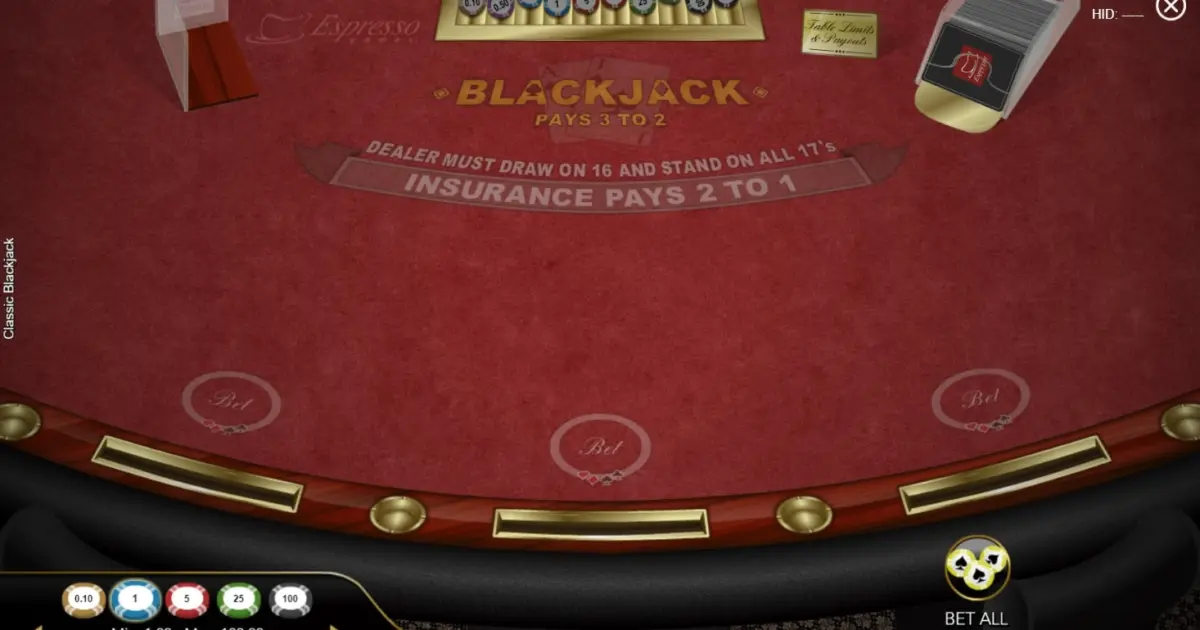
If you want a blackjack table with a published return figure and a free demo attached, this one qualifies. Espresso Games lists a 99.57% RTP for classic blackjack (espresso), which sits a little above the 99.41% average across the blackjack tables catalogued here. The catch is the same as every blackjack RTP: that number describes a player who never misdeals a decision.
Classic Blackjack (Espresso) at a glance
What is confirmed about this table is short, so it is worth stating plainly rather than dressing it up. Espresso Games is the developer, the return figure is 99.57%, a free demo is available, and the title places it in the Classic rule family.
| Field | Value |
|---|---|
| Game | Classic Blackjack (Espresso) |
| Provider | Espresso Games |
| RTP | 99.57% |
| House edge | 0.43% |
| Category | Blackjack |
| Free demo | Yes |
| Provider average RTP | 99.64% (4 tables) |
| Blackjack average RTP here | 99.41% |
Note what is absent. Espresso Games does not publish the deck count, the soft 17 rule, the blackjack payout, the double and split conditions, surrender availability or the table limits for this game in the data available here. Those are the levers that actually determine your edge, and each one is printed on the in-game rules or paytable screen. Open it before you commit money. Espresso Games has four blackjack tables in total, averaging 99.64%, so this is a mid-pack entry within its own studio rather than the studio’s best number.
What a 99.57% RTP means at a blackjack table
RTP is simply 100% minus the house edge, so 99.57% means a house edge of 0.43%. Over a very long run of hands, the theoretical cost of play is 43p per £100 wagered. That is low by casino standards, and low by blackjack standards too.
Here is the caveat that matters more than the figure itself: a published blackjack RTP assumes perfect basic strategy on every single hand. Not most hands. Every hand. The mathematician who certified 99.57% modelled a player who hits, stands, doubles and splits exactly as the optimal chart dictates, with zero deviations, zero hunches and zero fatigue.
Deviate and the number falls immediately. A player working from instinct — standing on 16 against a dealer 7 because it feels safer, refusing to split 8s against a 10, hitting a soft 18 against a 3 — will typically realise something in the region of 97% to 98%, and a genuinely careless player can drop below that. The gap between the certified figure and your actual return is entirely a function of how disciplined your decisions are. Treat 99.57% as a ceiling you have to work toward, not a rate you are handed for sitting down.
The rules that move the house edge
The title says Classic, and the Classic label normally indicates the baseline rule set that standard strategy charts are written for: dealer peeks for blackjack, blackjack pays 3:2, multiple decks. That is a strong hint from the name, not a confirmed rule for this specific table. Check the paytable.
The rules-of-thumb worth carrying in your head, in rough order of impact:
- Blackjack payout is the big one. A shift from 3:2 to 6:5 costs the player roughly 1.4% — more than three times this table’s entire stated edge. If a table pays 6:5, no amount of correct play rescues it.
- Dealer standing on soft 17 favours the player by about 0.2% against a table where the dealer hits.
- Fewer decks favour the player. Single deck is worth a few tenths of a percent over eight decks, all else equal.
- Double after split and re-splitting aces each add a small amount back to the player, in the region of a tenth of a percent apiece.
- Late surrender is worth around 0.07% when used correctly.
- European no-hole-card rules, where the dealer takes no card until the player finishes, cost roughly 0.11% because you can lose doubled and split bets to a dealer blackjack.
A 0.43% edge is consistent with a reasonably player-friendly combination, but you cannot reverse-engineer which combination from the figure alone.
Basic strategy, and what it can and cannot do
Basic strategy is not a system. It is a solved chart: for every possible player total against every possible dealer upcard, one action has the highest expected value, and the chart tells you which. It was worked out with computers decades ago and there is nothing left to argue about.
What it can do is bring your realised return up toward the certified 99.57%. What it cannot do is push past it. Playing every hand perfectly leaves a 0.43% edge intact — basic strategy minimises the house edge, it never eliminates it or flips it. Anyone selling you otherwise is selling you something.
Card counting is worth addressing directly, because it is the first thing experienced players ask. It does not work here. This is an RNG table, and an RNG table reshuffles the full deck before every hand, so no card is ever depleted and no count can ever run positive. The information counting depends on simply does not exist.
Betting progressions deserve the same bluntness. Martingale, D’Alembert, doubling after a loss — none of them change expected value. They redistribute your variance, converting many small results into rarer, larger ones, and they run into table limits and finite bankrolls. A flat unit of 1% to 2% of a session budget keeps swings survivable without pretending to alter the maths.
Side bets and insurance
The data available here does not list which side bets this table offers, if any. Perfect Pairs and 21+3 are common on classic tables, but assume nothing — the game’s own betting layout will tell you.
The general point holds regardless of what you find. Side bets carry house edges in the region of 2% to 7%, sometimes higher, which is five to fifteen times the 0.43% edge on the base game. Every unit you move from the main box to a side bet raises the average cost of your session. They pay large multiples occasionally, which is the appeal, but the price of that shape is a much worse long-run return.
Insurance is the clearest case. Offered when the dealer shows an ace, it pays 2:1, but a dealer with an ace up completes blackjack less often than one in three times. At standard odds it is a losing bet on every hand, and basic strategy declines it without exception. Since counting is off the table on an RNG game, there is no scenario here where insurance becomes correct. Decline it every time.
Playing the Classic Blackjack (Espresso) demo
A Classic Blackjack (Espresso) free demo is available, and it is the right way to approach this table. Use it for two things: reading the rules screen to fill in the deck count, soft 17 rule and payout that the published data omits, and drilling the strategy chart until correct play is automatic rather than deliberate.
What demo play cannot do is predict real-money results. Short sessions are dominated by variance, and a good or bad run in free mode carries no information about what follows. Espresso Games has three other tables worth comparing in the same demo mode: Single Deck BJ (Espresso) posts the studio’s strongest figure at 99.86%, European Blackjack (Espresso) sits marginally lower at 99.55% under a different rule family, and Lucky 7 Blackjack (Espresso) matches this table’s 99.57% exactly.
If you move to real money: this is 18+ only, set a budget before the first hand and stop when it is gone, and treat the spend as entertainment rather than income. A 0.43% edge is still an edge against you.
Verdict: who should sit at this table
This is a solid, unremarkable classic table with a return figure a fraction better than the blackjack average here. If you know basic strategy and want a no-frills game where the chart applies without modification, it does the job.
Two reservations. The first is that the rule detail is not published, so the 99.57% is a certified number you cannot yet trace to specific rules — you have to open the paytable to know what you are playing. The second is that within Espresso Games’ own range, the single-deck table posts a materially better 99.86%, which is worth almost three tenths of a percent. Check its rules and compare before defaulting to this one.
For a player who plays accurately, the difference between the best and worst tables in this studio is smaller than the difference between playing the chart and playing on instinct. Fix the second problem first.
Frequently Asked Questions
Can I play Classic Blackjack (Espresso) for free?
Yes, a free demo is available with no download or registration. It runs on the same rules and RNG as the real-money version, so it is the best place to read the paytable and drill basic strategy. Just remember demo results tell you nothing about how a real-money session will go.
What is the Classic Blackjack (Espresso) RTP?
Espresso Games lists 99.57%, which is a house edge of 0.43% and slightly above the 99.41% average across blackjack tables here. That figure assumes perfect basic strategy on every hand. Play from instinct instead and your realised return typically falls to somewhere around 97% to 98%.
How many decks does this table use?
Espresso Games does not publish the deck count, the soft 17 rule or the blackjack payout for this table in the available data. Deck count moves the edge by a few tenths of a percent, so open the in-game rules screen and confirm all three before playing for money.
Does card counting work on this blackjack table?
No. This is an RNG table, which reshuffles the full deck before every hand, so no card is ever depleted and no count can go positive. Betting progressions like Martingale do not help either — they reshape variance without changing the 0.43% house edge.
How does it compare to Single Deck BJ (Espresso)?
Single Deck BJ (Espresso) posts a higher 99.86% RTP against this table's 99.57%, a difference of nearly three tenths of a percent. Both come from Espresso Games, whose four blackjack tables average 99.64%. Compare their rules screens directly, since fewer decks generally favour the player.




