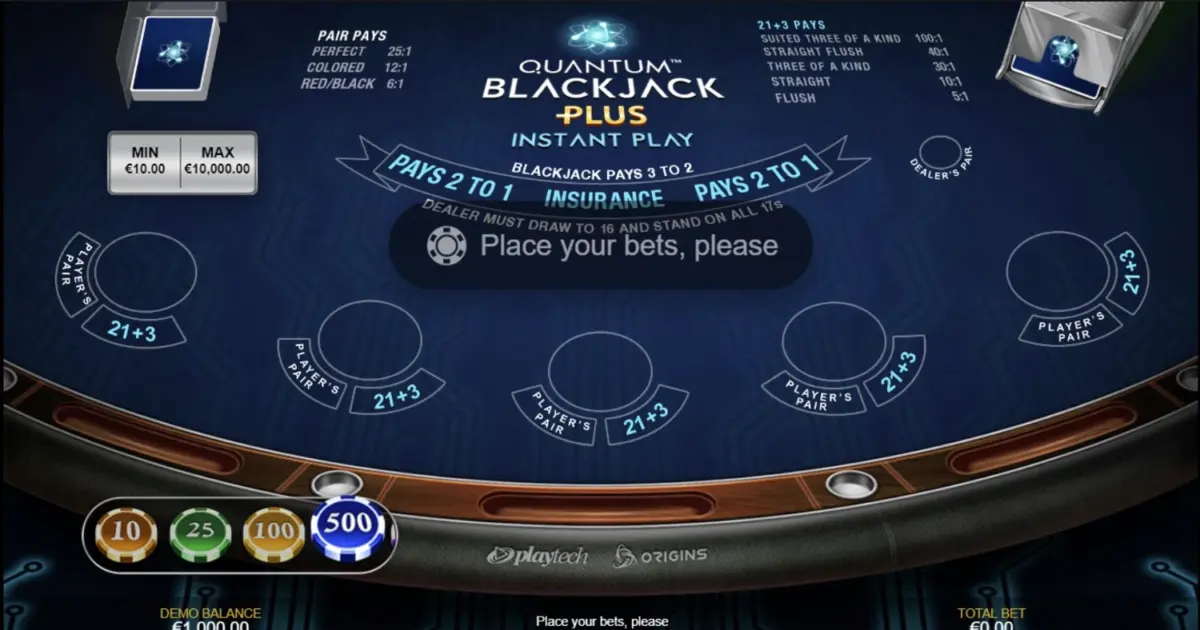
Quantum Blackjack Plus from Origins (Playtech) posts a 99.68% RTP, placing it 0.27 percentage points above the blackjack category average and second-highest in the provider’s nine-table catalogue. That figure is real, but it assumes you play perfect basic strategy on every decision. Casual play costs you a material slice of that return. The table offers free demo play, so you can verify the rule set and test your strategy before committing real money.
Quantum Blackjack Plus and the Origins (Playtech) table range
Origins, part of the Playtech family, runs nine blackjack tables with a mean RTP of 99.6%, making it one of the stronger providers in this category. Quantum Blackjack Plus sits near the top of that range at 99.68%, trailing only Blackjack Surrender (Origins) at 99.66% by a fractional margin. If you want similar mathematics with different rule sets, All Bets Blackjack delivers 99.58% and Cashback Blackjack offers 99.55%. The few hundredths separating these tables can matter over long sessions, but rule comfort and speed often matter more than decimal-point RTP differences when you are choosing a seat.
The 99.68% figure, and the assumption behind it
The published 99.68% return-to-player represents the long-run statistical payback when you execute perfect basic strategy on every hand. Basic strategy is the solved chart of correct plays for every possible two-card total against every dealer upcard. It is not a betting system or a hunch; it is a mathematical proof. If you deviate from it—standing on 16 against a dealer 10 because you “feel” a bust coming, or doubling soft 18 against a dealer 6 because it seems aggressive—you hand edge back to the house. Even a handful of mistakes per hundred hands can erode a percentage point or more from the 99.68% figure, turning one of the best tables in the genre into an average one.
The inverse of RTP is house edge. At 99.68%, the house edge is 0.32%, meaning the casino expects to keep 32 cents of every hundred dollars wagered over the infinite long run when strategy is perfect. That is exceptionally low, but it never reaches zero. No betting progression, no card-counting system applied to an RNG table that reshuffles after every hand, and no lucky streak changes that fact.
| Metric | Value |
|---|---|
| RTP | 99.68% |
| House Edge | 0.32% |
| Provider | Origins (Playtech) |
| Provider Average RTP | 99.6% |
| Category Average RTP | 99.41% |
| Free Demo | Yes |
Rules to confirm before you bet real money
Origins does not publish the complete rule set for Quantum Blackjack Plus in external marketing materials, and blackjack rules are not decorative—they are the levers that set the house edge. The difference between a 3:2 blackjack payout and a 6:5 payout alone costs you roughly 1.4 percentage points, turning a strong table into a weak one. Whether the dealer hits or stands on soft 17 moves the edge by about 0.2%. The number of decks, whether you can double after splitting, whether you can re-split aces, and whether late surrender is offered all shift the mathematics by measurable amounts.
The “Quantum” label in the title may indicate a variant or side-bet feature, but without confirmation from the in-game rules screen, that remains speculation. Before you place a real-money wager, open the paytable or rules panel inside the game client and verify the blackjack payout ratio, the soft-17 rule, the deck count, and the double and split restrictions. If the table offers side bets such as Perfect Pairs or 21+3, note that these carry a far higher house edge than the base game and are not factored into the 99.68% RTP. Insurance, offered when the dealer shows an ace, is a losing proposition at standard 2:1 odds and should be declined.
Strategy: the chart, not a system
Perfect basic strategy is a lookup table, not a feeling. You memorise or reference a chart that tells you whether to hit, stand, double, or split for every combination of your hand and the dealer’s upcard. Hard 16 against a dealer 10? Hit. Soft 18 against a dealer 9? Hit. Pair of 8s against a dealer 10? Split. These plays are derived from combinatorial mathematics and simulation; they minimise the house edge without ever eliminating it.
Card counting does not work at this table. Quantum Blackjack Plus uses an RNG and reshuffles the virtual deck after every hand, so no count you keep has any predictive value. Systems that claim to “beat” the house by adjusting bet size after losses—Martingale, D’Alembert, and their cousins—change the variance profile of your session but do not change the expected value. A progression can give you a higher chance of a small win and a lower chance of a large loss, or vice versa, but over enough hands the 0.32% edge grinds the same whether you flat-bet or double after every loss. No hand is ever “due,” and the RNG has no memory.
Variance at the blackjack table
Blackjack has lower variance than slots but higher variance than baccarat’s Banker bet. A hundred-hand session can easily swing ten or twenty units in either direction even when you play perfectly, because the distribution of outcomes includes doubles, splits, and blackjack payouts that amplify individual results. The 99.68% RTP is a long-run expectation; short-run results are noise.
Bankroll sizing matters. A common guideline is to sit with at least fifty times your base bet, and a hundred times is safer if you expect to play through meaningful variance. If your unit is five dollars, bring 250 to 500 dollars. That does not guarantee a winning session—it gives you enough cushion to survive a negative swing without going bust before the mathematics can assert itself. Set a loss limit before you start, and walk when you hit it.
Free play first
Quantum Blackjack Plus offers a free demo mode, and you should use it. Play fifty hands in demo to confirm the rule set, verify the interface speed, and test your strategy execution under something closer to real conditions than a strategy-drill app. The demo uses the same RNG and the same rules as the real-money version, so the only difference is that your mistakes cost you nothing.
If you move to real money, set a budget in advance, treat the cost as entertainment rather than income, and never chase losses. This is a game of chance with a house edge, and no session outcome is guaranteed. Play only if you are over eighteen and gambling is legal in your jurisdiction. If gambling is causing you harm, seek help from a responsible-gambling service in your region.
Who this table is for
Quantum Blackjack Plus is for players who already know basic strategy or are willing to learn it, and who want one of the lowest house edges available in the RNG blackjack category. If you play casually and guess at decisions, you will not see 99.68%; you will see something closer to 98%, and at that return you might as well play a faster game. If you memorise the chart, play at a comfortable pace, and avoid side bets, this table delivers mathematics as strong as you will find outside a live-dealer or land-based shoe game with optimal rules. The Origins interface is clean and quick, and the free demo removes any friction from testing it first. It is not a table for recreational players who treat strategy as optional; it is a table for players who do the work and want the payoff.
Frequently Asked Questions
Is there a free demo for Quantum Blackjack Plus?
Yes, Quantum Blackjack Plus offers free demo play. The demo uses the same RNG and rule set as the real-money game, so it is the correct place to verify the blackjack payout ratio, the soft-17 rule, and other house rules before you wager real money. Play at least fifty demo hands to confirm the interface and test your strategy execution.
What does the 99.68% RTP mean for my session?
The 99.68% RTP is the long-run statistical return when you play perfect basic strategy on every hand. Over a single session of a hundred or two hundred hands, variance dominates and you can easily finish up or down ten or twenty units regardless of correct play. The RTP asserts itself over thousands of hands, not hundreds, and any deviation from basic strategy lowers your realized return below 99.68%.
Does card counting work on Quantum Blackjack Plus?
No. Quantum Blackjack Plus uses an RNG and reshuffles the virtual deck after every hand, so no card count has predictive value. Card counting works only in games where dealt cards leave the shoe and change the composition of remaining cards. At an RNG table, every hand is independent and the deck composition resets, making counting futile.
How does Quantum Blackjack Plus compare to other Origins tables?
At 99.68% RTP, Quantum Blackjack Plus ranks second among Origins' nine blackjack tables, just behind Blackjack Surrender (Origins) at 99.66%. All Bets Blackjack delivers 99.58% and Cashback Blackjack offers 99.55%. The few hundredths separating these tables matter over long sessions, but rule comfort and speed are often more important than decimal-point RTP differences when choosing a seat.
Should I take insurance or play the side bets?
No. Insurance pays 2:1 when the dealer has blackjack, but the true odds make it a losing bet at that payout. Side bets such as Perfect Pairs or 21+3, if offered, carry a far higher house edge than the base game—often several percentage points—and are not included in the 99.68% RTP. Decline insurance and avoid side bets if you want to preserve the table's low house edge.




