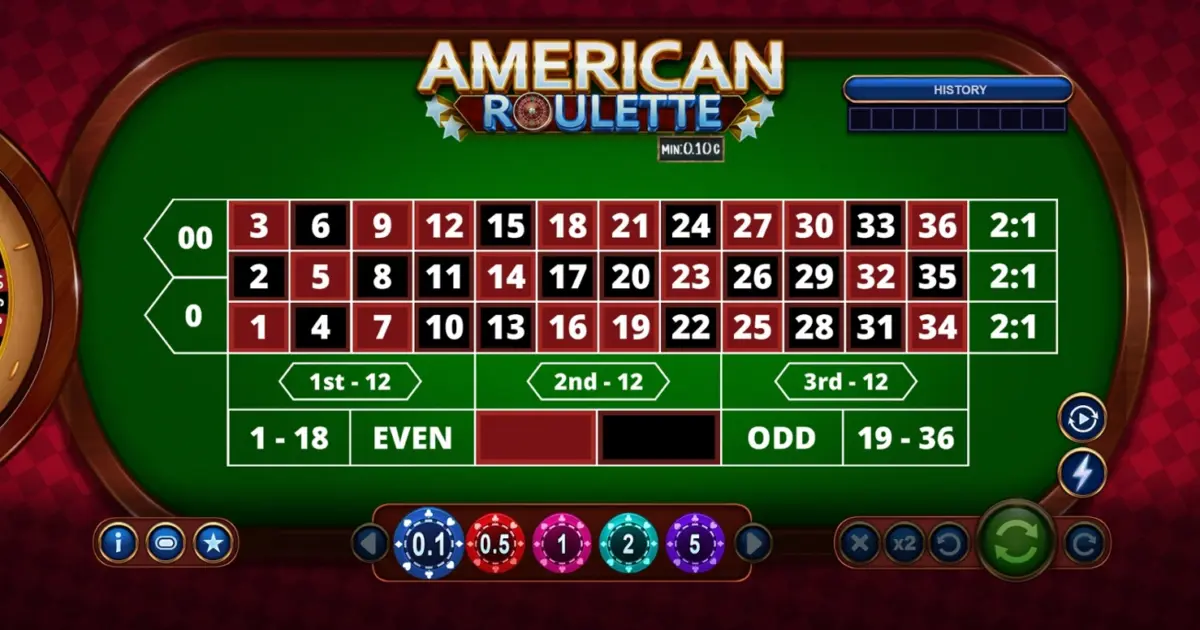
The name american roulette promises a double-zero wheel and the steepest house edge in the game. Yet Wizard Games lists a 97.74% RTP here, which works out to a 2.26% edge — a number that belongs to a different wheel family entirely. Before deciding whether this table suits your session, it helps to understand what the label claims and what the math actually delivers.
How American Roulette plays
The standard ruleset is straightforward: a croupier spins a wheel, a ball lands in a numbered pocket, and players win or lose according to where they placed chips. On a double-zero wheel, the extra 00 pocket is the source of the house advantage. You place bets on the layout — straight numbers, splits, streets, corners, six-lines for inside bets; red/black, odd/even, low/high, dozens, and columns for outside bets — then watch the result. There is no decision to make after the ball is in motion, no skill component, and no information advantage from watching previous spins. Wizard Games labels this table with an American variant hint, so a player arriving from a European table would expect the extra pocket and a noticeably larger edge. What you actually get at the payout level is something else, discussed below.
| Provider | Wizard games |
|---|---|
| RTP | 97.74% |
| Free demo | Yes |
The pocket count is the whole story
Every roulette edge comes from one gap: the payout odds offered by the table versus the true odds the wheel produces. A classic American wheel has 38 pockets. A straight-up number hit pays 35 to 1, but the true odds against hitting it are 37 to 1. That two-unit gap across all 38 outcomes produces the 5.26% house edge. On a 37-pocket European wheel, the same 35-to-1 payout creates only a one-unit gap, yielding 2.70%. The variant hint on this game points to 38 pockets and 5.26%, but the stated 97.74% RTP implies an edge of 2.26% — closer to the European wheel or perhaps a European wheel with a partial La Partage mechanism. You cannot reconcile these numbers from a game title alone. Check the rules screen in the live lobby before committing real money.
Reading the 97.74% figure
An RTP of 97.74% means that over a theoretically infinite number of spins, 97.74 units in every 100 wagered return to players as winnings, and 2.26 units remain with the house. That figure sits above the corpus average of 96.97% by 0.77 percentage points. It is slightly below what a pure European wheel returns (97.30% is the standard figure) but far above what a true American wheel returns (94.74%). If the game truly carries this RTP, it means either the wheel has 37 pockets despite the title or some return mechanism is in play. The American Roulette High Stakes table from the same provider carries an identical 97.74% RTP, suggesting Wizard Games applies the same maths model across its “American” branded products. Treat the RTP as the reliable number and the title as a label to verify.
Choosing bets for the session you want
Bet selection changes variance, not expected value. Every standard bet on a single-zero wheel carries the same percentage edge; on a double-zero wheel the same holds — except for the five-number basket bet (covering 0, 00, 1, 2, 3) which is historically worse at 7.89% on true American tables. If FACTS confirmed a basket bet here, I would flag it. The field is absent, so I cannot say whether Wizard Games offers it or not.
What you can decide is session shape:
- Straight-up numbers: highest variance, biggest single-spin swings, same expected loss per unit as everything else.
- Outside bets (red/black, odd/even): lowest variance, steady small wins and losses, longest sessions per bankroll unit.
- Dozens and columns: moderate variance, paying 2:1 against true odds of roughly 2.08:1 or 2.16:1 depending on pocket count.
If you want a more forgiving session, the European Roulette 0.10C table from the same provider offers lower stakes to test the water. For higher-limit play, see European Roulette High Stakes.
Martingale and friends: the honest answer
No sequence of bets changes the expected value of a roulette session. The Martingale — doubling your stake after each loss on an even-money bet — produces small wins most of the time and one large loss that erases them when you hit a losing streak long enough to reach the table cap. Each spin is an independent random event. The wheel has no memory. Tracking previous results tells you nothing about the next outcome on an RNG-driven table. Fibonacci, D’Alembert, Labouchere, and every other progression redistribute variance and accelerate your exposure to the table limit. They do not reduce the house edge by even a fraction of a percentage point. If a system changed the math, casinos would not offer the game. You can play however you like in free demo mode, but understand what you are observing: a reshaped loss curve, not a turned edge.
Bankroll and table limits
Table limits for this game are not listed in available data. On a live Wizard Games table you would see minimum and maximum bets displayed in the interface; the free demo typically mirrors the same range but does not guarantee it. Without those figures you cannot calculate how many Martingale doublings fit inside the cap — a relevant number because the progression’s failure point is entirely determined by the maximum bet, not by your bankroll.
Whatever table you choose, set a budget before your first spin and treat any money wagered as the cost of entertainment, not an investment with an expected return. Roulette is a negative-expectation game over any time horizon that matters. If at any point chasing losses stops feeling like entertainment, stop playing. The American Roulette High Stakes option from Wizard Games carries the same RTP but higher stakes — a different risk profile, not a better one.
Verdict on American Roulette
Wizard Games has published a 97.74% RTP on this american roulette table, which is genuinely competitive and well above the provider’s own 96.45% average across five games. The tension between that figure and the double-zero implication of the title is the one thing worth resolving before real-money play. If the rules screen confirms a 38-pocket wheel, the RTP claim is suspect and the true edge is far worse. If it confirms 37 pockets or a special return mechanism, this table offers one of the better roulette maths available from this provider. The free demo is available with no download required, giving you a riskless way to check the rules screen and observe the wheel layout. For players who just want to understand how an American-style table compares to other variants in the Wizard Games catalogue, start here and branch to the European entries.
Frequently Asked Questions
Can I play American Roulette free on this site?
Yes. Wizard Games provides a free demo for American Roulette that runs in your browser with no download required. The demo replicates the same layout and animation as the real-money version, letting you observe the wheel and test your familiarity with the interface without wagering anything.
What is the RTP of American Roulette by Wizard Games?
The stated RTP is 97.74%, which corresponds to a 2.26% house edge. That figure is 0.77 percentage points above the corpus average of 96.97% and above Wizard Games' own provider average of 96.45%. It does not match the 94.74% RTP you would expect from a standard 38-pocket American wheel.
Is American Roulette played with a single-zero or double-zero wheel?
The name and variant hint point to a double-zero American wheel with 38 pockets and a 5.26% house edge. However, the stated 97.74% RTP implies a 2.26% edge, which is more consistent with a single-zero wheel. These two signals conflict, so verify the wheel type in the game's rules screen before playing real money.
Does the Martingale system work on this roulette table?
No betting system changes the house edge. Each spin is an independent event with no memory of previous outcomes. Martingale redistributes variance by producing frequent small wins alongside rare large losses capped by table limits. The expected value remains negative regardless of bet sequence.
How does American Roulette compare to European Roulette 0.10C from the same provider?
Both tables are from Wizard Games. American Roulette lists 97.74% RTP while European Roulette 0.10C lists 94.74% RTP. If these figures are accurate, the American-labelled table returns more per unit wagered, which is unusual given the traditional house-edge relationship between the two wheel types. Verify both on their respective rules screens.




