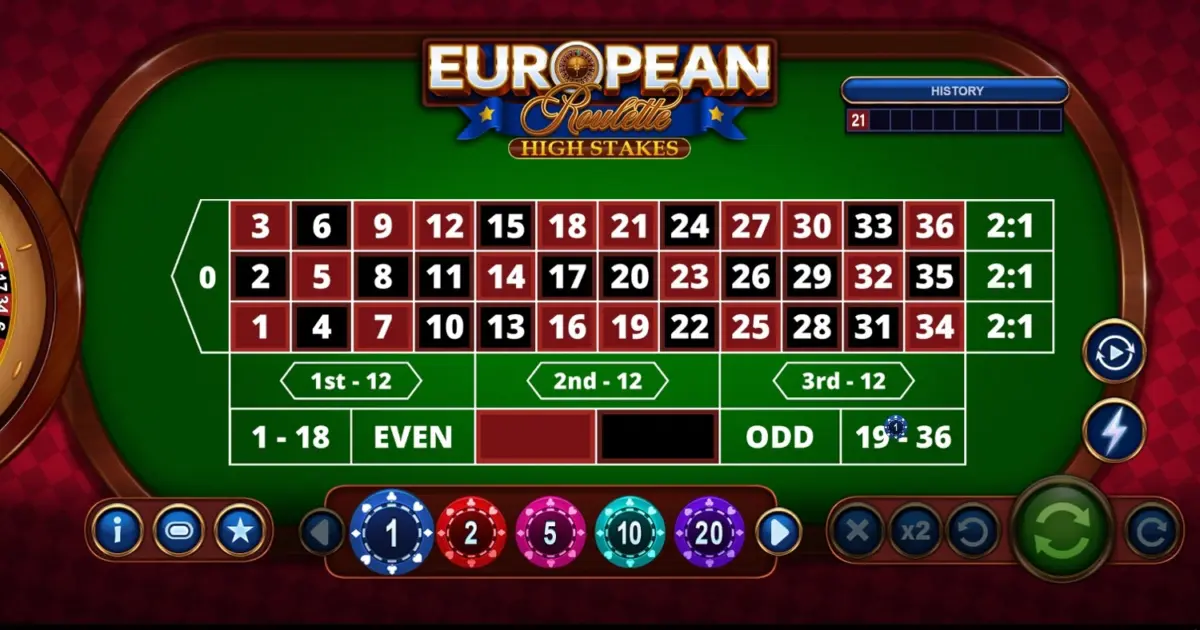
European Roulette High Stakes is a Wizard Games table that places a single-zero wheel behind a high-stakes betting range. The name tells you the wheel family, the provider’s own figures report an RTP of 94.74%, and those two data points do not quite reconcile—which makes it essential to read the maths before you commit real money. This review lays out what is known, what is missing, and how to decide whether this particular layout earns a place in your rotation.
How European Roulette High Stakes plays
You spin a wheel, place chips on a felt layout, and wait for the ball to land. That core loop is identical across every roulette variant ever built, so the differentiators are the wheel itself, the payout schedule, and the number range you are allowed to stake. This table is labelled European and sits in the high-stakes tier, meaning Wizard Games presumably widened the minimum bet to attract players who want large chips in play. A free demo is available, which lets you confirm the interface, the betting grid layout, and the call-bet availability without depositing. Use that demo first—especially to check whether French rules like La Partage or En Prison are active, because neither is mentioned in the available data and their presence or absence materially changes your expected loss on even-money bets.
The game is one of five titles from this provider, whose catalog averages 96.45% RTP across the set. Against a corpus average of 96.97%, this particular entry sits roughly two percentage points below the field, a gap large enough to warrant scrutiny.
| Provider | Wizard games |
|---|---|
| RTP | 94.74% |
| Free demo | Yes |
The pocket count is the whole story
Every roulette house edge traces back to one structural fact: the wheel has more pockets than the payout schedule accounts for. On a European wheel, there are 37 pockets numbered 0 through 36. The zero is the extra pocket that the payouts were not designed to cover. A straight-up bet on one number pays 35 to 1, but the true odds of winning are 36 to 1. That one-pocket gap is the entire source of the 2.70% house edge, and it applies uniformly to every standard bet on the table—red, black, a single number, a corner, a dozen, a column. The edge does not shift based on which bet you choose.
American wheels add a second zero (00), bringing the pocket count to 38 and the standard house edge to 5.26%. If you want to see that structure in action at a similar high-stakes tier, American Roulette High Stakes from the same provider carries a 97.74% RTP, which aligns more closely with what a double-zero wheel should deliver. Comparing the two side by side in demo mode makes the pocket-count effect concrete.
Reading the 94.74% figure
Here is where you need to think carefully. A theoretical European wheel at 2.70% house edge produces an RTP of 97.30%. This game’s stated RTP is 94.74%, which corresponds to a 5.26% house edge—the exact figure you get from a 38-pocket American wheel. Either the RTP figure accounts for something not visible in the rules summary (a side bet, a commission, a reduced payout schedule), or the labelled variant and the reported math are in tension. You cannot resolve this from a review page alone.
Open the game’s own paytable and rules screen before depositing. Check the straight-up payout: if it is 35:1 on a 37-pocket wheel, expect 2.70%. If the payouts have been trimmed to fund a multiplier feature or a side bet, the effective RTP will sit where Wizard Games says it does—94.74%—and you should treat that as the number governing your session’s expected cost. At 94.74%, every 100 units you cycle through the table returns 94.74 units on average; the remaining 5.26 is the cost of playing. Compare that to a fair European layout at 97.30%, and you are paying nearly double for the same entertainment.
For a lower-stakes entry from the same provider, European Roulette 0.10C lists the identical 94.74% RTP at a ten-cent minimum, which confirms the figure is not an artifact of the high-stakes configuration.
Choosing bets for the session you want
Once you have confirmed the payout schedule, the remaining question is shape, not cost. Inside bets—a straight number, a split, a street, a corner, a six-line—carry high variance. You will lose most spins and occasionally collect a 35:1 or 17:1 return. Outside bets—red/black, odd/even, high/low, dozens, columns—hit far more often but pay at 1:1 or 2:1. Neither category offers a better expected value; both lose at the same rate over thousands of spins. What they offer is a different emotional and financial experience.
On a 94.74% game, outside bets stretch your session because your chips change hands slowly. Inside bets compress it because a single loss costs one unit while a win returns thirty-five, creating sharp peaks and valleys. If your goal is an evening of sustained action with small swings, play outside. If you want the possibility of a large single hit and can tolerate a series of small losses leading up to it, play inside. Neither choice moves the long-run cost.
Martingale and friends: the honest answer
Every roulette system sold online claims to exploit the structure of even-money bets by adjusting stake size after losses. The Martingale doubles your bet after each loss, recovering all previous losses plus one unit when you eventually hit. Fibonacci uses a sequence. D’Alembert increments by one. The mathematical reality shared by all of them: none changes expected value, because the wheel has no memory and each spin is independent of the last.
What these systems do change is the distribution of outcomes within your session. A Martingale produces many small wins and an occasional catastrophic loss that wipes out dozens of prior gains. On a 94.74% game—where the per-spin cost is already elevated—that catastrophic loss arrives at the same frequency it would on any other table, but the damage is slightly larger because each underlying spin was already more expensive. Table limits cap recovery regardless of bankroll depth. No progression converts a negative expectation into a positive one. The system does not fail because you ran out of money; it fails because the house edge is baked into every spin it depends on.
Bankroll and table limits
The FACTS block for this game does not include minimum or maximum table limits. For a title explicitly branded “High Stakes,” that absence is significant. The minimum bet determines how slowly or quickly your bankroll circulates through the table, and the maximum bet determines how far a progression can recover before the limits close the door. In a demo session, check both numbers on the actual layout before you assume your planned bet size will fit.
If you do play with real money, set a budget before your first spin and treat it as the cost of the session—no different than a ticket to a show. Roulette at 5.26% effective edge is expensive entertainment; budget accordingly. This game is for players 18 and over. Loss limits, time limits, and the decision to stop should be made before the wheel spins, never during a losing sequence. If gambling stops feeling like entertainment, stop gambling and contact a support line in your region.
Verdict on European Roulette High Stakes
Wizard Games has published an RTP figure that implies a house edge roughly double what the European label promises, and until you can confirm the paytable, you should plan around the number given rather than the number the variant name suggests. That is not a disqualifying issue—knowledge is the point—but it means you should not open this table expecting 2.70% cost and instead budget for 5.26%.
Use the free demo to inspect the payout grid, confirm whether French rules apply, and record the actual table limits. If the math checks out for your tolerance and the high-stakes minimum fits your bankroll plan, the game delivers a familiar roulette experience from a small provider with a below-average RTP across its catalog. If it does not, the same provider’s American Roulette at 97.74% RTP is already in your comparison list, and its higher payout likely reflects a more standard structure. Compare both in demo before choosing where to place real chips.
Frequently Asked Questions
Can I play European Roulette High Stakes for free?
Yes, a free demo version is available. You can spin the wheel and place bets without depositing money, which is useful for checking the payout grid, confirming table limits, and testing whether La Partage or En Prison rules are active before committing a bankroll.
What is the RTP of European Roulette High Stakes?
The published RTP is 94.74%, which implies a 5.26% house edge. That figure sits 2.23 percentage points below the corpus average of 96.97%. A standard European wheel theoretically returns 97.30%, so verify the paytable on the game's own rules screen to confirm what is actually in play.
Is European Roulette High Stakes played on a single-zero or double-zero wheel?
The game is labelled European, indicating a 37-pocket single-zero wheel. However, the stated 94.74% RTP matches the house edge of a 38-pocket American wheel, creating a discrepancy. Check the in-game layout directly—count the pockets on the betting grid or read the rules tab—before assuming the edge is 2.70%.
Does the Martingale system work on this table?
No betting system changes expected value. Each spin is independent, and a 94.74% RTP means every unit you cycle through costs 5.26 on average regardless of stake sizing. The Martingale concentrates losses into rare large hits while producing frequent small wins, and table limits on a high-stakes game cap recovery attempts faster than they would on a low-limit table.
What is the best bet to make on European Roulette High Stakes?
No single bet type carries a lower house edge than another on a standard roulette layout—the edge is uniform across inside and outside bets. Choose based on variance preference: even-money outside bets extend session length, while straight-up inside bets produce larger swings. If French rules are confirmed active on the table, even-money bets gain a partial-return advantage.




