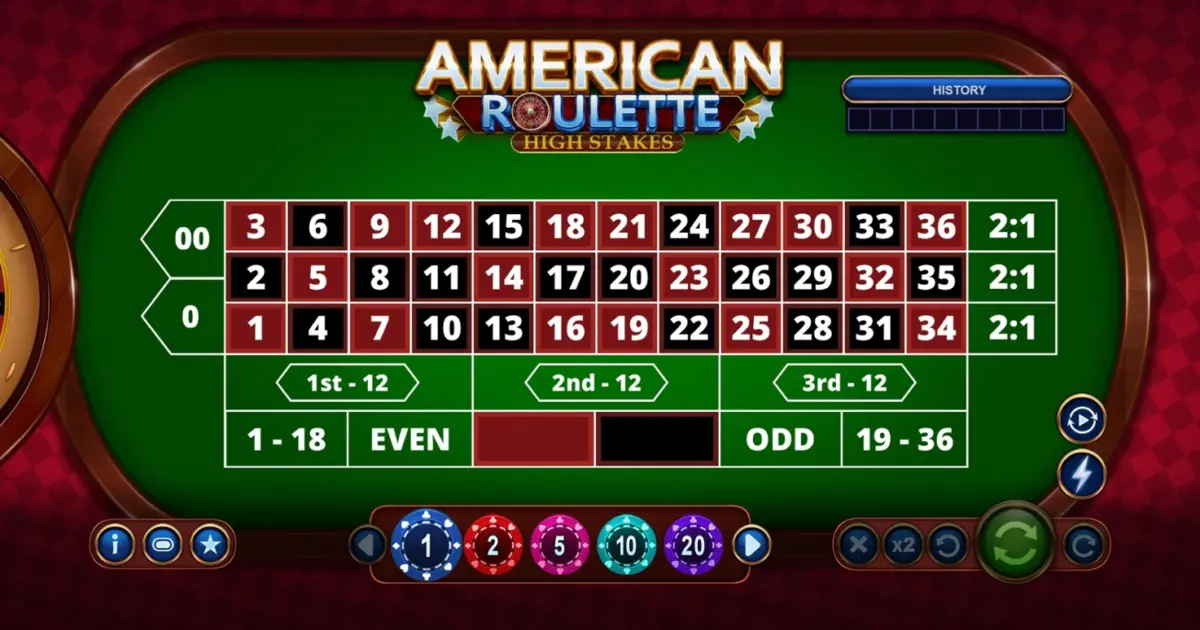
The headline number on american roulette high stakes is a listed RTP of 97.74%, which is unusually high for a table carrying “American” in its title. That combination is worth pausing over rather than taking at face value, because a standard 38-pocket wheel does not produce that figure. If you want a straightforward single-zero table, the maths is easier to reason about elsewhere; if you want to play this one, the rules screen is the first thing to open.
What kind of roulette is American Roulette High Stakes?
The title points to an American wheel, which normally means 38 pockets — the numbers 1 to 36 plus a single zero and a double zero. On that layout the house edge on every standard bet is 5.26%, and 7.89% on the five-number basket bet that only exists on the American layout. That is close to double the 2.70% you get on a single-zero European wheel.
FACTS does not confirm the pocket count for this specific table, though, and that matters more than usual here. The name is a strong hint, not a stated rule, and the listed RTP does not line up neatly with a textbook double-zero wheel. Open the game’s own rules or information screen and count the pockets on the wheel graphic before you place a real-money bet.
“High Stakes” in the title suggests a table positioned for larger bets, but no minimum or maximum limits are given in the data available. If you are choosing a table on the basis of what you can wager per spin, that gap is a reason to check the table itself rather than rely on the name.
Return to player and house edge
Wizard games lists this table at 97.74% RTP. For context, the average across the wider corpus of games here is 96.97%, putting this one 0.77 percentage points above it, and comfortably above the 96.45% average across the five Wizard games titles in this collection. On paper that is a favourable position.
The complication is reconciling that figure with the wheel the name implies. A conventional 38-pocket American wheel returns 94.74% on standard bets — the mirror image of a 5.26% house edge. A conventional 37-pocket European wheel returns 97.30%. The listed 97.74% matches neither exactly, which means either the payout structure differs from the classic layout, some rule reduces the zero penalty, or the figure is measured across a bet mix rather than a single bet type.
You cannot resolve that from the outside, and guessing would be worse than useless. What you can do is treat the listed RTP as the provider’s published figure and read the paytable to see which bets it actually applies to. Two tables with the same headline RTP can behave very differently if one funds a feature by trimming the straight-up payout.
One useful comparison point: the sister table American Roulette from the same studio carries the identical 97.74% figure, suggesting a shared engine and paytable between the two.
Reading the Wizard games paytable before you bet
On a classic wheel, the payouts are fixed and universal: 35:1 straight up, 17:1 split, 11:1 street, 8:1 corner, 5:1 six line, 2:1 column and dozen, 1:1 on red/black, odd/even and high/low. The house edge comes entirely from the gap between those payouts and the true odds created by the zero pockets.
Because the RTP here does not match either standard wheel cleanly, the paytable is where you find out why. Check three things specifically. First, the straight-up payout — if it reads anything other than 35:1, that single change reshapes the whole return profile. Second, whether any zero rule applies to even-money bets. La Partage returns half your stake when zero lands and drops the even-money edge to roughly 1.35%; En Prison holds the bet for one more spin instead. FACTS does not say whether either applies here, and on a double-zero layout they are uncommon.
Third, whether a racetrack or call bets (voisins, orphelins, tiers) are offered. These are shortcuts for placing groups of neighbouring numbers, not different bets with different odds, but their presence changes how quickly you can build a layout. Nothing in the data confirms they exist on this table.
Bet coverage, variance and session length
Bet selection does not change your expected loss per unit staked on a standard wheel. It changes how that loss arrives. A straight-up number pays 35:1 against true odds of 37:1 on a double-zero wheel, so you win rarely and large; an even-money bet resolves close to half the time and grinds slowly. Same edge, entirely different session.
| Bet | Numbers covered | Payout | True odds (38 pockets) | Win chance |
|---|---|---|---|---|
| Straight up | 1 | 35:1 | 37:1 | 2.63% |
| Split | 2 | 17:1 | 18:1 | 5.26% |
| Street | 3 | 11:1 | 11.67:1 | 7.89% |
| Corner | 4 | 8:1 | 8.5:1 | 10.53% |
| Basket (0-00-1-2-3) | 5 | 6:1 | 6.6:1 | 13.16% |
| Six line | 6 | 5:1 | 5.33:1 | 15.79% |
| Column or dozen | 12 | 2:1 | 2.17:1 | 31.58% |
| Red/black, odd/even, high/low | 18 | 1:1 | 1.11:1 | 47.37% |
Those figures describe a standard 38-pocket wheel and are shown for orientation. Confirm the actual payouts on this table’s paytable, since the listed RTP suggests they may not match exactly. The basket bet row is the one to remember: at a 7.89% house edge on a standard American wheel, it is the worst bet on the layout, and there is no version of the game where it becomes a good idea.
Patterns, hot numbers and the gambler’s fallacy
Every spin on an RNG wheel is independent of every spin before it. The wheel keeps no record. Five reds in a row tells you nothing whatsoever about the sixth spin, and a number that has not landed in 200 spins is not owed anything. The scoreboard showing recent results is decoration.
Betting systems do not change this. Martingale doubles after each loss, which recovers previous losses when it works and produces one very large loss when it does not — and it will, because the required stake grows geometrically until it hits the table maximum or your balance. Fibonacci and D’Alembert progress more gently and fail the same way, more slowly. The Labouchere cancellation system is bookkeeping, not an edge.
Here is the arithmetic that settles it: if every individual bet has negative expected value, then any sequence of those bets, in any order, at any stake size, also has negative expected value. Nothing you do with bet sizing alters the payout gap on the layout. Systems trade a high chance of small wins for a small chance of a large loss. That is a variance choice, not a profit strategy, and on a double-zero wheel you are making it against a 5.26% edge rather than 2.70%.
Trying the demo
A free demo of this table is available, which is the sensible place to start. Play American Roulette High Stakes free and use the session for verification rather than entertainment: count the pockets, read the paytable, note the straight-up payout, check the minimum and maximum bet, and look for any zero rule on even-money bets. Those are the things FACTS cannot tell you and the game itself can.
Demo play runs on the same RNG but proves nothing about what a real-money session will do. Short-run results in either mode are dominated by variance, and a good demo run is not a signal.
Roulette is entertainment, not income. It is for players aged 18 or over. Decide what you are willing to lose before you open the game, treat that figure as the cost of the entertainment, and stop when it is gone rather than chasing it back. If the amount you are betting starts to matter to you, that is the point to close the tab.
If you would rather start from a wheel where the maths is unambiguous, European Roulette High Stakes is the single-zero table in the same studio’s range at a similar stake positioning, and European Roulette 0.10C covers the same layout at a lower entry point.
Verdict on American Roulette High Stakes
The listed 97.74% RTP is genuinely above the 96.97% corpus average and above this provider’s own 96.45% average, so on published figures the table looks competitive. The honest caveat is that the figure and the name pull in different directions, and the data available does not resolve which layout and paytable you are actually facing.
That makes this a table worth opening in demo mode before it is a table worth funding. If the wheel turns out to carry 38 pockets with standard 35:1 payouts and no zero rule, you are playing a 5.26% edge regardless of the headline RTP, and the European alternatives in the same range are the better structural choice. If the paytable explains the higher figure, it becomes more interesting.
Either way, no bet selection or staking pattern will move the edge in your favour. Pick the bets whose rhythm you enjoy, set the budget first, and let the demo answer the questions the marketing does not.
Frequently Asked Questions
Can I play American Roulette High Stakes free with no download?
Yes, a free demo of this Wizard games table is available and runs in the browser, so there is nothing to install. Use it to check the wheel layout, the straight-up payout and the table limits, since none of those details are confirmed in the published data available for this game.
What is the American Roulette High Stakes RTP?
Wizard games lists it at 97.74%, which is 0.77 percentage points above the 96.97% average across the wider game corpus and above the studio's own 96.45% average across its five titles. Confirm which bet types that figure applies to on the game's paytable before betting.
How many pockets does this wheel have and what is the house edge?
The name points to an American wheel, which normally means 38 pockets with 0 and 00 and a 5.26% house edge on standard bets. That is not confirmed for this table, and the listed 97.74% RTP does not match a textbook double-zero wheel, so check the rules screen.
Does any betting system work on this table?
No. Every spin is independent, the wheel keeps no memory, and no staking pattern changes expected value. Martingale, Fibonacci, D'Alembert and Labouchere all redistribute variance, swapping frequent small wins for rare large losses, and they run into the table maximum. Recent results have no predictive value.
How does it compare to American Roulette from the same provider?
Both list the identical 97.74% RTP, which suggests a shared paytable and engine, with the difference likely sitting in stake sizing rather than the maths. No limits are published for either, so open both demos and compare the minimum and maximum bets directly.




