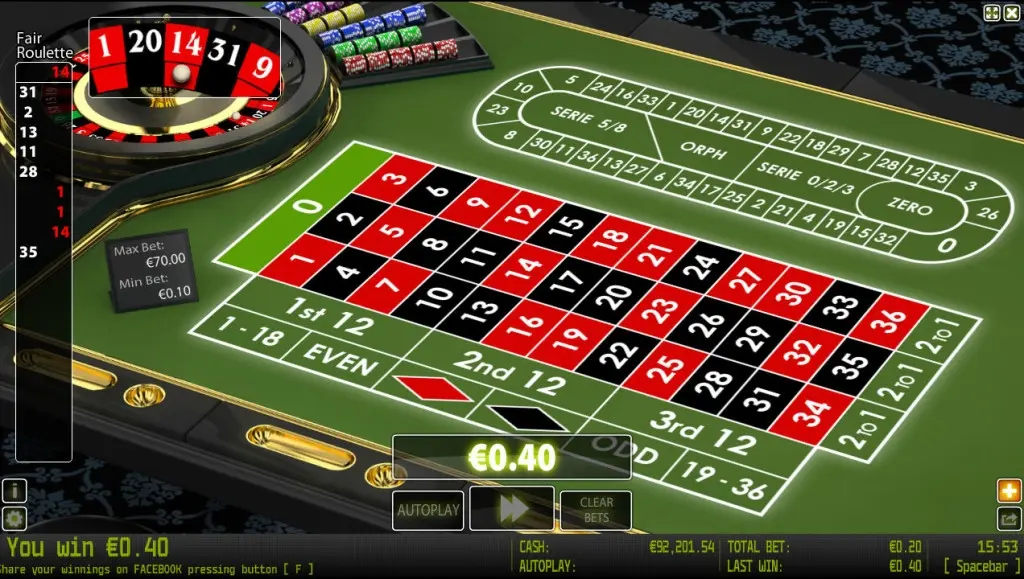
Fair roulette, as Worldmatch names this table, carries a listed RTP of 97.3% — a figure that lines up almost exactly with the 2.70% house edge of a single-zero wheel. That makes it a reasonable table to spend time on, and a free demo is available so you can check the layout at zero cost. What the FACTS for this table do not confirm is the pocket count, whether French rules apply, the table limits, or whether a racetrack for call bets is present, so treat the rules screen as required reading.
Is Fair Roulette worth your spins?
On the numbers available, yes, with a caveat. A 97.3% RTP is above the 96.97% average across the wider game corpus reviewed here, and comfortably above the 96.51% average of Worldmatch’s own catalogue. In roulette terms, that 97.3% figure implies a house edge of 2.70%, which is what a 37-pocket European wheel produces on every standard bet.
The caveat is that the name “Fair Roulette” tells you nothing about the wheel. It is a marketing label, not a variant. A 38-pocket double-zero wheel would return 94.74%, and a table applying La Partage would return roughly 98.65% on even-money bets. The 97.3% figure is the strongest clue you have, but the game’s own rules panel is the only place it becomes a fact.
Ranked 98th here and sitting in the 56.5th popularity percentile, this is a mid-table draw rather than a headline release. It is worth your spins if the rules screen confirms a single zero.
Worldmatch and this wheel
Worldmatch has 13 games in this catalogue, averaging 96.51% RTP, so Fair Roulette sits near the top of the provider’s own range. That spread is wide. At the low end, Ecuruleta is listed at 94.73%, a figure that points squarely at a double-zero layout and roughly a 5.26% edge — a meaningful gap in cost per spin.
At the top end, Instant 3D Roulette matches Fair Roulette exactly at 97.3%, so the choice between them comes down to presentation and spin speed rather than maths. If you want the lowest edge available on even-money bets, French Roulette Privee is also listed at 97.3% and its name points to French rules, which would cut the even-money edge to about 1.35% — again, confirm that on its rules screen.
There is no release date or licensing detail in the data for Fair Roulette. If provider provenance matters to you, check the operator’s game information panel rather than assuming.
House edge: 2.70%, 5.26% or 1.35%?
Three numbers cover almost every roulette table you will meet, and the pocket count decides which one applies to you.
2.70% is the single-zero European wheel: 37 pockets, and a straight-up number paying 35:1 against true odds of 36:1. That one-pocket gap is the entire edge, and it applies equally to red/black, dozens, columns and straight-up bets.
5.26% is the double-zero American wheel: 38 pockets, the same 35:1 payout, so the gap doubles. The five-number basket bet on that layout is worse still at 7.89% and is the one bet on any roulette table worth avoiding outright.
1.35% is what French rules produce on even-money bets. Under La Partage you get half your stake back when zero lands; under En Prison the bet is held for one more spin. Either way the even-money edge halves, which makes it the best standard bet in roulette. It applies only to even-money bets — inside bets stay at 2.70%.
The 97.3% listed for this table is consistent with 2.70%, so a single zero is the likely answer here. Verify it, because a wrong assumption nearly doubles your cost per spin.
Bet types, payouts and true odds
Assuming the single-zero wheel the RTP points to, here is how the standard bets compare. Note that the house edge column does not move.
| Bet | Pockets covered | Payout | True odds | Win chance | House edge |
|---|---|---|---|---|---|
| Straight up | 1 | 35:1 | 36:1 | 2.70% | 2.70% |
| Split | 2 | 17:1 | 17.5:1 | 5.41% | 2.70% |
| Street | 3 | 11:1 | 11.33:1 | 8.11% | 2.70% |
| Corner | 4 | 8:1 | 8.25:1 | 10.81% | 2.70% |
| Line | 6 | 5:1 | 5.17:1 | 16.22% | 2.70% |
| Column / dozen | 12 | 2:1 | 2.08:1 | 32.43% | 2.70% |
| Red/black, odd/even, high/low | 18 | 1:1 | 1.06:1 | 48.65% | 2.70% |
The takeaway is that inside and outside bets do not differ in expected value at all. What changes is variance. A straight-up bet lands under three times in a hundred spins and pays 35 units; red/black lands just under half the time and pays one. Choose based on how long you want your balance to last, not on which bet is somehow better value.
What experienced players actually do
They flat stake. The same chip value every spin, no doubling after a loss. Martingale, Fibonacci, D’Alembert and “wait for five reds then bet black” all leave the expected value untouched at 2.70% of everything you stake. Spins are independent and the wheel has no memory, so a run of red says nothing about the next result. What progressions do is reshape variance: many small wins, then one sequence that runs into the table maximum or your balance, whichever comes first.
They set a session budget and a spin count before opening the game, because roulette’s pace is what actually determines losses. Three hundred spins at one unit costs the same in expectation whether you win early or late.
They pick the lowest-edge bet available. If a table offers French rules, even-money bets there cost roughly half what the same bet costs elsewhere. On a plain single-zero wheel, all standard bets are equal, so the decision becomes purely about variance tolerance.
And they ignore results boards. Displayed history on an RNG wheel is decoration. No number, colour or sector is ever due.
Free play before real money
A Fair Roulette free demo is available, and it is the practical way to answer the questions the data leaves open: count the pockets, look for a zero-only or a zero and double-zero layout, check whether La Partage or En Prison is mentioned, note the minimum and maximum stakes, and see whether a racetrack for call bets is offered. None of those are confirmed in the data for this table, and all of them change how you would play it.
Demo results do not predict real-money results. A demo session that runs 20% ahead is variance, not an edge, and the 2.70% applies identically in both modes.
Roulette is 18+ entertainment, not income. Set a budget before you start, treat it as the cost of the session, and stop when it is spent rather than when you feel a turn is coming. If play stops feeling optional, use the operator’s deposit limits, time-outs and self-exclusion tools.
Final take
Fair Roulette’s 97.3% RTP is a genuinely competitive number, above both the Worldmatch average of 96.51% and the corpus average of 96.97%, and it points strongly to a 37-pocket single-zero wheel at a 2.70% house edge. Confirm that on the rules screen, flat stake, set your spin budget in advance, and if French rules are available on a sibling table, that even-money edge of about 1.35% is worth crossing the lobby for.
Frequently Asked Questions
Can I play Fair Roulette free with no download?
Yes. A free demo of Fair Roulette is available and runs in the browser, so no download is needed. Use it to check the pocket count, the stake range and whether French rules are offered, since none of those details are confirmed in the published data for this table.
What is the Fair Roulette RTP?
Worldmatch lists Fair Roulette at 97.3% RTP, which means the game is modelled to return 97.30 units for every 100 staked over a very large number of spins. That figure is above the 96.51% average across Worldmatch's 13 games here and above the 96.97% corpus average.
Is Fair Roulette a European or American wheel?
The data does not confirm it. The 97.3% RTP corresponds to a 2.70% house edge, which is what a 37-pocket single-zero European wheel produces, so that is the likely layout. A 38-pocket double-zero wheel would return 94.74% instead. Check the game's rules screen before staking.
Does any betting system work on Fair Roulette?
No. Martingale, Fibonacci, D'Alembert and waiting for a colour streak all leave expected value unchanged. Each spin is independent and the wheel has no memory, so past results carry no predictive weight. Progressions only redistribute variance and bring you to the table limit or your balance faster.
Which bet should I choose to make my balance last longest?
Even-money bets — red/black, odd/even, high/low — land just under 48.65% of the time on a single-zero wheel, giving the smoothest ride. They carry the same 2.70% edge as a straight-up number, so you are buying lower variance, not better value. Flat staking extends the session further still.




