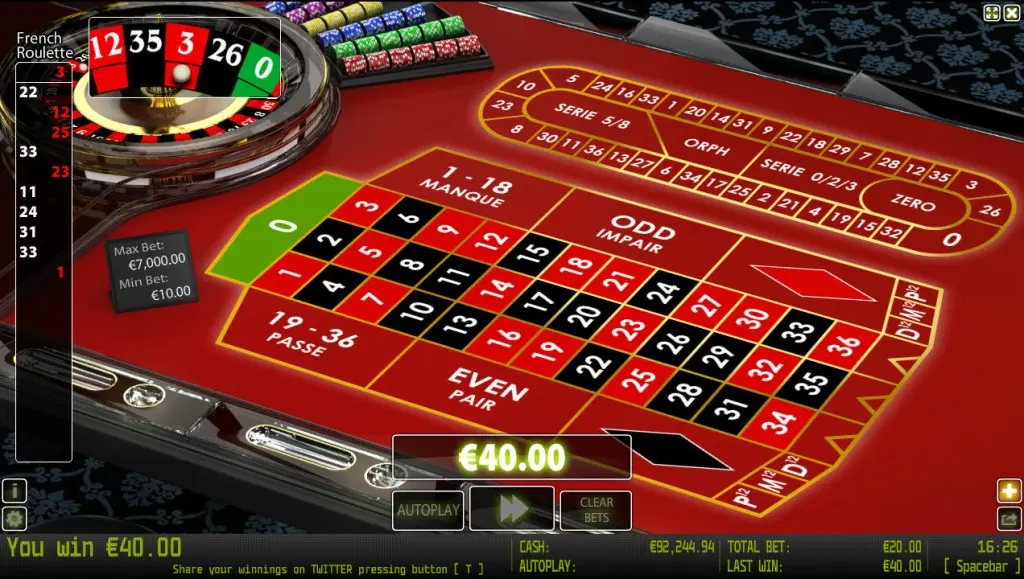
French Roulette Privee gives you a stated RTP of 97.3% and a free demo you can open without depositing, which is enough to make it worth a look before you commit money anywhere. The name and the published figure both point toward a single-zero wheel, and that matters more than anything else on the table. What FACTS does not tell you is whether La Partage is actually switched on, and that single detail is the difference between a good bet and a mediocre one.
French Roulette Privee at a glance
This is a roulette table from Worldmatch, listed with an RTP of 97.3% and available to play as a demo. It sits at rank 150 in the roulette catalogue and lands in the 33.2 popularity percentile, so it is not a headline title. That is a traffic statistic, not a quality one: roulette is decided by wheel layout and zero handling, not by how many people happen to be spinning.
Worldmatch runs 13 games in this catalogue with an average RTP of 96.51%. At 97.3%, this table is the better end of that range and sits 0.33 percentage points above the 96.97% corpus average. Two of the provider’s other tables match the same figure exactly, which is worth knowing when you compare.
What is missing from the available data: table limits, whether a racetrack and call bets are offered, and whether any side bets or multipliers exist. Limits matter most. If you plan to play even-money bets across a long session, the maximum stake defines how far a losing streak can run before the table stops you, and you cannot plan around a number you have not seen. Check the game’s own rules and limits screen before your first real spin.
Which wheel is this, and what it costs you
The title says French, and French roulette conventionally means 37 pockets with a single zero, plus either La Partage or En Prison. Treat that as a strong hint and nothing firmer. The name of a table is marketing copy; the rules screen is the contract.
Here is what each wheel family costs you, so you can read the rules screen and know immediately where you stand:
- A single-zero wheel has 37 pockets and a house edge of 2.70% on every standard bet.
- A double-zero wheel has 38 pockets and a house edge of 5.26% on standard bets, rising to 7.89% on the five-number basket bet.
- French rules add La Partage or En Prison. When zero lands, La Partage returns half your even-money stake, and En Prison holds it for one more spin. Either mechanism drops the even-money house edge to roughly 1.35%, the best standard bet available in roulette.
The 97.3% figure is consistent with a single-zero wheel, but a published RTP is a blended number and does not tell you which bets it was calculated across. Open the rules screen and look for two things: the pocket count and an explicit mention of La Partage or En Prison. If the zero rule is absent, your even-money bets face 2.70% rather than 1.35% — the same wheel, twice the cost per unit staked.
What a 97.3% RTP means per spin
An RTP of 97.3% is a long-run average return of 97.3 units for every 100 staked, which is the same as saying the house keeps 2.7 units. That is expressed across an enormous number of spins, not across your session. Over 50 spins the figure tells you almost nothing about your balance.
Turn it into money. Betting 1.00 per spin at 40 spins an hour puts 40.00 through the table, and 2.7% of that is 1.08 in expected cost per hour. Raise the stake to 5.00 and the expected hourly cost is 5.40. Nothing about your bet selection changes that arithmetic on a standard wheel, because on a single-zero layout every standard bet carries the same 2.70% edge. Straight-up numbers and red-black are equally priced; they differ only in how violently your balance moves.
The one exception is the French zero rule. If La Partage is active, even-money bets cost about half as much per unit staked as everything else on the felt. That is the only place on a roulette table where bet choice changes expected value rather than just variance.
Inside versus outside bets
Inside and outside bets change the shape of your results, not the expected value. The table below shows a single-zero layout, since that is what the title points to. Confirm the pocket count in-game before treating these as this table’s numbers.
| Bet | Pockets covered | Payout | True odds | House edge |
|---|---|---|---|---|
| Straight up | 1 | 35:1 | 36:1 | 2.70% |
| Split | 2 | 17:1 | 17.5:1 | 2.70% |
| Street | 3 | 11:1 | 11.33:1 | 2.70% |
| Corner | 4 | 8:1 | 8.25:1 | 2.70% |
| Line | 6 | 5:1 | 5.17:1 | 2.70% |
| Dozen or column | 12 | 2:1 | 2.08:1 | 2.70% |
| Even money | 18 | 1:1 | 1.06:1 | 2.70%, or ~1.35% with La Partage |
Read the straight-up row closely, because it explains the whole game. You are paid 35:1 on something that happens once in 37 spins. That single missing pocket is the entire house edge, and every other bet on the layout is built from the same gap. Widen your coverage and you win more often for less; narrow it and you win rarely for more. The cost stays flat.
Why no betting system changes the maths
No progression alters expected value. Martingale, Fibonacci, D’Alembert, waiting for five reds before backing black — every one of them redistributes variance and none of them touches the 2.70% edge. Spins are independent. The wheel has no memory, and on an RNG table there is no physical bias to find in previous results.
What a doubling progression actually does is trade many small wins for one large loss. Start at 1.00 and seven consecutive losses require a 128.00 eighth bet to recover 1.00, and you have already staked 127.00 to get there. Table limits close that door long before your balance does, which is exactly why the maximum stake is a number worth reading first.
If a number has not appeared in 200 spins, its chance next spin is unchanged. Tracking boards feel like information and are not. The honest version of system advice is this: pick the bet whose swing size you are comfortable with, and if La Partage is available, use even-money bets because the rule genuinely lowers your cost.
Playing the French Roulette Privee demo
The demo is available, so you can load the table with play credits and check the things the listing does not tell you: pocket count, zero handling, minimum and maximum stakes, and whether a racetrack is offered for call bets. That is the whole value of demo mode. It shows you the ruleset and the interface. It does not predict real-money results, and a good or bad demo session carries no information about what happens next.
Play for entertainment, not income. This is an 18+ activity, you should set a budget before you open the table and stop when it is spent, and no roulette wheel can be relied on to return money to you. If your play stops feeling like entertainment, close it.
For comparison inside the same catalogue, Fair Roulette is listed at the same 97.3% and is a useful reference point for whether the zero rule is what separates them. Ecuruleta sits lower at 94.73%, which shows how much spread there is across Worldmatch roulettes.
Verdict
The published 97.3% RTP is the best figure Worldmatch offers on a roulette table, above its 96.51% house average and above the 96.97% corpus average. The name points to a single-zero French layout, and if La Partage is active this becomes a genuinely well-priced table for even-money play at around 1.35%.
That conditional is the review. Confirm the pocket count and the zero rule on the rules screen, and check the stake limits while you are there, because none of that is published in advance. If you want a broader look at the same RTP tier before deciding, Instant 3D Roulette is listed at 97.3% as well.
Frequently Asked Questions
Can I play French Roulette Privee for free?
Yes, a free demo is available, so you can open the table with play credits and no deposit. Use it to check the pocket count, how zero is handled, and the stake limits, since none of those are published in the listing. Demo results carry no information about real-money outcomes.
What is the French Roulette Privee RTP?
Worldmatch lists 97.3%. That means a long-run average return of 97.30 for every 100.00 staked, so the house keeps 2.70. At 1.00 per spin and 40 spins an hour, the expected cost is about 1.08 per hour. It sits above the 96.51% Worldmatch average.
Which wheel does this table use and what is the house edge?
The title points to a French single-zero wheel, which normally means 37 pockets and a 2.70% house edge, dropping to roughly 1.35% on even-money bets when La Partage applies. That is a hint from the name, not confirmed data, so read the game's own rules screen before betting.
Does the Martingale or any pattern work on this table?
No. Progressions redistribute variance and never change expected value. Spins are independent and the wheel has no memory, so previous results tell you nothing about the next one. Doubling after losses also runs into the table maximum fast: seven straight losses from 1.00 needs a 128.00 next bet.
How does it compare to other Worldmatch roulettes?
It matches the provider's best listed figure. Fair Roulette and Instant 3D Roulette are also at 97.3%, while Ecuruleta is 94.73%. Across 13 Worldmatch games the average is 96.51%, so this table is at the top of that range. The zero rule, not the RTP, is likely the deciding difference.




