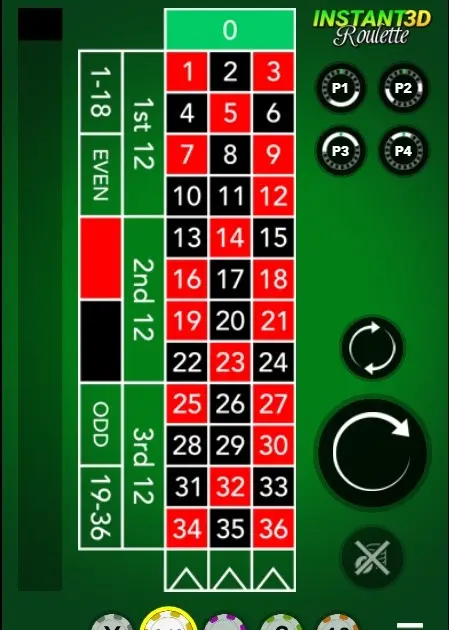
If you want a roulette table with a published return figure and a free demo attached, instant 3d roulette from Worldmatch clears that bar: the stated RTP is 97.3%, and you can spin it without depositing or downloading anything. What FACTS does not tell you is the pocket count, and on a roulette table that single number matters more than anything else on the page.
So treat this review as two halves. One half is what is confirmed about this table. The other half is the maths of roulette, which is fixed, public and does not care which studio built the wheel.
How Instant 3D Roulette plays
The name and the variant hint both point the same way: an immersive, 3D presentation layer sitting on top of a standard wheel. That is a camera-and-rendering decision, not a rules decision. A cinematic ball drop, a wheel you view from angles a physical table would never give you, and spin timing built for speed rather than ceremony.
What the presentation cannot do is change the payout table underneath. Straight-up numbers, splits, streets, corners, columns, dozens, red or black, odd or even, high or low — those bets and their payouts are standardised across the game. If a 3D table pays differently, it is because the paytable was altered, and you would read that on the game’s own rules screen, not infer it from the graphics.
FACTS does not confirm whether this table offers a racetrack for call bets like voisins du zéro or orphelins, whether it supports favourite-bet saving, or what its spin-to-spin pace is. Those affect how a session feels rather than what it costs you, but if you like placing neighbour bets, check the interface in the demo before you commit real money.
The pocket count is the whole story
Every meaningful question about a roulette table reduces to how many pockets the wheel has and what happens when zero lands. FACTS does not state the pocket count for this table, so here is the framework and where to look.
A single-zero European wheel has 37 pockets. A straight-up number pays 35:1 against true odds of 36:1, and that one-pocket gap produces a house edge of 2.70% on every standard bet. A double-zero American wheel has 38 pockets, the same 35:1 payout, and a house edge of 5.26% — plus 7.89% on the five-number basket bet, which is the worst bet on any roulette layout.
French rules change the picture again. Under La Partage or En Prison, a zero returns half your stake on even-money bets, cutting the even-money house edge to roughly 1.35%. That is the best standard bet in roulette, and it is why a French table is worth seeking out.
The rules screen tells you which of these three you are playing. Nothing about the title or the visuals does. Worldmatch also lists French Roulette Privee at the same 97.3% figure, and that one names its ruleset in the title.
Reading the 97.3% figure
An RTP of 97.3% means that over an enormous number of spins the game is modelled to return 97.30 units for every 100 staked. The mirror image is a 2.70% house edge, which is exactly the European single-zero figure — consistent with a 37-pocket wheel with no La Partage. Consistent is not confirmed, though. Read the rules screen.
For context, this sits above the Worldmatch average of 96.51% across their 13 tables, and above the 96.97% average of the tables reviewed here — a gap of 0.33 percentage points. In practical terms that is about 33 pence per £100 wagered, which is real but small.
The bigger point is that RTP is a long-run average, not a session forecast. Over a few hundred spins your result will be dominated by variance, not by the third decimal place of the return figure. Two tables with identical RTP can feel completely different depending on how you bet.
Choosing bets for the session you want
On a standard European layout, every bet below carries the same 2.70% expected cost. What changes is the shape of the ride.
| Bet | Pays | True odds (37 pockets) | Win chance |
|---|---|---|---|
| Straight up (1 number) | 35:1 | 36:1 | 2.70% |
| Split (2 numbers) | 17:1 | 17.5:1 | 5.41% |
| Street (3 numbers) | 11:1 | 11.33:1 | 8.11% |
| Corner (4 numbers) | 8:1 | 8.25:1 | 10.81% |
| Dozen or column | 2:1 | 2.08:1 | 32.43% |
| Red/black, odd/even, high/low | 1:1 | 1.06:1 | 48.65% |
Want a long session on a small budget? Even-money bets land just under half the time and keep your balance moving slowly. Want the chance of a big hit and accept most spins will be losses? Straight-up numbers deliver that, with roughly a 1-in-37 hit rate per number. Neither is smarter; they cost the same per unit staked.
Martingale and friends: the honest answer
No betting system changes expected value. Not Martingale, not Fibonacci, not D’Alembert, not Labouchère, not waiting for five reds before backing black. This is not a matter of opinion or of finding the right variation.
Spins are independent. An RNG wheel has no memory, so the probability of red on the next spin is identical whether the last five were red, black or a mix. Calling a number “due” or a sector “hot” describes a feeling, not a property of the wheel. Tracking previous results has no predictive value here.
What progressions actually do is redistribute variance. Martingale converts many small wins into occasional very large losses, and it runs into two hard walls: your bankroll and the table maximum. Doubling from £1 after eight consecutive losses needs £256 on the ninth bet and has already cost £255. The house edge on every one of those bets stayed at whatever the wheel’s edge is.
If you arrived searching for a system that works, the useful answer is that there isn’t one. Choose bets for the session shape you want instead.
Bankroll and table limits
FACTS does not state this table’s minimum or maximum stakes, and that gap matters. Limits set whether small-stake play is viable at all, and they cap any progression long before your bankroll does. Check the numbers in the demo, where staking is free.
A workable approach: decide the total you are willing to lose before you open the game, divide it by your unit stake, and see how many spins that buys. At 100 units of bankroll, even-money betting typically gives a few hundred spins of play. The same bankroll on straight-up numbers can vanish in a fraction of that, or spike hard — that is variance, not a flaw.
Roulette is entertainment, not income. Play only if you are 18 or over, set a budget in advance and treat it as the cost of the session, and stop when it is gone rather than chasing it. If gambling stops feeling like a choice, step away and use the operator’s deposit limits, timeouts and self-exclusion tools.
Verdict on Instant 3D Roulette
A published 97.3% RTP, a free demo, and a presentation layer that makes the wheel more interesting to watch. That is a reasonable package, and 97.3% is above both the Worldmatch house average and the wider average of tables covered here.
The caveat is what is not stated: pocket count, whether zero returns half your even-money stake, and the stake range. Those three answers determine your real cost per spin, and all three live on the game’s rules screen. Verify them there before depositing.
Worth comparing against Fair Roulette, another Worldmatch table at the same 97.3%, and worth avoiding the studio’s Ecuruleta if return figures matter to you, since it publishes 94.73% — a gap of more than 2.5 percentage points on every unit you stake.
Frequently Asked Questions
Can I play Instant 3D Roulette free with no download?
Yes. A free demo is available for this table, so you can place bets with play credits, test the 3D interface and check the rules screen without depositing or installing anything. Demo results are generated the same way as real-money spins, but they never predict what a real-money session will do.
What is the Instant 3D Roulette RTP?
The published RTP is 97.3%, meaning the game is modelled to return 97.30 units per 100 staked over a very long run. That is above the Worldmatch average of 96.51% across their 13 tables and above the 96.97% average of the tables reviewed here. It is not a session forecast.
Is this a European or American wheel?
FACTS does not confirm the pocket count, so you should check the game's own rules screen. The 97.3% RTP corresponds to a 2.70% house edge, which matches a 37-pocket single-zero wheel without La Partage, but that is inference rather than confirmation. A 38-pocket double-zero wheel would carry a 5.26% edge instead.
Does the Martingale system work on this table?
No. Martingale and every other progression leave expected value unchanged, because spins are independent and the wheel has no memory. Progressions only reshape variance, turning frequent small wins into rarer large losses, and they hit your bankroll or the table maximum first. Doubling from £1 needs £256 on the ninth bet.
Which bet should I choose for a longer session?
Even-money bets — red or black, odd or even, high or low — land just under 48.65% of the time on a 37-pocket wheel and drain a bankroll slowly. They carry the same house edge as straight-up numbers, so you are choosing variance, not value. Straight-up bets hit about 1 spin in 37.




