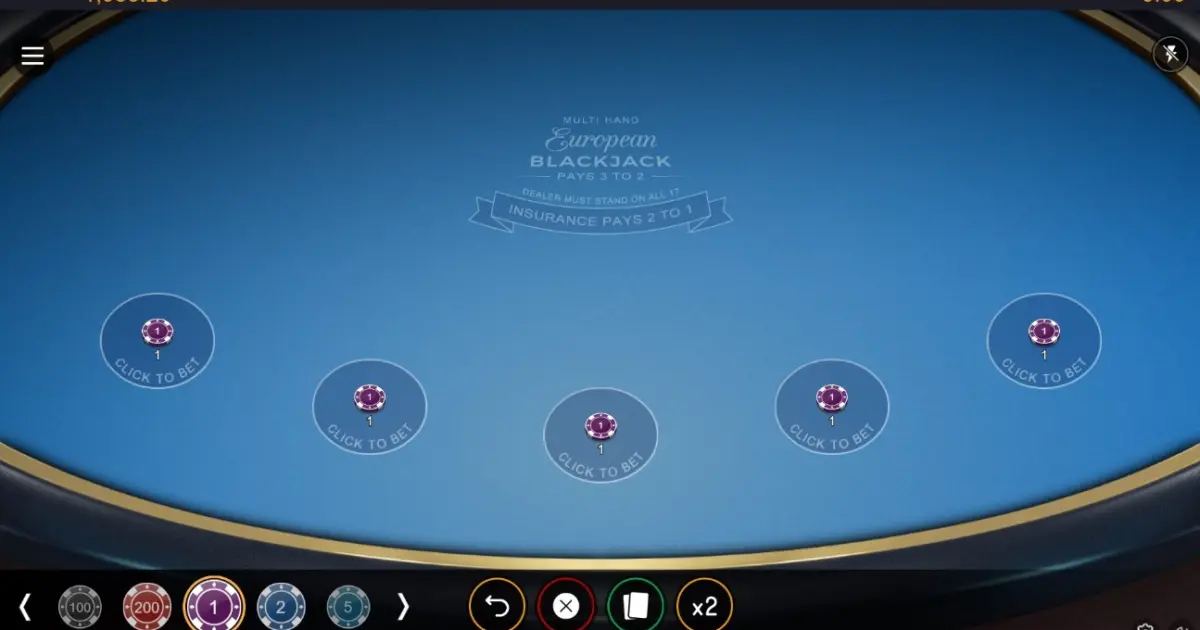
If you want a low-edge blackjack table you can play without downloading anything, multihand european blackjack from Switch Studios is a reasonable place to spend an hour. The published return is 99.6%, and a free demo is available, so you can read the paytable and rule screen at zero cost before deciding whether the real-money version suits you.
The catch is structural rather than mathematical: the name points to European rules and multiple hands per round, and both of those change how much money passes through your hands per hour.
How Multihand European Blackjack plays
The core loop is the blackjack you already know. You place a bet, receive two cards, and try to finish closer to 21 than the dealer without busting. Hit, stand, double and split are the standard decisions, and the dealer plays a fixed, published rule set with no discretion.
What the title adds is the multi-hand layout: you play several hands in the same round against a single dealer hand. That is not a strategy advantage. Each hand is decided on its own against the same dealer upcard, so your expected value per hand is unchanged — but your total stake per round is multiplied by however many boxes you open. Three hands at one unit each is a three-unit round, and the swings scale with it.
Switch Studios does not publish the deck count, table limits, or the exact double and split permissions in the data available here. Those details matter at the margin, and they are all printed on the game’s own rules screen. Open the demo, read that screen, and confirm before you commit money. It takes thirty seconds and removes the guesswork entirely.
European rules and what the name tells you
The name indicates European blackjack, which normally means the dealer takes no hole card until you have finished acting on your hands. In the American peek format, the dealer checks for blackjack immediately, and if they have it, you lose only your original stake — doubles and splits are returned. Under the no-hole-card format, that protection disappears: if you double or split against a ten or an ace and the dealer turns over blackjace, the additional money can go with it.
The practical consequence is a small but real edge cost, usually cited around 0.11% for the no-peek rule, and a change in correct play. Basic strategy charts written for European tables are slightly more conservative about doubling and splitting against a dealer ten or ace. If you use an American chart on a European table, you are giving away a fraction of a percent every session.
Treat this as a strong hint, not a confirmed rule. The title implies it; the paytable proves it. Check whether the dealer peeks, and check what happens to a doubled bet when they hold blackjack.
Reading the 99.6% return figure
A 99.6% RTP is the same statement as a 0.4% house edge — the two are just complements. Across a very large number of hands, the table is modelled to return 99.6 pence per pound wagered and keep 0.4 pence. That sits above the 99.41% average across the blackjack tables in our database, and almost exactly on the Switch Studios average of 99.61% across their 22 titles.
The caveat is the one that matters most and gets mentioned least. Every published blackjack RTP assumes perfect basic strategy on every single hand. It is the return achieved by a player who never deviates, never hits a hard 17 on a hunch, and never takes insurance. A casual player guessing through borderline decisions realises a materially lower figure — commonly a full percentage point or more worse, depending on how often they stray.
So 99.6% is not a promise. It is a ceiling, and reaching it is a skill requirement. It also says nothing about a single session, where variance dominates completely.
Where the house edge actually comes from
The edge exists for one reason: you act first. If you bust, you lose immediately, whatever the dealer does afterwards. Every player-friendly rule is a partial refund against that structural disadvantage, and each one moves the number by a known amount.
| Figure | Value |
|---|---|
| Published RTP | 99.6% |
| Implied house edge | 0.4% |
| Provider | Switch Studios |
| Provider average RTP | 99.61% |
| Database average RTP | 99.41% |
| Free demo | Available |
As general rules of thumb: a blackjack paying 6:5 instead of 3:2 costs you roughly 1.4% and is by far the most damaging change any table can make — always check this first. A dealer who hits soft 17 costs about 0.2%. Fewer decks help; eight decks are worth around 0.06% more to the house than six. Double after split, re-splitting aces and late surrender each hand a little back to you, between 0.08% and 0.14%.
Side bets sit outside all of this. Perfect Pairs and 21+3 typically carry house edges of several percent, many times the base game. Insurance is a losing proposition at standard 2:1 odds regardless of what your hand looks like. The data here does not confirm which side bets, if any, this table offers.
Does card counting work here?
No. Counting works by tracking which cards have left the shoe so you can raise your bet when the remaining deck is rich in tens and aces. An RNG table that reshuffles after every hand destroys that link: each round is dealt from a fresh, full distribution, so the count from the previous hand carries exactly zero information into the next one.
The same reasoning kills every betting progression. Martingale, D’Alembert, doubling after a loss — none of them touch the expected value of a hand, because the expected value of each hand is fixed by the rules. What they change is the shape of your variance: you trade many small wins for occasional very large losses, and you reach the table maximum faster than most people expect. Nor is a hand ever “due”; independent deals have no memory.
What genuinely reduces the edge is basic strategy. It is not a system but a solved chart — the mathematically correct decision for every player total against every dealer upcard. It minimises the house edge. It never removes it.
Bankroll and unit sizing
Multi-hand play changes the arithmetic of bankroll planning more than most players allow for. If you open three boxes, you stake three units per round and reach three times the hourly volume of a single-hand table. A bankroll that comfortably absorbs 100 single-hand rounds absorbs barely 33 three-hand rounds. Size your unit against your total exposure per round, not per box.
A common approach is keeping one unit at or below 1% of the session bankroll, which leaves room for the losing streaks that a 0.4% edge game will still hand you regularly. Doubles and splits also need funding mid-hand, so reserve headroom for them.
This is entertainment, not income. Play only if you are 18 or over, set a budget before you open the game, and treat that budget as the cost of the session rather than money you expect to recover. If a limit stops being a limit, stop playing.
Demo play is useful for drilling decisions and learning the interface. It does not predict real-money outcomes.
Verdict
At 99.6% this is a competitive table, above the database average and in line with what Switch Studios offers elsewhere. The multi-hand format suits players who already know their chart and want more hands per hour; the European no-hole-card rule, if confirmed, means you should use a European strategy chart rather than an American one.
Ranked 127th and in the 5.3rd popularity percentile, it is not a heavily played title, which says more about visibility than quality. If you want a higher headline return, Classic Blackjack lists 99.9% and Vegas Strip Blackjack 99.7% from the same studio. For an identical 99.6% with a different structure, ReDeal Blackjack is worth comparing side by side in the demo.
Frequently Asked Questions
Can I play Multihand European Blackjack free with no download?
Yes. A free demo of Multihand European Blackjack is available and runs in the browser, so no download is needed. It uses play-money chips with the same rules and paytable as the real-money version, which makes it a sensible place to read the rules screen and drill basic strategy decisions before staking anything.
What is the Multihand European Blackjack RTP?
Switch Studios publishes 99.6%, equivalent to a 0.4% house edge. That figure sits above the 99.41% average across the blackjack tables in our database. Critically, it assumes perfect basic strategy on every hand — a player who guesses through borderline decisions will realise a noticeably lower return over time.
How do the rules change the house edge on this table?
The 0.4% edge is the product of the specific rule set. As rules of thumb, a 6:5 blackjack payout costs roughly 1.4%, a dealer hitting soft 17 about 0.2%, and the European no-hole-card rule around 0.11%. Switch Studios does not publish the deck count here, so check the in-game rules screen.
Does card counting or a betting system work on this game?
No. This is an RNG table, and if it reshuffles every hand, the count carries no information from one round to the next. Betting progressions like Martingale change the shape of your variance, not the expected value. Basic strategy is the only method that genuinely reduces the 0.4% edge.
Who is Switch Studios and how does this compare to their other tables?
Switch Studios is the provider, with 22 titles in our database averaging 99.61% RTP. This table's 99.6% is right on that average. Their Classic Blackjack lists 99.9% and Vegas Strip Blackjack 99.7%, both higher, though the multi-hand format here gives you more hands per round.




