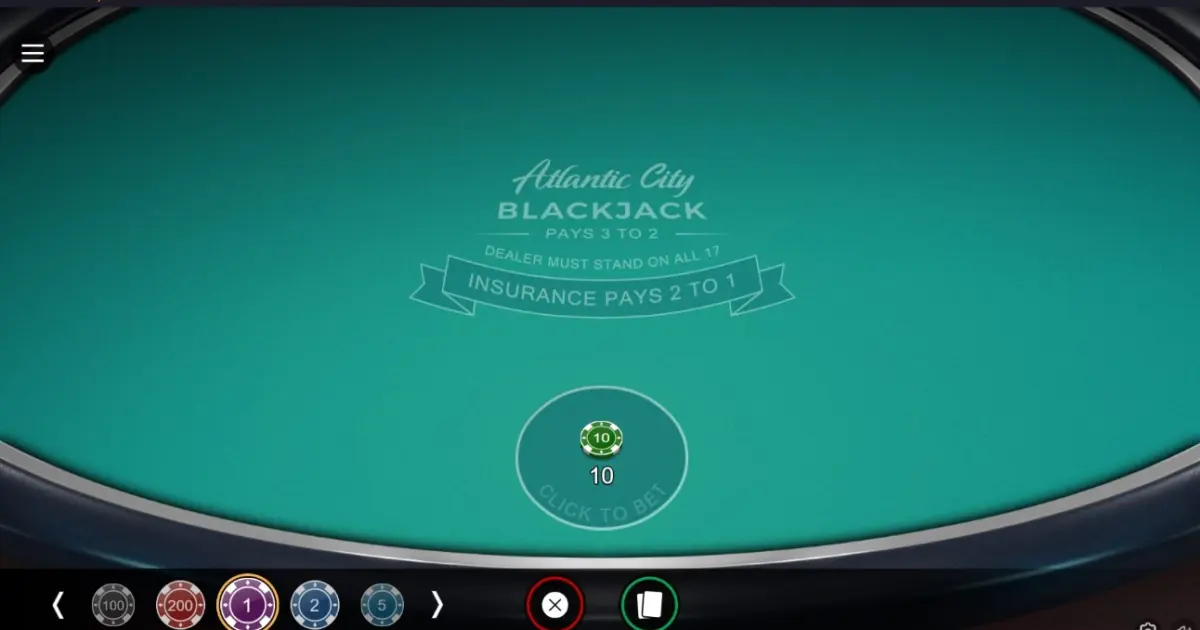
Atlantic City Blackjack from Switch Studios sits at a 99.7% RTP, placing it slightly above the provider’s own average of 99.61% and well above the corpus-wide blackjack average of 99.41%. That is a competitive number on paper. The question is whether you will actually realise it, and that depends entirely on how well you execute basic strategy hand after hand.
Atlantic City Blackjack at a glance
Switch Studios publishes 22 blackjack titles, and this table ranks 102nd by popularity across the full catalogue, meaning it is a mid-tier entry rather than a headline product. The provider places it among its higher-paying variants, just ahead of its own portfolio average and clearly above the corpus benchmark. The free demo is available, so you can inspect the interface and rule set before deciding whether to play for real money.
| Detail | Value |
|---|---|
| Provider | Switch Studios |
| RTP | 99.7% |
| Implied house edge | 0.3% |
| Provider average RTP | 99.61% |
| Corpus average RTP | 99.41% |
| Free demo | Available |
Switch Studios does not publish the deck count, the blackjack payout ratio, or the full rule set on its public game page for this title. That gap matters, because a single rule such as 6:5 instead of 3:2 on blackjack would erase most of the edge advantage this RTP figure implies. Check the in-game rules screen before committing.
What a 99.7% RTP means at a blackjack table
Every published blackjack RTP figure, including this one, assumes you play perfect basic strategy on every single hand. There is no exception, no asterisk, and no casino that will tell you otherwise. A casual player who deviates from the chart even a few times per hour realises a materially lower return, and the gap between 99.7% and what you actually get can easily reach a full percentage point or more.
The 0.3% house edge implied by this RTP is therefore a floor, not a forecast. It represents the absolute minimum theoretical cost of playing when you make the mathematically optimal decision every time. If you are new to the game or play on autopilot, the real cost is meaningfully higher.
For context, the corpus average sits at 99.41%, which implies a 0.59% house edge. This table cuts that roughly in half on paper. Compare that with another provider title, Vegas Strip Blackjack, which carries the identical 99.7% RTP. If both tables share the same underlying rule set, the choice between them comes down to interface preferences rather than expected value.
The rules that move the house edge
The game title references Atlantic City, which in a live-casino context normally signals a specific rule package: eight decks, the dealer standing on soft 17, and late surrender available. If Switch Studios has implemented that package here, the rules are player-friendly. Dealer standing on soft 17 reduces the house edge by roughly 0.2% compared to hitting it. Late surrender, when usable, shaves off another 0.05–0.07%. Eight decks is the standard in multi-deck blackjack and costs you a small amount versus fewer decks, but the effect between six and eight is negligible for most players.
Crucially, none of those rules are confirmed in the game’s published data. The name hints at them, but “Atlantic City” has become a marketing label as much as a ruleset descriptor. Before you treat those numbers as real, open the in-game paytable and verify the deck count, the soft-17 behaviour, and whether surrender is offered. A single unconfirmed rule can shift the edge by a full tenth of a percentage point or more.
For a contrast in how much rule packages vary, see Classic Blackjack from the same provider, which lists a 99.9% RTP. That 0.2-point gap likely reflects a different rule combination, possibly a single-deck format or more favourable doubling terms.
Basic strategy, and what it can and cannot do
Basic strategy is a solved mathematical chart, not a system, not a hunch, and not something you improvise at the table. It tells you the highest-expected-value action for every possible player hand against every possible dealer upcard, derived from exhaustive combinatorial analysis of millions of simulated hands. You either follow it or you do not.
What basic strategy cannot do is eliminate the house edge. Even executed flawlessly, the dealer retains a mathematical advantage — on this table, presumably the 0.3% stated above, but only if the rules match what the title implies. No sequencing, no bet-sizing trick, and no “feeling” changes the fundamental arithmetic of the game.
What it does deliver is the best possible return available to you. Deviating from the chart, even slightly, compounds across hundreds of hands. A player who hits on hard 16 against a dealer 10 roughly 30% of the time instead of always standing is quietly surrendering several hundredths of a percentage point every session, every week, indefinitely.
If you are still building your chart fluency, the free demo is the correct place to practise. Mistakes cost nothing there, and repetition builds the reflexes that protect your edge at a real-money table.
Side bets and insurance
Switch Studios does not list the side bets available on this particular table, so check the game screen before you assume any are present. If Perfect Pairs or 21+3 are offered, treat them as separate bets with a materially higher house edge than the base game — typically in the range of 2% to 6% or worse, depending on the exact paytable. That means a side bet can cost you five to twenty times more per dollar wagered than the 0.3% implied by the main game.
Insurance deserves specific attention because it appears at nearly every blackjack table and looks like a safety net. It is not. At standard odds, insurance is a losing proposition. The dealer’s ten-card in the hole does not appear often enough to justify the even-money payout the bet offers. The correct basic-strategy play against insurance is always to decline it, with one narrow exception involving card counting at a live shoe that is irrelevant here because this is an RNG table that reshuffles every hand.
If you want to minimise your total expected loss, play only the base hand and skip every optional wager on the screen.
Playing the Atlantic City Blackjack demo
Switch Studios offers a free demo of this table, accessible without a download or registration. The Atlantic City Blackjack free demo runs on the same RNG logic as the real-money version, so the card distribution you see while practising mirrors what you would face at a funded session. That makes it a genuine environment for building strategy fluency and confirming which rules the game actually applies.
What the demo cannot do is predict your real-money results. Variance over any short session is enormous, and a sequence of poor outcomes in demo play tells you nothing about your next funded session or vice versa. The demo tests your knowledge of the rules and your chart recall, not your luck.
One practical note on playing Atlantic City Blackjack no download: browser performance on RNG blackjack tables depends more on your device and connection than on the game file itself. If the demo feels laggy on one device, try another before concluding anything about the provider’s optimisation.
If you do move to real money, set a session budget before you start, treat it as an entertainment expense rather than an investment, and stop when it is gone. Play only if you are 18 or older in your jurisdiction. No game, including this one, can be a reliable income source.
Verdict: who should sit at this table
Atlantic City Blackjack is a reasonable mid-popularity option from a provider with a genuinely strong portfolio average. The 99.7% RTP puts it in the top tier of published figures on this site, and it matches the RTP on ReDeal Blackjack within a tenth of a point. For a player who knows the chart cold and plays methodically, the maths is as good as an RNG blackjack table gets on paper.
The caveat remains the same one that applies to every blackjack RTP claim: those numbers are a theoretical floor that only applies under perfect play. If you are still learning the chart, the effective edge you face is higher than anything the paytable states.
Who benefits most from this table? A player who already knows basic strategy and wants a clean interface with a decent stated return, someone looking to practise Atlantic City rules before sitting at a live shoe, or a browser-based player who values no-download convenience. If you have not yet studied the chart, start at a demo with fewer rule variables until the decisions become automatic.
Frequently Asked Questions
Is there a free demo for Atlantic City Blackjack?
Yes. Switch Studios offers a free demo that runs on the same RNG as the real-money version. You can access it without downloading software or registering an account, making it suitable for practising basic strategy and confirming the exact rules the game applies before risking any money.
What is the RTP on Atlantic City Blackjack and does it apply to my play?
Switch Studios publishes a 99.7% RTP for this table, implying a 0.3% house edge. That figure assumes perfect basic strategy on every single hand. A casual player who deviates from the chart even a few times per hour will realise a materially lower return than the published number suggests.
How does the house edge on this table compare to the provider average?
The implied 0.3% house edge is below Switch Studios' portfolio average, which sits at a 0.39% edge derived from its 99.61% average RTP. It is also well below the corpus-wide average of 0.59%. The 0.29-percentage-point advantage over the corpus is meaningful across thousands of hands, provided you play optimally.
Does card counting work on Atlantic City Blackjack?
No. This is an RNG table, meaning the virtual deck reshuffles completely before every hand. Card counting relies on tracking the composition of a fixed shoe to identify player-favourable spots. Because no information carries over between hands here, counting cannot shift the edge in any direction regardless of your skill.
How does Atlantic City Blackjack compare to Vegas Strip Blackjack from the same provider?
Both Switch Studios titles publish a 99.7% RTP. Vegas Strip Blackjack also implies the same 0.3% house edge under perfect play. The difference between them, if any, will come down to specific rule implementations such as surrender availability and doubling terms, so verify each game's in-play rules screen before choosing.




