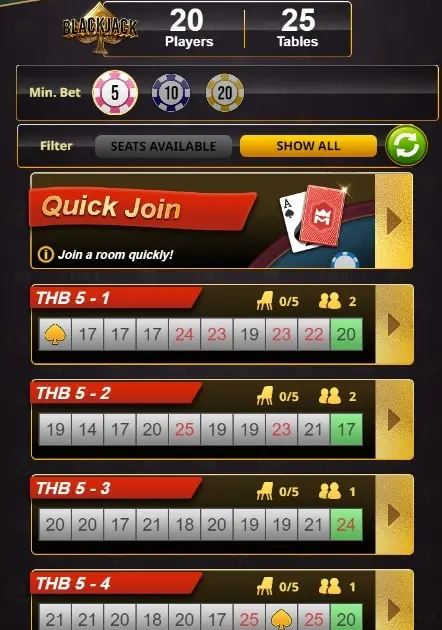
The headline figure for blackjack (kingmaker) is a published RTP of 99.28%, which corresponds to a house edge of roughly 0.72%. That is a normal, respectable number for an online blackjack table and it sits a fraction below the 99.41% average across the blackjack titles catalogued here. Whether the table is worth your time depends less on that gap than on one thing: the figure assumes flawless basic strategy, and most players do not deliver it.
Is Blackjack (Kingmaker) a fair table?
Yes, on the published number. An RTP of 99.28% means the theoretical house edge is about 0.72%, or 72p expected loss per £100 wagered over a very long run of hands. Compared with almost any other casino game, that is generous. Slots routinely run 4% to 8% against you.
The caveat matters more than the figure. A blackjack RTP is not a passive property of the table the way a slot’s RTP is. It is calculated on the assumption that the player makes the mathematically optimal decision on every hand — every hit, stand, double and split taken from the correct basic strategy chart for that exact rule set. Deviate, and your realised return drops below 99.28%. A casual player who stands on 16 against a dealer 7 because it feels safer, takes insurance out of habit, or splits tens is not playing a 99.28% game. They are playing something considerably worse, often 1.5% to 2.5% house edge territory, and the published figure tells them nothing useful about their own results.
So the honest answer: the table is fair, and it is on you to collect what it offers.
King Midas (Kingmaker) and this table
King Midas (Kingmaker) has exactly one blackjack table in this catalogue, and this is it. That makes the provider’s average RTP identical to this game’s — 99.28% — because there is nothing else to average against. A single-title provider gives you no track record to read across, no house style in rule generosity to infer, and no sibling table to compare against. Judge this one on its own paytable and nothing else.
For context, the widely played tables in this category cluster close together. If you want a direct comparison, Classic Blackjack publishes the same 99.28% return, so the two are theoretically identical on the base game and the difference comes down to rules and side bets. If you would rather start from the more player-friendly end of the range, American Blackjack is quoted at 99.5%, which is about a quarter of a percent better on paper — small per hand, meaningful over thousands.
Rule set: what the title implies
Here is where honesty is more useful than confidence. The title is simply “Blackjack” with no qualifier — no “European”, no “Single Deck”, no “Multihand”, no “Switch”. That gives no rule hint whatsoever, and Kingmaker does not publish the specifics alongside the RTP figure in this listing.
That means the following are unknown to you before you open the game: the number of decks, whether the dealer stands or hits on soft 17, whether blackjack pays 3:2 or 6:5, whether double after split and re-splitting aces are permitted, whether late surrender exists, whether the dealer peeks for blackjack, what side bets are offered, and the table limits. Every one of those moves the edge.
The practical step is short and non-negotiable if you care about the maths: open the in-game rules or paytable screen before you wager anything real. The 99.28% RTP is a strong signal that the rule set is reasonably standard, because badly configured rules would drag the number lower. But a signal is not a specification. Read the screen.
The maths of a blackjack hand
Blackjack’s edge is built from small, additive rule effects, and knowing the direction of each one lets you read any paytable quickly. As general rules of thumb:
- A blackjack paying 6:5 instead of 3:2 costs you roughly 1.4%. It is the single most damaging change a table can make, and it dwarfs everything else on this list. If you see 6:5, walk.
- A dealer who hits soft 17 rather than standing costs you around 0.2%.
- More decks favour the house. Moving from one deck to eight adds a few tenths of a percent.
- Double after split and re-splitting aces each return a small amount to you, in the region of a tenth of a percent or so.
- Late surrender helps you slightly, and dealer peek is better for you than a European no-hole-card rule where you lose doubled and split stakes to a dealer blackjack.
Basic strategy is the chart that turns those rules into the correct play for every hand total against every dealer upcard. It is a solved problem, not a system — the answers were computed decades ago and there is nothing to discover. It minimises the house edge; it never removes it.
One thing it cannot do here: card counting has no traction against an RNG table that reshuffles the deck before every hand. Counting works by tracking depletion across a shoe. If the shoe resets each round, there is no information to carry forward and no count to build. Betting progressions fare no better. Doubling after a loss reshapes your variance into rarer, larger swings; it leaves expected value untouched. No hand is ever “due”.
Common mistakes that cost you the edge
Three habits do most of the damage, and all three are avoidable.
Insurance is the first. At the standard 2:1 payout it is a losing proposition — the dealer completes blackjack less often than the odds require to break even, so taking it hands back part of the edge basic strategy just earned you. Decline it as a standing rule.
Second is deviating from the chart when a hand feels wrong. Hitting 16 against a dealer 7 through 10 feels reckless and is correct. Standing on soft 18 against a 9 feels prudent and is not. The chart already accounts for how often you bust; your intuition does not. If you cannot recall a line, look it up rather than guess — the demo mode exists for exactly that.
Third is the side bets. Perfect Pairs, 21+3 and their relatives typically carry house edges several times the base game’s, sometimes 5% or higher. It is not known which side bets, if any, this table offers, but the principle holds wherever you find them: a few pounds a hand on a 5% bet erodes a 0.72% game fast. If you want the 99.28% return, bet the base game and nothing else.
Trying it free first
A Blackjack (Kingmaker) free demo is available, and it is genuinely the right way to start. Use it to read the rules screen, confirm the deck count, soft 17 rule and blackjack payout, then run a few hundred hands with a basic strategy chart open beside you until the correct plays stop needing a lookup. That is unglamorous practice, and it is the only thing that closes the gap between the published RTP and your actual return.
What the demo cannot do is forecast money. Free-play results carry no predictive weight for real-money sessions; a good run in the demo is variance, not evidence.
Blackjack is for adults aged 18 or over. Set a budget before you open the table, treat it as the cost of entertainment rather than a source of income, and stop when that budget is spent rather than when you feel a session owes you something.
Final take on Blackjack (Kingmaker)
A 99.28% published return is solid, a little below the category average of 99.41%, and low enough in house edge that the table is not the limiting factor on your results — your decision accuracy is. The frustration is the missing detail. With no rule qualifier in the title and no published deck count, soft 17 rule or blackjack payout, you cannot fully price the table before you open it, and Kingmaker’s single-title catalogue gives you no pattern to fall back on.
That makes this a straightforward recommendation with one condition attached: check the paytable first, confirm blackjack pays 3:2, then play the base game with a strategy chart and skip the side bets. If the rules read well, you have a fair table. If you want a slightly better published figure from the same category, Blackjack (Mascot Gaming) is quoted at 99.5%.
| Detail | Value |
|---|---|
| Game | Blackjack (Kingmaker) |
| Provider | King Midas (Kingmaker) |
| RTP | 99.28% |
| Implied house edge | Approx. 0.72% |
| Category | Black Jack |
| Category average RTP | 99.41% |
| Difference vs category average | -0.13% |
| Provider titles in catalogue | 1 |
| Free demo | Available |
Frequently Asked Questions
Can I play Blackjack (Kingmaker) for free?
Yes, a free demo is available with no deposit required. It is the sensible place to confirm the table's deck count, soft 17 rule and blackjack payout from the in-game rules screen, and to rehearse basic strategy decisions. Bear in mind that demo results tell you nothing about how a real-money session will go.
What is the RTP of Blackjack (Kingmaker)?
The published RTP is 99.28%, implying a house edge of about 0.72%. That figure assumes you play perfect basic strategy on every hand, without exception. Play by instinct, take insurance, or misplay stiff totals and your realised return falls well below 99.28% — often into 1.5% to 2.5% house edge territory.
What rules does this blackjack table use?
They are not published in this listing. The title carries no qualifier such as European or Single Deck, so the deck count, soft 17 rule, blackjack payout, surrender and double rules are all unknown until you open the game. Check the paytable screen before wagering; a 6:5 blackjack payout alone costs roughly 1.4%.
Does card counting work on Blackjack (Kingmaker)?
No. RNG blackjack tables reshuffle before every hand, so there is no depletion to track and no count to carry between rounds. Betting progressions like Martingale do not help either — they change the shape of your variance into rarer, larger swings while leaving expected value unchanged. Basic strategy is the only edge-reducing tool available.
How does it compare with Classic Blackjack?
Both publish the same 99.28% RTP, so on the base game they are theoretically identical and the difference comes down to specific rules and side bet offerings. If you want a better published figure, American Blackjack and Blackjack (Mascot Gaming) are both quoted at 99.5%, roughly a quarter of a percent better across a long run of hands.




