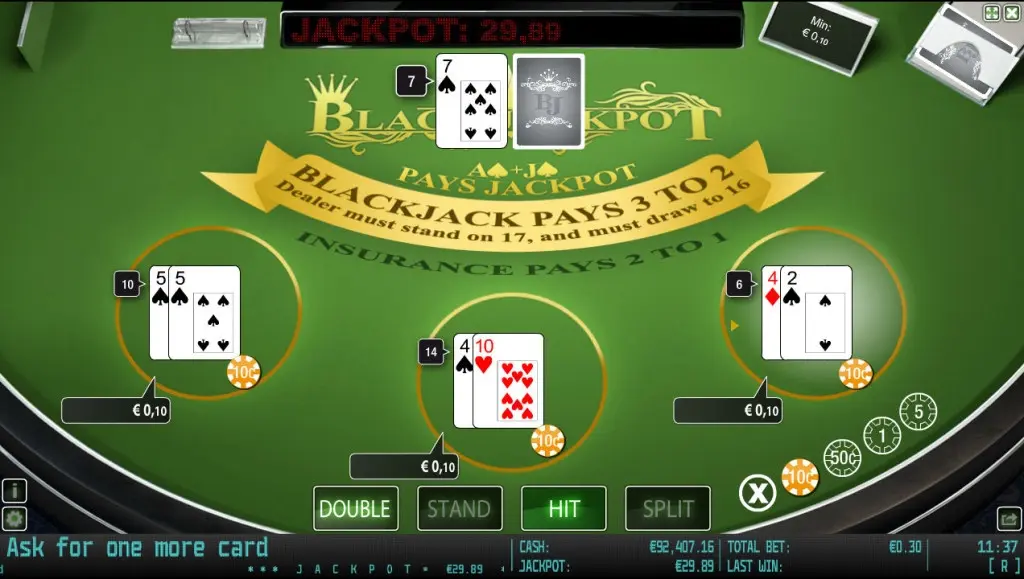
If you are deciding whether black jackpot blackjack is worth your time, the short answer is that its published return-to-player figure of 99.44% places it marginally above the market average, but the listing hides several rule details that could shift the actual edge against you. Worldmatch releases the RTP without the underlying rule set, so a maths-literate player should treat the headline number as a ceiling rather than a guarantee.
Here is what is confirmed. The provider is Worldmatch, a developer with eight blackjack titles in the catalogue, and the game sits in the Cards subcategory. Free-play access is available, which means you can observe dealing cadence and hand timing without staking a unit. What is absent from the published data is the deck count, the dealer’s soft-seventeen rule, the blackjack payout ratio, whether double-after-split and resplitting aces are permitted, and any side-bet menu. Each of those variables moves the house edge by tens or hundreds of basis points, so their omission is the single biggest weakness in this listing.
Black Jackpot in one minute
Black jackpot blackjack is a Worldmatch table that reports a 99.44% RTP, implying a house edge of 0.56% under conditions the provider does not describe. The game appears in the Cards subcategory and offers a free demo. Beyond those four data points, the rule architecture that any serious blackjack player cares about is unpublished. You will need to open the in-game rules screen before depositing, because a hidden six-to-five blackjack payout or a dealer hitting soft seventeen could erase the small advantage the headline RTP suggests over the market.
House edge versus RTP: the numbers explained
The Black Jackpot RTP figure of 99.44% translates to a 0.56% house edge per round, assuming perfect basic strategy on every decision. That assumption is critical. A casual player who stands on a soft eighteen against a dealer six or splits a pair of eights against a ten is not playing the strategy the 99.44% number was computed against. Realistic returns for imperfect play sit roughly half a percentage point to a full percentage point lower, depending on how many errors creep in per shoe.
General rules-of-thumb that move the edge in blackjack, listed so you know what to verify once you open the rules screen:
| Rule variable | Effect on house edge (approximate) | Published for this game? |
|---|---|---|
| Six-to-five blackjack payout instead of three-to-two | +1.4 percentage points against the player | No |
| Dealer hits soft seventeen instead of stands | +0.2 percentage points | No |
| Single deck versus eight decks | Single deck reduces edge by roughly 0.15–0.2 points, depending on other rules | No |
| Late surrender permitted | Reduces edge by roughly 0.07 points | No |
| Double after split permitted | Reduces edge by roughly 0.14 points | No |
| Published RTP | 99.44% | Yes |
| Provider | Worldmatch | Yes |
Because none of the rule rows above are confirmed, the 0.56% figure is best understood as a theoretical floor. If the table pays six to five on blackjack, the practical edge rises to roughly 1.9% under perfect play. If it pays three to two and stands on soft seventeen, the published number is more credible.
How black jackpot blackjack compares to other online blackjack
The market-wide corpus average across all blackjack titles tracked on this site is 99.41%. Black Jackpot sits +0.03 percentage points above that benchmark, which is a genuine but narrow improvement. It also matches the provider average exactly: Worldmatch’s eight blackjack games all report 99.44%, suggesting the studio uses a single rule template across the portfolio.
Two titles from the same developer are BlackJack Pro and Black Jack Single. Both carry the identical 99.44% figure. The name “Black Jack Single” hints at a one-deck shoe, which would lower the edge if the payout is three to two, but a single-deck game paying six to five still carries roughly 1.46%—worse than a multi-deck three-to-two table. Always verify the paytable.
Against the broader theme, Multihand Blackjack edges ahead at 99.5% RTP, and Classic Blackjack trails at 99.28%. A 0.22-point gap between Black Jackpot and Classic Blackjack corresponds to roughly one additional dollar returned per thousand wagered under perfect strategy—enough to matter over long sessions if you are tracking expected value per unit.
Basic strategy in practice
Basic strategy is a solved decision chart: for every player total against every dealer upcard, one action carries the highest expected value. It is not a system, not a feeling, and not a sequence you memorise by hand. Deviations from the chart are quantifiable, and the cost of each common error is well documented in blackjack literature.
Because Worldmatch does not publish the rule set for this specific table, the correct chart to follow depends on what you find in the game’s own help screen. A multi-deck, stand-on-soft-seventeen, double-after-split table produces one chart. A hit-soft-seventeen variant shifts several boundary decisions—for instance, you may need to surrender or hit hands you would stand on in the friendlier ruleset. The safe approach is to load the demo, identify the rules, then consult the matching chart before playing for money.
On any table where the dealer stands on soft seventeen and blackjack pays three to two, basic strategy recovers essentially all the edge that rule structure permits. That is why the 99.44% figure is plausible for a well-configured game, and why it is also the most optimistic reading of an incomplete listing.
Betting systems and why they do not change the odds
Martingale, D’Alembert, Fibonacci and every other progression redistribute the shape of your session variance. They do not alter the expected value per hand, because each individual decision carries the same house edge regardless of how you size the bet. A doubling plan after a loss increases the probability of a short winning session and the probability of a catastrophic drawdown that wipes out the bankroll in a handful of hands. The maths is indifferent to your stake schedule.
Card counting—the only legitimate technique for reducing the house edge—requires a persistent shoe where removed cards shift the composition of remaining cards. Against an RNG blackjack table that reshuffles every hand, the count resets to zero before the next deal. There is no informational edge to exploit, regardless of how skilled your counting system is. Black Jackpot is an RNG game, so counting is not relevant here.
The free demo
Black Jackpot’s free demo mode lets you examine dealing speed, animation timing and the rules screen without risking money. Use it to confirm three things before you deposit: the blackjack payout ratio, whether the dealer hits or stands on soft seventeen, and how many decks are in play. Those three facts let you compute the true edge under basic strategy and decide whether 99.44% is credible or optimistic.
Demo results carry no predictive power over real-money sessions. The RNG does not track your play, and a streak of wins in free mode says nothing about future outcomes.
If you move to real money, set a session budget in advance and treat any deposit as entertainment spending, not income. Play only if you are 18 or older, and stop when the budget is reached regardless of the hand in progress.
Verdict
Black Jackpot is a serviceable Worldmatch table with a published RTP that clears the market average by a hair. For a player who verifies the rules first, it offers a reasonable starting point among Worldmatch’s eight blackjack variants. For a player who trusts the headline number without checking the paytable, the risk is real: the undisclosed six-to-five possibility alone could swing the practical edge by more than a full percentage point.
Bottom line: open the rules screen, confirm the payout and soft-seventeen handling, then match your play to the correct basic-strategy chart. If those rules are player-friendly, the 99.44% figure is achievable. If they are not, the demo will show you that within a few hands, and you can move on without a single unit at risk.
Frequently Asked Questions
Can I play Black Jackpot blackjack for free?
Yes. Worldmatch's Black Jackpot is available as a free demo with no download or registration required on this review site. The demo uses the same RNG logic as the real-money version, letting you confirm the blackjack payout, soft-seventeen rule and deck count from the in-game help screen before staking anything.
What is the RTP of Black Jackpot blackjack and does it account for imperfect play?
The published RTP is 99.44%, which assumes perfect basic strategy on every single hand. A casual player making even a few common errors per shoe typically realises a return closer to 98.5–99.0%, meaning the headline figure overstates what most players actually receive back over time.
How does Black Jackpot's house edge compare to other Worldmatch blackjacks?
The house edge is 0.56% based on the 99.44% RTP, identical to every other Worldmatch blackjack title tracked here including BlackJack Pro and Black Jack Single. All eight games in the provider catalogue share the same published return, indicating a standardised rule template across the portfolio.
Does card counting work on Black Jackpot blackjack?
No. Black Jackpot is an RNG game that reshuffles the deck before every hand, resetting the card composition to a fresh state. Without a persistent shoe, no counting system can produce an informational edge, regardless of the player's skill or the counting method used.
Is Black Jackpot better than Multihand Blackjack from a returns perspective?
Multihand Blackjack reports a 99.5% RTP against Black Jackpot's 99.44%, a difference of 0.06 percentage points. Over one thousand units wagered under perfect strategy, that gap returns roughly sixty cents more to the player. Whether the rule details behind those numbers are identical depends on what each paytable discloses.




