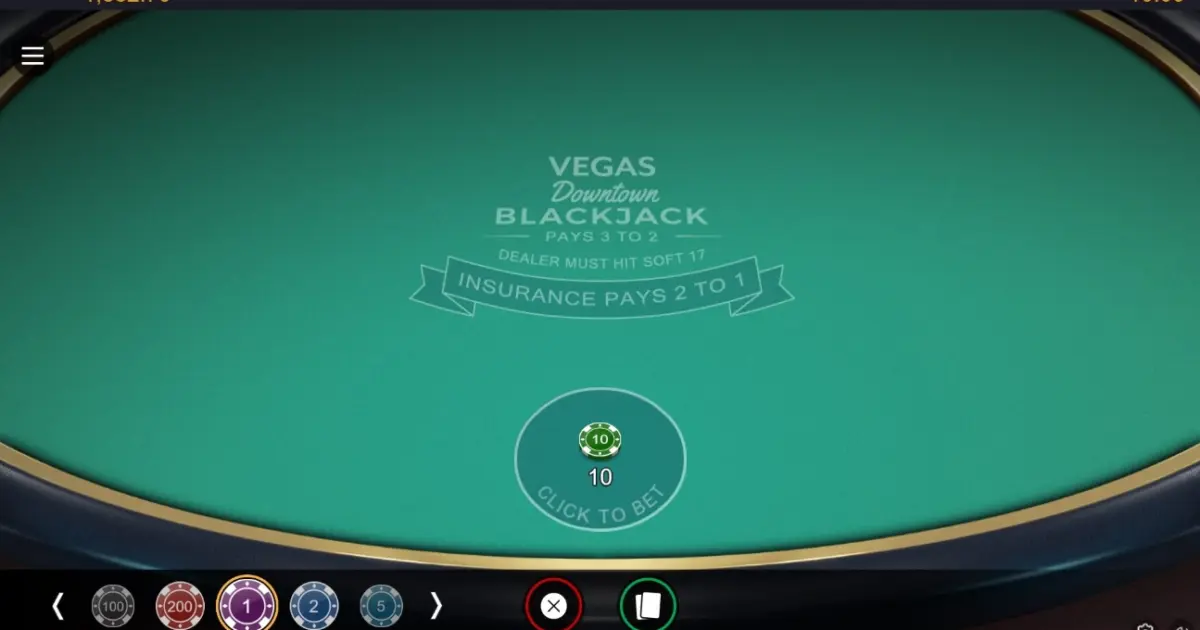
If you want a low-edge blackjack table to practise on without spending anything, vegas downtown blackjack is a reasonable place to sit. Switch Studios publishes a 99.6% RTP for it, which is a shade above the 99.41% average across the blackjack tables we index, and a free demo is available so you can learn the interface before any money is involved. The catch, as always, is that the published number assumes flawless play.
Vegas Downtown Blackjack at a glance
This is a digital, RNG-dealt blackjack table from Switch Studios, a studio with 22 games in our index and an average RTP of 99.61% across them — so this table is right in line with the developer’s usual standard rather than an outlier in either direction.
| Detail | Value |
|---|---|
| Game name | Vegas Downtown Blackjack |
| Provider | Switch Studios |
| Published RTP | 99.6% |
| Implied house edge | 0.4% |
| Category | Blackjack |
| Free demo | Available |
| Provider average RTP | 99.61% across 22 games |
Switch Studios does not publish the deck count, the dealer’s soft 17 rule, the blackjack payout, the surrender rule or the table limits for this game in the data available here. Those are the details that actually set the edge, so open the in-game rules or paytable screen before you commit real money. Everything below is either universal blackjack maths or clearly flagged as an inference.
What a 99.6% RTP means at a blackjack table
RTP is simply 100% minus the house edge, so 99.6% means a 0.4% house edge. Over a long run of hands, the theoretical cost of play is about 40p per £100 wagered. That is low by casino standards and typical of a decently ruled blackjack table.
Here is the part that matters most, and the part most players skip: that figure assumes perfect basic strategy on every single hand. Every correct double, every correct split, every 16 you hit against a dealer 7 or higher. The published RTP is not an average across all players — it is the ceiling reached by a player who never deviates from the chart.
Play on instinct instead, standing on soft 18 against a 9 or splitting tens because it feels right, and the real return you experience drops materially. Casual play can easily give up a full percentage point or more, turning a 0.4% edge into something closer to a slot machine’s. Nothing about the number is dishonest; it just describes a standard of play, not a guarantee.
Short sessions also say nothing about the long run. Variance dominates over a few hundred hands, so a losing evening at a 99.6% table is entirely normal, and a winning one is not evidence of an edge.
The rules that move the house edge
Because the specific rule set is not published here, it is worth knowing which rules to look for and roughly what each is worth. As general rules-of-thumb:
- Blackjack paying 3:2 versus 6:5 is the single most damaging change, costing the player roughly 1.4%. If a table pays 6:5, no other rule compensates for it.
- A dealer who stands on soft 17 is better for you than one who hits it, worth roughly 0.2%.
- Fewer decks favour the player. Moving from eight decks to one is worth a few tenths of a percent.
- Double after split adds around 0.15%; re-splitting aces adds a little more.
- Late surrender is worth roughly 0.07% and only helps if you use it correctly.
- A dealer who peeks for blackjack is better for you than a European no-hole-card game, where your doubled and split bets are exposed.
The game’s title places it in the Vegas family, and the variant hint attached to it points at Vegas Strip rules: four decks, dealer stands on soft 17, doubling after split allowed. Treat that as a strong indication of the rule family, not a confirmed rule set — the name indicates a Vegas-style game, which normally means those conditions, but you should confirm each one in the paytable before playing for money. If you want a table where the Strip rules are stated on the tin, Vegas Strip Blackjack lists a 99.7% RTP and removes the guesswork.
Basic strategy, and what it can and cannot do
Basic strategy is not a system. It is the solved answer to blackjack: for every combination of your hand and the dealer’s up card, one decision has the highest expected value, and the chart tells you which. It was computed, not invented, and there is nothing to believe in.
What it does is bring your return up to the published RTP. What it cannot do is make the game profitable. Perfect play minimises the house edge; it never removes it. A 0.4% edge played perfectly is still a 0.4% edge.
Card counting does not help here either. This is an RNG table that reshuffles the deck before every hand, so no information carries from one hand to the next. There is no depleted deck to track and no count to build. Any counting technique that works in a live shoe game is simply inert against software like this.
Betting progressions deserve the same plain treatment. Doubling after a loss, D’Alembert, and every variation on the theme change the shape of your results — bigger swings, more frequent small wins, occasional very large losses — without moving the expected value by a single basis point. No hand is ever due, and past hands carry no information about the next one.
Side bets and insurance
The side bets offered at this table, if any, are not listed in the information available, so check the felt in the demo. As a category, though, side bets are consistent: Perfect Pairs, 21+3 and their relatives carry house edges of several percent, often in the 3% to 8% range depending on deck count and paytable. Against a base game with a 0.4% edge, a single side-bet unit can cost more in expectation than ten hands of blackjack.
Insurance is the clearest case. At standard 2:1 odds it is a losing bet, because the dealer’s hole card is a ten-value card less often than the payout requires. Declining insurance every time is correct unless you are counting, and you cannot count here. The same applies to the even-money offer on your own blackjack — it is insurance under a friendlier name.
Playing the Vegas Downtown Blackjack demo
A free demo is available for this table, which makes it a genuinely useful practice tool. Load it with a basic strategy chart open beside you and play a few hundred hands until the correct decisions stop requiring thought. That is the highest-value use of demo play: building the habit that the 99.6% figure depends on.
What demo results cannot do is predict real-money outcomes. The maths is identical, but a few hundred hands is far too small a sample to tell you anything about your long-run return, in either direction.
Blackjack is for players aged 18 or over. Decide what your session budget is before you open the table, treat that money as the cost of entertainment rather than a source of income, and stop when it is gone rather than reaching for more. A low house edge lowers the expected cost of play; it does not make play free.
If you want to compare interfaces across the same studio, ReDeal Blackjack lists the same 99.6% RTP, while Classic Blackjack sits at 99.9% — the highest of the Switch Studios blackjacks we index.
Verdict: who should sit at this table
This is a solid, unremarkable low-edge table, and unremarkable is a compliment in blackjack. A 99.6% RTP is better than the category average, the free demo removes any cost to trying it, and the Switch Studios interface is consistent across their range.
The reservation is transparency. With the deck count, soft 17 rule and blackjack payout unpublished here, you are trusting the in-game rules screen to confirm what the title implies. If those check out as Vegas-style rules, this is a perfectly good place to play. If you would rather not check, a table with a stated rule set and a marginally higher published RTP is the easier choice.
Best suited to players who already know basic strategy or want to learn it without risk. Least suited to anyone hoping a system will turn 0.4% into an edge — nothing here, or anywhere, does that.
Frequently Asked Questions
Can I play Vegas Downtown Blackjack free?
Yes, a free demo is available, so you can play Vegas Downtown Blackjack free with virtual chips and no deposit. It is the sensible way to learn the interface and drill basic strategy decisions. Bear in mind that demo results tell you nothing reliable about real-money outcomes, since a few hundred hands is far too small a sample.
What is the RTP of Vegas Downtown Blackjack?
Switch Studios publishes an RTP of 99.6%, which implies a 0.4% house edge. That figure assumes perfect basic strategy on every hand, including every correct double and split. Play from instinct and your realised return will be meaningfully lower. The number describes a standard of play, not a guaranteed return.
What rules does this table use?
The deck count, dealer soft 17 rule and blackjack payout are not published in the information available. The title points at Vegas Strip rules — four decks, dealer stands on soft 17, double after split — which is a strong hint rather than a confirmed rule set. Check the in-game paytable before playing for money.
Does card counting work on Vegas Downtown Blackjack?
No. This is an RNG table that reshuffles before every hand, so no information carries between hands and there is no count to build. Betting progressions like doubling after a loss do not help either: they reshape your variance without changing the 0.4% expected cost of play at all.
Who makes this game, and how does it compare to their others?
Switch Studios develops it. The studio has 22 titles in our index averaging 99.61% RTP, so 99.6% is typical for them rather than exceptional. Classic Blackjack from the same studio lists 99.9%, the highest of their blackjack tables, while Vegas Strip Blackjack sits at 99.7% with its rule family stated openly.




