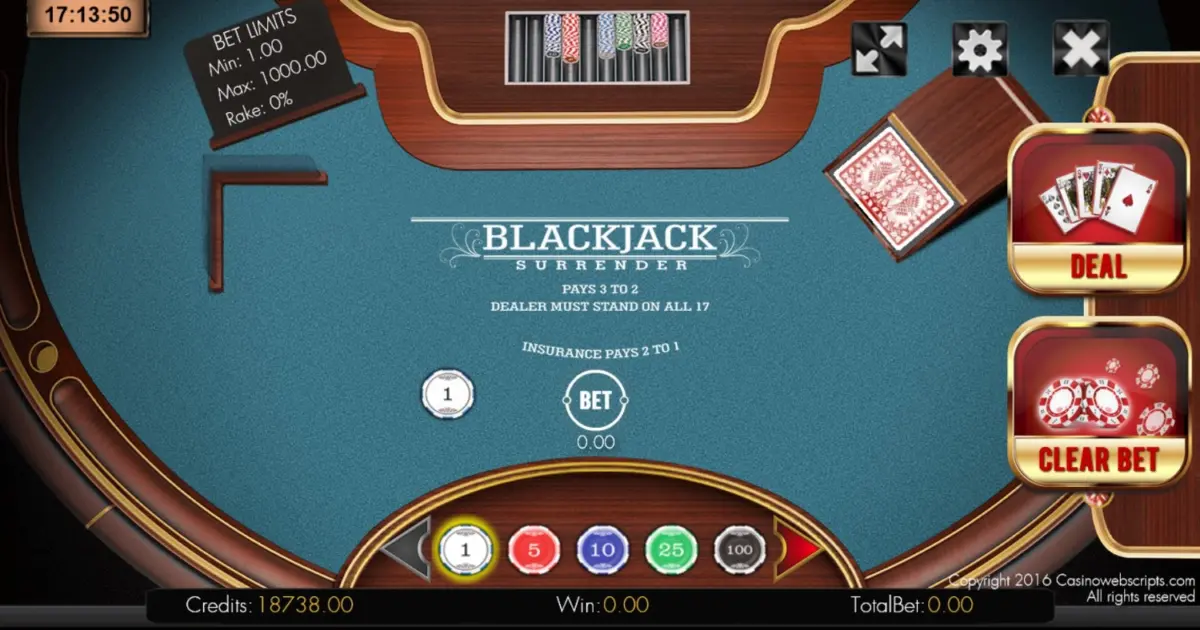
If you want to practise the one decision most blackjack players get wrong, this table is worth your time. Blackjack 21 Surrender is a Casino Web Scripts release with a published return of 99.64%, which is a strong figure for the category, and the free demo lets you test the surrender rule without risking anything. The catch is the same as always: that number belongs to a player who never misplays a hand.
What kind of blackjack is Blackjack 21 Surrender?
The title names its defining rule. Surrender lets you abandon a hand after seeing your two cards and the dealer’s upcard, giving back half your stake instead of playing out a position you are likely to lose. The name indicates a surrender variant, which normally means late surrender, offered only after the dealer has checked for blackjack. Some tables offer early surrender, which is far more generous to the player. Casino Web Scripts does not publish which version applies here, so open the in-game rules screen before you play for money.
Surrender is worth roughly 0.07% to 0.10% of edge when used correctly, and it is easy to overuse. The correct surrender spots in a typical shoe are narrow: hard 16 against a dealer 9, 10 or ace, and hard 15 against a 10. Folding anything else because it feels bad hands the house free money.
Beyond that, Casino Web Scripts publishes eight blackjack titles with an average return of 98.86%, so this table sits well above its own provider’s norm.
| Provider | Casino Web Scripts |
|---|---|
| RTP | 99.64% |
| Theme | Cards |
| Free demo | Yes |
Return to player: 99.64%
A 99.64% RTP means a house edge of 0.36%, and it puts this table 0.23 percentage points above the 99.41% average across the blackjack tables in our index. On paper, every 100 units wagered returns 99.64 over an enormous sample.
The caveat matters more than the figure. Published blackjack RTP assumes perfect basic strategy on every single hand. That is not a marketing footnote; it is how the number is calculated. A casual player who stands on soft 18 against a 9, skips a double on 11, or splits tens realises a materially lower return, often a full percentage point or more below the headline. The 0.36% edge is the floor, reached only by flawless play, and it is never zero.
For comparison inside the same studio, BlackJack 21 Classic also carries a 99.64% return without the surrender option, which is a useful control if you want to feel what surrender actually contributes.
Deck count, dealer rules and the payout that matters most
Casino Web Scripts does not publish the deck count, the dealer’s soft 17 rule, the blackjack payout, or the double and re-split terms for this table. Those are the levers that build the 0.36% edge, so read the paytable before you deposit.
The one to check first is the blackjack payout. As a general rule of thumb, a natural paying 3:2 is standard, and dropping it to 6:5 costs the player roughly 1.4% — it is the single most damaging rule change in blackjack and it swamps every other rule on the felt. A 99.64% table cannot pay 6:5 and still be a 99.64% table, so if the paytable shows 6:5, the published figure does not describe what you are playing.
The rest move things by smaller amounts. A dealer standing on soft 17 is worth about 0.2% to you versus hitting. Fewer decks favour the player, worth a few tenths between eight decks and one. Double after split and re-splitting aces each add a little in your favour; a European no-hole-card rule, where the dealer takes no card until you have acted, costs you around 0.11% because you can lose doubled and split money to a dealer blackjack.
Playing your first ten hands
Open the demo, set the smallest bet the table allows, and keep a basic strategy chart on screen. Basic strategy is not a system or a betting pattern — it is a solved chart, computed for a given rule set, that tells you the highest-expectation play for every hand you can hold against every dealer upcard. It minimises the house edge. It does not remove it.
Your first ten hands should be about building the reflexes: always split aces and eights, never split tens or fives, double 11 against anything but an ace, hit soft 17, stand on hard 17 and above. Then work on the surrender decisions, because that is what you came here for. Deal deliberately and check the chart on every borderline hand rather than guessing and confirming afterwards.
One thing not to bother with: card counting does not work here. This is an RNG table that reshuffles before every hand, so the composition of the next deal is independent of everything that came before. No count survives a shuffle. Nothing is ever due, and no run of dealer wins makes the next hand more likely to go your way.
Side bets: the maths behind the temptation
Casino Web Scripts does not list which side bets, if any, this table offers, so treat what follows as general guidance and check the paytable.
Where side bets appear, they price far worse than the base game. Perfect Pairs typically runs a house edge in the region of 4% to 11% depending on deck count, and 21+3 commonly sits around 3% to 8%. Against a base game holding a 0.36% edge, a single side bet unit can cost you more in expectation than ten hands of the main game. They are entertainment charges, not value plays.
Insurance deserves its own warning. At the standard 2:1 payout it is a losing bet, because the dealer completes blackjack from a ten-value hole card less often than one time in three. Taking it does not protect your hand; it adds a second negative-expectation wager alongside the first. Decline it, including on your own blackjack, where “even money” is the same bet wearing a friendlier name.
Session limits and bankroll
Blackjack’s low edge makes variance the thing you actually feel. Even at 0.36%, a short session swings widely, and a losing hour tells you nothing about whether you played correctly. Sizing your unit at roughly 1% of the money you have set aside gives you room to absorb that noise without a run of ten hands ending the session.
Ignore betting progressions. Martingale, D’Alembert and any “double after a loss” pattern reshape the distribution of outcomes — more small wins, occasional catastrophic losses — while leaving expected value exactly where the rules put it. No staking pattern beats a house edge.
Play is for adults aged 18 or over. Decide what the session is worth to you before you sit down, treat it as the price of entertainment rather than a source of income, and stop at that figure whether you are ahead or behind. Demo results tell you nothing about how real-money play will go.
Verdict on Blackjack 21 Surrender
A published 99.64% return, an above-average figure for the category, and a rule that rewards disciplined play make this a reasonable table for practising surrender decisions. Ranked 82nd in our index and sitting in the 39th popularity percentile, it is not a heavily played title, which matters less than the maths.
What holds it back is disclosure. Without the deck count, soft 17 rule or payout published, you are trusting the RTP figure without seeing the rules that produce it. Verify them in-game. If you want a lower-variance point of comparison, Multihand Blackjack at 99.5% lets you spread the same bankroll across several hands, and BlackJack 21 FaceUp 3D Dealer at 99.61% shows both dealer cards, which removes the guesswork surrender exists to manage.
Frequently Asked Questions
Can I play Blackjack 21 Surrender free with no download?
Yes. A free demo of Blackjack 21 Surrender is available and runs in the browser with no download and no deposit. It uses play-money chips, so you can drill surrender decisions and basic strategy at no cost. Bear in mind demo results tell you nothing about how a real-money session will go.
What is the RTP of Blackjack 21 Surrender?
The published RTP is 99.64%, which is 0.23 points above the 99.41% average across the blackjack tables in our index. That figure assumes perfect basic strategy on every hand, without exception. Misplay borderline hands and your realised return drops materially below it, often by a full percentage point.
What house edge does this table carry, and what changes it?
A 99.64% return means a 0.36% house edge. Deck count, the dealer's soft 17 rule and the blackjack payout all move that number, and Casino Web Scripts does not publish them here. The payout matters most: 6:5 instead of 3:2 costs a player roughly 1.4%, far more than any other single rule.
Does card counting work on Blackjack 21 Surrender?
No. This is an RNG table that reshuffles before every hand, so each deal is independent and no running count carries over. Betting progressions like Martingale do not help either; they change the shape of your results, not the expected value. Correct basic strategy play is the only lever you have.
Who makes Blackjack 21 Surrender, and how does it compare to their other tables?
Casino Web Scripts, which publishes eight blackjack titles averaging 98.86% RTP. At 99.64%, this table sits well above that house average. BlackJack 21 Classic matches the same 99.64% figure without surrender, while BlackJack Ultimate 3D Dealer trails at 96.54%, a meaningful gap over any real number of hands.




