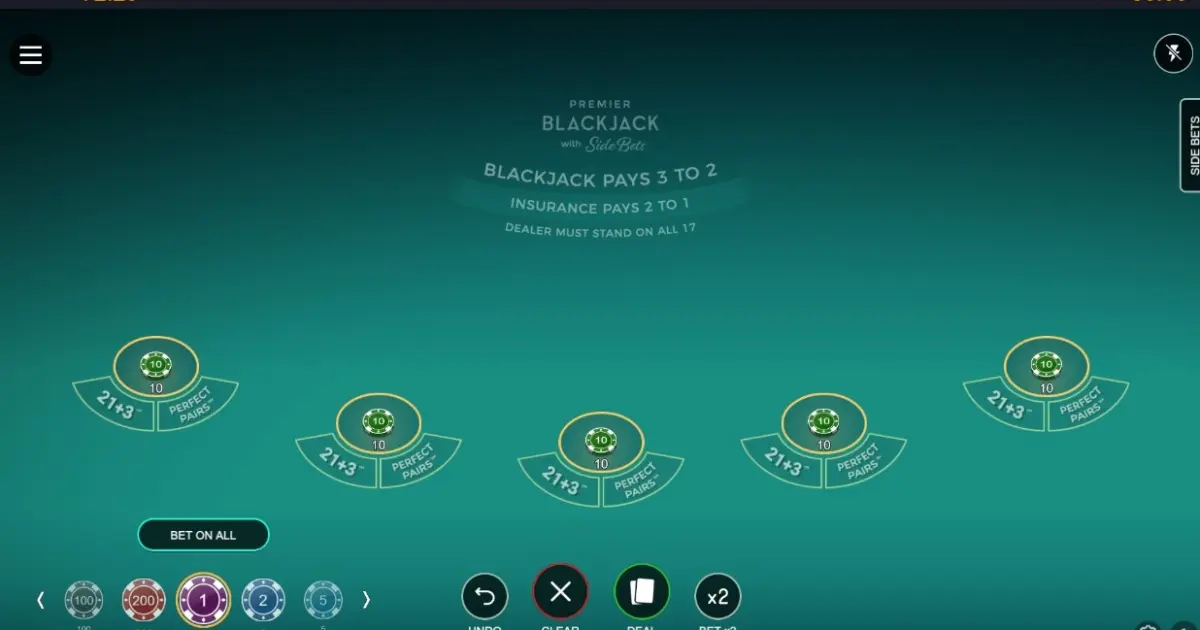
Premier Blackjack with Side Bets is a solid pick if you want a straightforward blackjack base game with the option to add side wagers for higher variance. Switch Studios delivers a clean, no-frills table whose 99.6% RTP sits just above the corpus average of 99.41%, meaning the maths are fair relative to the broader market. If you prefer your edge as thin as possible and your rules transparent, this table is worth a spin in free demo mode before you commit real money.
What kind of blackjack is Premier Blackjack with Side Bets?
The title tells you most of what you need to know: this is a “Premier” branded blackjack from Switch Studios that includes optional side bets alongside the standard base game. The Premier label in the Switch Studios catalogue generally signals a polished, modern presentation with smooth animations and a clean UI, though it does not by itself lock in a specific rule set. Because Switch Studios does not publish the exact deck count, dealer soft-17 rule, or double-after-split allowance for this table, you will want to open the in-game rules or paytable before placing real-money bets. Those details move the house edge by small but meaningful amounts — a dealer who hits soft 17 adds roughly 0.2% to the edge compared with one who stands, and the ability to double after splitting trims the edge by about 0.13%. Without confirmed rules, the published 99.6% RTP is your best anchor, but verifying the rule set ensures that figure actually applies to your session. The provider’s average across its 22 games sits at 99.61% RTP, so this table is essentially in line with the Switch Studios standard — neither an outlier nor a weak link.
| Provider | Switch Studios |
|---|---|
| RTP | 99.6% |
| Free demo | Yes |
Return to player: 99.6%
An RTP of 99.6% translates to a house edge of 0.4% — competitive among online blackjack variants and slightly above the corpus average of 99.41%. That 0.19% advantage over the broader library average is small but real: over 10,000 hands at $10 per hand, it theoretically saves you about $19 compared with the average online blackjack table. The critical caveat is that the 99.6% figure assumes perfect basic strategy on every single hand. Basic strategy is a solved, maths-derived chart that tells you the correct play for every possible player hand against every possible dealer up-card. It is not a “system” and it does not guarantee profits — it simply minimises the house edge to its mathematical floor. A casual player who deviates from basic strategy even occasionally will see their effective RTP drop below 99%, sometimes well below. If you do not know basic strategy by heart, print a chart or use a strategy trainer before playing for real. Compared with related Switch Studios titles, this RTP sits between Classic Blackjack at Classic Blackjack (99.9%) and Vegas Strip Blackjack (99.7%), so it is a shade less generous than those stripped-down variants but still firmly in the upper tier.
Deck count, dealer rules and the payout that matters most
Switch Studios has not published the deck count for Premier Blackjack with Side Bets. In general, fewer decks favour the player — single-deck blackjack carries a lower house edge than eight-deck shoes, all else being equal — but the difference at typical online configurations is a few hundredths of a percent. Check the in-game help screen to confirm. The single most consequential rule you can verify is the blackjack payout. A 3:2 payout on natural blackjacks is the industry standard for fair games and is what the 99.6% RTP almost certainly assumes. If the table pays 6:5 instead, that single change costs the player roughly 1.4% — the most damaging common rule alteration in blackjack. A 6:5 game with an otherwise identical rule set would drop this table’s RTP to around 98.2%, which is a completely different proposition. Other rules to look for include whether the dealer hits or stands on soft 17 (H17 versus S17), whether you can double after splitting (DAS), and whether late surrender is available. Each of these moves the edge by a few tenths of a percent. Because this is an RNG table that reshuffles a virtual shoe after every hand, card counting offers zero advantage — the deck composition resets constantly, eliminating the information advantage that counters exploit in live games.
Playing your first ten hands
If you are new to this table, start in the free demo — it is available with no download required — and play ten hands at the minimum stake just to get a feel for the interface and pacing. Your goal is not to “warm up” the RNG; each hand is independent. The goal is to confirm you understand the controls, the speed of deal and resolution, and how the side bet options are presented. For the base game, follow basic strategy without exception. That means always splitting aces and eights, never splitting tens, standing on hard 12 against dealer 4, 5, or 6, and hitting hard 16 against dealer 7 or higher. These are not opinions — they are the mathematically correct plays that keep the house edge at its minimum of 0.4%. If the interface offers insurance when the dealer shows an ace, decline it every time. Insurance is a side bet on whether the dealer has a ten underneath, and at standard 2:1 odds it carries a house edge of roughly 7.7%. It is a losing proposition over any meaningful sample. After your ten demo hands, you will know whether the table’s speed and layout suit you, and you can decide whether to move to real money with a clear head.
Side bets: the maths behind the temptation
The “Side Bets” in the title are the table’s main differentiator from a plain Switch Studios blackjack, and they deserve a cold look at the numbers. Common blackjack side bets — Perfect Pairs, 21+3, and similar offerings — typically carry house edges between 2% and 11%, vastly higher than the 0.4% base game. Perfect Pairs, which pays when your first two cards form a pair, generally sits around a 4–6% house edge depending on the pay table. The 21+3 bet, which combines your two cards with the dealer’s up-card to make a poker hand, often runs even higher. These bets are high-variance by design: they hit infrequently but pay large multiples, which is exactly the profile that drains bankrolls slowly while offering occasional spikes. If you enjoy them, treat them as a separate entertainment budget layered on top of your base-game bankroll, not as an extension of it. The base game’s 0.4% edge is what you are optimising for; the side bets are where the casino makes its real margin on this table. Always check the specific pay table in-game, because payouts vary and directly determine the edge.
Session limits and bankroll
Before you sit down — even at the demo — decide on a session budget and a stop-loss. A reasonable starting point for real-money play is a bankroll of at least 50 times your base bet, which gives you enough runway to absorb normal variance without busting out in ten minutes. At a $5 base bet, that means $250 set aside specifically for this session. If you hit your stop-loss, walk away. If you double your session bankroll, consider pocketing the profit and either ending the session or playing the remainder with house money. These are not strategies that change the expected value — the house edge of 0.4% is baked into every hand — but they protect you from the emotional decisions that turn a small loss into a big one. This is entertainment, not income. Set a budget you can afford to lose, never chase losses, and stop playing if it stops being fun. You must be 18 or older to play for real money. If gambling stops being enjoyable, resources like GamCare and BeGambleAware are available 24/7.
Verdict on Premier Blackjack with Side Bets
Premier Blackjack with Side Bets is a competent, well-priced blackjack from Switch Studios. The 99.6% RTP is honest and competitive, the side bets are clearly optional, and the free demo lets you evaluate the table with zero risk. Its main weakness is informational: without published details on deck count and specific rules, you are trusting the RTP figure rather than verifying it yourself — something a careful player should resolve in the in-game help screen before wagering real cash. If you want the absolute lowest edge, Switch Studios’ own Classic Blackjack at 99.9% RTP edges this table out by 0.3%. If you want a different flavour of the same provider’s work, ReDeal Blackjack matches this game’s 99.6% RTP with a unique redeal mechanic that some players prefer. For most players, though, Premier Blackjack with Side Bets hits a comfortable middle ground: a fair base game with the option to add excitement through side wagers, as long as you keep those wagers small and separate from your core bankroll.
Frequently Asked Questions
Can I play Premier Blackjack with Side Bets for free?
Yes, a free demo is available with no download required. You can play it directly in your browser to learn the interface and test basic strategy without risking real money.
What is the RTP of Premier Blackjack with Side Bets?
The published RTP is 99.6%, which assumes perfect basic strategy on every hand. Casual players who deviate from the correct chart will see a lower effective return, typically in the 98–99% range.
How does the house edge compare to other online blackjack tables?
At 0.4%, the house edge is slightly better than the corpus average of 0.59% (99.41% RTP). It sits just below Switch Studios' own Classic Blackjack at 99.9% RTP, making it competitive but not the provider's tightest game.
Does card counting work on Premier Blackjack with Side Bets?
No. This is an RNG table that reshuffles the virtual deck after every hand, which eliminates the deck-composition information that card counters rely on. No counting system provides an edge against an online RNG blackjack.
Are the side bets on this table worth playing?
Side bets like Perfect Pairs and 21+3 typically carry house edges between 2% and 11%, far higher than the 0.4% base game. They are high-variance entertainment, not a value proposition — keep any side-bet stakes small and separate from your main bankroll.




