Jingle Spin slot from NetEnt returns 96.48% RTP, placing it 0.77 percentage points above the market average and comfortably ahead of the provider’s own 96.1% baseline. That margin matters over a session, and the free demo lets you gauge the game’s rhythm without staking real money. NetEnt has not published reel count, payline structure, volatility rating or stake range for this title, so the sections below address what those missing figures mean and how the published RTP compares across the provider’s 191-game catalogue.
| Specification | Value |
|---|---|
| Provider | NetEnt |
| RTP | 96.48% |
| Popularity rank | 2,920 (85.4th percentile) |
| Free demo | Yes |
The reel grid explained
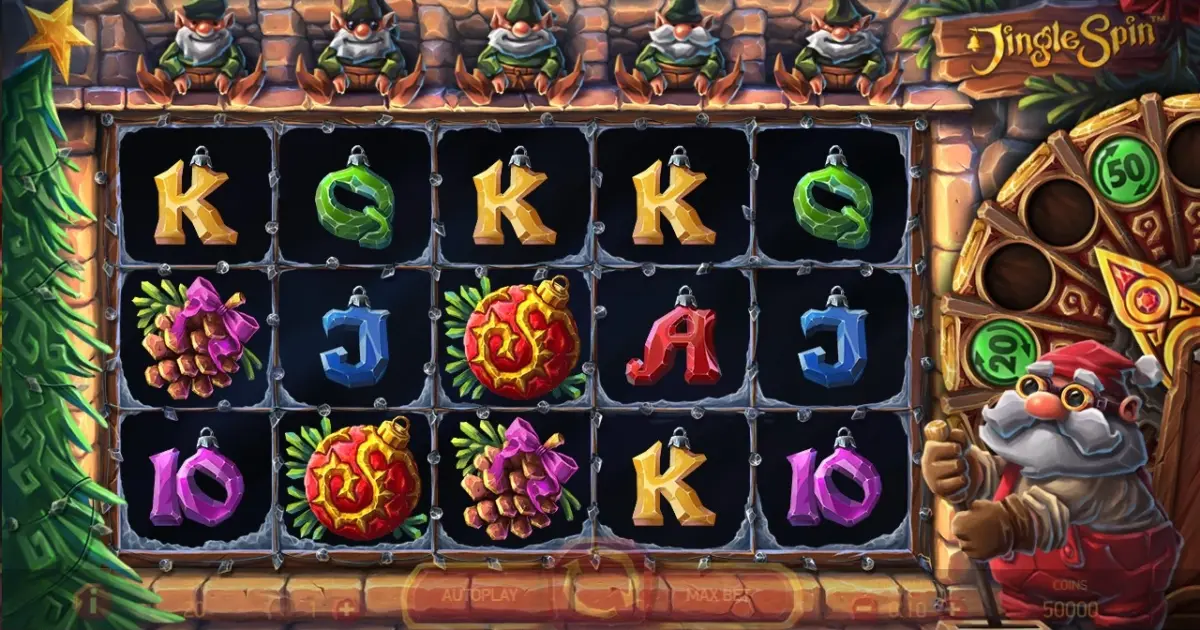
NetEnt has not disclosed the reel count or grid dimensions for Jingle Spin. Most modern video slots use a five-reel layout, but without confirmation you should not assume that arrangement here. The absence of this data means you cannot predict symbol distribution, stopping positions or the mechanical footprint of the game before you load it. If reel count matters to your choice—some players prefer the tighter geometry of three-reel classics, others the broader canvas of five or six reels—then the demo is your only reliable source. Load it, observe the grid, and decide whether the layout suits your preference. Missing specifications are not inherently negative, but they do push more of the evaluation work onto your own trial session rather than advance research.
Paylines, ways and how Jingle Spin pays
NetEnt has not published payline count, ways-to-win structure or win-evaluation method for this game. In general terms, a payline slot awards wins when matching symbols land on predefined patterns—often left to right across adjacent reels—while a ways-to-win game pays for matching symbols in any position on consecutive reels, regardless of row. The distinction affects hit frequency and the feel of a session: ways games tend to produce smaller, more frequent wins; payline games can cluster dry spins between larger pays. Some modern slots abandon both models in favor of cluster pays, cascades or other mechanics. Without knowing which system Jingle Spin uses, you cannot estimate how often a spin is likely to return a prize or how wins will be distributed across your session. The demo will show you the paytable and help files, which should clarify the mechanic. Treat any payline or ways figure you see quoted on affiliate sites with caution unless NetEnt itself has confirmed it.
96.48% RTP put in context
RTP—return to player—is the percentage of all wagered money a slot is designed to pay back over a very large sample, typically millions of spins. 96.48% RTP means the game returns £96.48 per £100 wagered across that sample. It is a long-run statistical average, not a guarantee for any single session or any one player. Jingle Spin’s 96.48% sits 0.77 percentage points above the 95.71% corpus average and 0.38 points above NetEnt’s own 96.1% mean, placing it in the upper half of the provider’s range. For comparison, Starburst returns 96.1%, Pirates Party 96.17%, and Gonzo’s Quest 96.0%—all within a narrow band. The difference between 96.0% and 96.48% is small in absolute terms but compounds over volume: across 1,000 spins at £1 each, the higher RTP returns an additional £4.80 in expectation. RTP does not tell you anything about volatility, hit frequency or win distribution; it is purely a measure of the house edge.
Volatility and hit patterns
NetEnt has not published a volatility rating or hit frequency figure for Jingle Spin. Volatility describes the size and spacing of wins: low-volatility slots pay smaller amounts more often, stretching a bankroll over a longer session; high-volatility games produce longer dry spells punctuated by larger single wins, demanding a deeper reserve to weather the swings. Hit frequency—the percentage of spins that return any prize—is a separate metric that shapes session rhythm independently of volatility. A game can hit frequently with small wins (low volatility, high hit rate) or rarely with large ones (high volatility, low hit rate). Without either figure, you cannot predict bankroll requirements, session length or the likelihood of a bonus triggering within a set number of spins. The demo cannot reveal the true volatility—variance expresses itself only over thousands of spins—but it will show you the paytable structure, which offers clues: a steep gradient between low and high symbol values suggests higher variance; a flatter pay structure points toward lower. Many slots in the festive theme category lean toward medium volatility to balance appeal across player types, but that is genre tendency, not game-specific fact.
Choosing a stake between a minimum and maximum
NetEnt has not disclosed the minimum or maximum bet for this title. Stake range matters because it determines who can afford to play and how long a given bankroll will last. A typical NetEnt slot offers a floor around £0.10 or £0.20 per spin and a ceiling between £100 and £200, but without confirmation you should check the demo before committing real money. A general rule: budget at least 100 times your chosen stake to give variance room to work. If you plan to bet £1 per spin, bring £100; if you want 200 spins of runway, halve the stake to £0.50. The math is the same at every level, but the absolute amounts change who can play comfortably. A game with a £1 minimum excludes casual players; a game capped at £10 frustrates high rollers. The missing data here is a gap NetEnt could easily fill, and its absence forces you to discover the range through trial rather than planning in advance.
Demo play versus real money
Jingle Spin offers a free demo with no download required. The demo uses the same RNG, the same reel strips and the same paytable as the real-money version, so the hit rate and win distribution are identical in aggregate. What differs is consequence: demo credits cost nothing and pay nothing. A bonus win in demo mode feels weightless because there is no capital at risk and no withdrawal at the end. The demo is a tool for evaluating the game’s rhythm, interface and mechanical feel before you stake your own money, not a predictor of what will happen when you do. Every spin is independent. A run of wins in demo does not make the game “due” to pay in real money, and a cold stretch in demo does not mean the slot is primed. RNG output is memoryless. If you choose to play for real money, set a budget you can afford to lose, treat the stake as the cost of entertainment, and stop when that budget is gone. Never chase losses, never bet money you need for other purposes, and never believe that a pattern in prior spins can tell you what the next spin holds. This is a game of chance with a house edge, and the house edge applies every time. 18+. Play responsibly.
Verdict on Jingle Spin
Jingle Spin slot earns recommendation on RTP alone: 96.48% is a tangible improvement over both the provider’s average and the market baseline, and that margin accumulates over volume. The game ranks in the 85th percentile for popularity among NetEnt’s 191 titles, indicating sustained player interest rather than a brief novelty spike. The free demo removes friction from evaluation—you can test the game’s interface, pace and paytable without creating an account or risking capital. What undermines confidence is the absence of basic specifications. Without reel count, payline or ways structure, volatility rating, or stake range, you cannot plan a session, estimate bankroll requirements, or compare the game’s mechanical profile to alternatives. The missing data is not a flaw in the game itself but a failure of disclosure, and it places a larger burden on your own trial-and-error than necessary. If you value transparency and want to budget your session before the first spin, look instead to providers who publish full specifications. If you are comfortable discovering those details through play and the RTP figure alone justifies your attention, then Jingle Spin delivers an above-average return in a category where every tenth of a percentage point counts. The demo is your best source of truth where the spec sheet is silent.
More from NetEnt
- Twin Spin — 96.6% RTP
Frequently Asked Questions
Can I play Jingle Spin free with no download?
Yes. Jingle Spin offers a free demo that runs directly in your browser with no software installation or account registration required. The demo uses the same RNG and paytable as the real-money version, so the hit rate and mechanical feel are identical. Demo credits have no cash value and cannot be withdrawn.
What does 96.48% RTP mean for my session?
RTP is the percentage of all wagered money the game returns over millions of spins. Jingle Spin's 96.48% means the slot pays back £96.48 per £100 wagered across that very large sample. It does not predict any individual session. Over 1,000 spins at £1 each, the RTP implies an expected return of £964.80, but variance means your actual result will differ.
Is Jingle Spin high or low volatility?
NetEnt has not published a volatility rating for Jingle Spin. Volatility describes win size and spacing—low volatility pays smaller amounts more often, high volatility produces rarer but larger wins. Without the rating you cannot estimate bankroll requirements or session length. The demo's paytable structure may offer clues, but true volatility expresses itself only over thousands of spins.
What else does NetEnt make besides Jingle Spin?
NetEnt publishes 191 slots, including Starburst at 96.1% RTP, Gonzo's Quest at 96.0%, and Pirates Party at 96.17%. The provider's average RTP is 96.1%, slightly below Jingle Spin's 96.48%. NetEnt is known for polished interfaces and transparent RTP disclosure across most of its catalogue, though key specifications for this title remain unpublished.
Can I win real money playing the Jingle Spin demo?
No. The demo uses virtual credits that have no cash value and cannot be withdrawn or converted to real money. Demo play is a tool for evaluating the game's mechanics, interface and rhythm before you stake your own funds. If you want the possibility of a real-money return, you must play the live version at a licensed operator, and all real-money play carries the risk of loss.