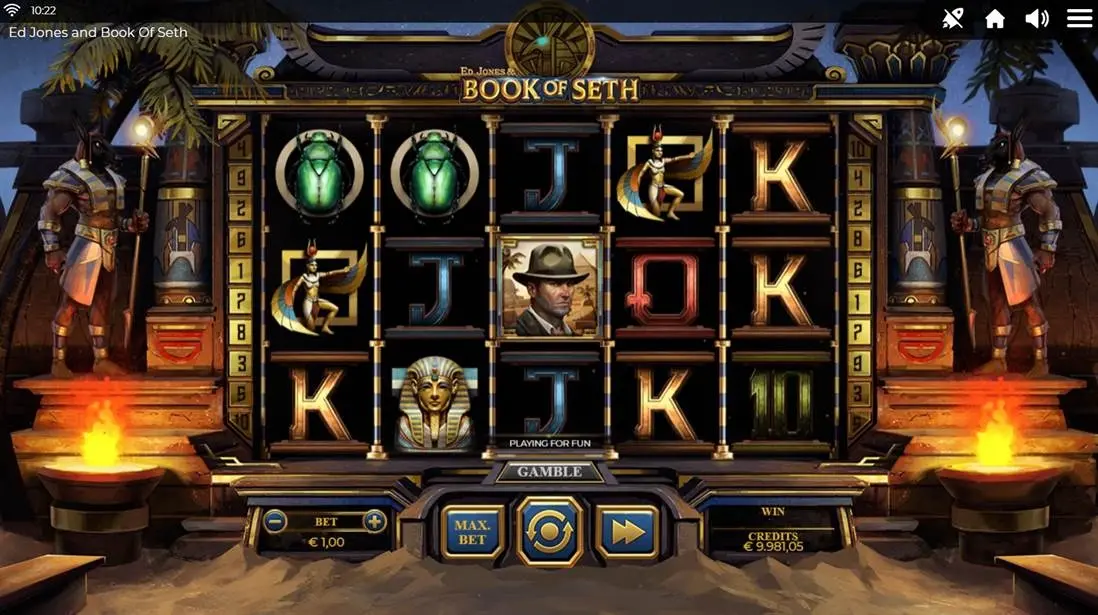
If you want a quick decision: the ed jones & book of seth slot pays back 95.63% of everything wagered across an enormous sample, which puts it fractionally below the 95.71% average of the games catalogued here and just above Spinmatic’s own 95.55% house average. It is a five-reel game built on an Egyptian theme, and it is playable in demo mode. What Spinmatic has not published is arguably more interesting than what it has, and that shapes most of this review.
Ed Jones & Book of Seth slot at a glance
The confirmed numbers are short and worth reading in one block before anything else.
| Detail | Figure |
|---|---|
| Provider | Spinmatic |
| RTP | 95.63% |
| Reels | 5 |
| Theme | Egypt (5-reel) |
| Category | Slot Machine |
| Popularity rank | 2,760 (86.2nd percentile) |
| Spinmatic catalogue size | 69 games |
| Spinmatic average RTP | 95.55% |
| Site-wide average RTP | 95.71% |
| Free demo | Available |
That rank of 2,760 places it in the 86.2nd percentile for traffic, so it gets a reasonable amount of attention without being a headline title. Spinmatic is a smaller studio with 69 games tracked here, and this release sits eight hundredths of a percentage point above their own average — mid-table for the house rather than a flagship payout. Paylines, volatility rating, stake range and maximum win are all absent from the published data. If you need those numbers before you play, the honest answer is that you will have to read them off the game’s own information screen rather than from any review, including this one.
What a 95.63% RTP actually returns
Return to player is a long-run statistical average, calculated over millions of simulated spins, not a promise about your next hundred. At 95.63%, the theoretical return is £95.63 for every £100 staked, which is a theoretical cost of £4.37 per £100 wagered. Put that through a concrete example: 1,000 spins at £0.20 each is £200 of total turnover, and the mathematical expectation across that turnover is a loss of roughly £8.74. Turnover is the key word — that £200 includes money you win and stake again.
The gap to the site-wide average of 95.71% is 0.08 percentage points, or eight pence per £100 wagered. In practical terms that difference is invisible inside a single session; variance dwarfs it completely. It only becomes meaningful across tens of thousands of spins. If RTP is your primary filter, the comparisons that matter are larger ones. Spinmatic’s Space Oddity is listed at 97.12%, nearly 1.5 points higher, and Book of the Sun reaches 96.23% within the same Egyptian bracket. Both return more per £100 staked over the long run. Note also that a published RTP is a single configuration: some studios ship multiple RTP builds of the same game, so check the figure shown in the game itself.
Volatility and what your session will feel like
Spinmatic has not published a volatility rating for this title, so any review that confidently labels it low, medium or high is guessing. That absence is worth knowing, because volatility affects your session far more directly than a fractional RTP difference does.
Volatility describes how a game’s returns are distributed. A low-volatility slot pays small amounts often, so balance drifts down gently and a modest budget lasts a long time. A high-volatility slot pays rarely but larger, which means long stretches of nothing punctuated by occasional bigger returns — and a much wider range of possible outcomes from the same number of spins. Two games can share an identical 95.63% RTP and feel nothing alike.
The practical workaround is the demo. Spin a few hundred rounds and watch the shape of the results: frequent small returns point one way, flat runs broken by spikes point the other. Whatever you observe, every spin is an independent event. Previous results do not influence the next one, and a stretch without a win does not make anything more likely. If you want a rating attached before you commit, the numbers you can compare are RTP and provider, which is what the table above gives you.
The 5-reel layout and how wins are counted
Five reels is the standard modern layout, and it tells you the game is built as a grid rather than a three-reel classic. What is not published here is the number of paylines or whether wins are counted on fixed lines, on a ways system, or by cluster.
The distinction matters for how a session reads. Fixed-payline games award wins along defined patterns across the reels, and the line count is usually multiplied into your stake per spin. “Ways” games count any combination of matching symbols on adjacent reels regardless of position, which produces more frequent small awards. Cluster mechanics pay for groups touching each other. All three can be tuned to the same overall return; they simply distribute it differently.
The same applies to features. Many five-reel slots include wilds, scatters and free-spin rounds, and a growing number sell direct entry to a bonus. Whether this one does any of that is not in the published data, so treat unsourced claims about bonus rounds, multipliers or a maximum win figure with real caution. The game’s own paytable is the authoritative source, and it takes about a minute to read before your first spin.
Stake range and sizing a bankroll
No minimum or maximum stake has been published for this release, so check the betting panel in the demo before planning anything. The sizing logic, though, is universal and does not depend on the game.
Work from spins rather than from money. Decide what you can comfortably lose, then divide by the number of spins you want from it. A £40 budget at £0.20 a spin buys 200 base spins before any returns are recycled; the same £40 at £1 a spin buys 40. Returns extend that in practice, but the ratio between stake and budget is what sets your realistic session length. As a rough guide, a stake around 1% of your budget or lower gives you enough spins for the maths to behave somewhat predictably. Higher stakes compress everything.
One thing worth stating plainly: no staking pattern changes expected value. Raising bets after losses, lowering them after wins, alternating, waiting — none of it alters the 95.63% figure, because each spin is settled independently by its own random outcome. Stake size only changes how fast your budget moves.
Playing the Ed Jones & Book of Seth demo before you commit
An Ed Jones & Book of Seth free demo is available, which is the most useful thing on this page given how much of the specification is unpublished. The demo runs on play-money credits in the browser with no download and no deposit, and it uses the same maths as the paid version.
Use it to fill the gaps this review cannot: read the paytable, note the actual stake range, count how often small returns land, and see whether the pacing suits you. Fifteen minutes there tells you more than any written description of an Egyptian theme. What it cannot do is predict real-money results — demo credits carry no value, and a good or bad run there says nothing about what follows.
Slots are paid entertainment, not income. Play only if you are 18 or over, set a budget before you open the game and stop when it is gone, and never stake money you need for anything else. If play stops feeling like a choice, step away and use the operator’s deposit limits and self-exclusion tools.
Verdict: who should play Ed Jones & Book of Seth
This suits someone who likes the Egyptian bracket and wants a mid-range Spinmatic five-reeler with a return that is honest rather than remarkable. 95.63% is 0.08 points below the site average and a shade above Spinmatic’s own — perfectly ordinary, and not a reason to avoid the game or to seek it out.
If return is your deciding factor, better numbers exist nearby: 97.12% on Space Oddity or 96.23% on Book of the Sun, while the better-known Book of Dead is listed at 94.25% and returns less per £100 staked than this does. If the missing volatility rating and unpublished max win bother you, the demo answers both questions faster than waiting for the studio to publish them. Start there, decide with your own eyes, and set your budget before you switch anything to real stakes.
Frequently Asked Questions
Can you play Ed Jones & Book of Seth for free?
A free demo of Ed Jones & Book of Seth is available and runs in the browser with no download and no deposit. It uses play-money credits and the same 95.63% RTP maths as the paid version, so it is the quickest way to check the paytable, stake range and pacing before risking anything.
What is the RTP of Ed Jones & Book of Seth?
The published RTP is 95.63%, meaning a theoretical return of £95.63 for every £100 staked across a very large sample. That sits 0.08 percentage points below the 95.71% average of the games tracked here and marginally above Spinmatic's 95.55% house average. Short sessions can land anywhere either side of it.
Is Ed Jones & Book of Seth high or low volatility?
Spinmatic has not published a volatility rating for this title, so treat any confident label elsewhere as guesswork. Volatility decides whether returns arrive as frequent small amounts or rare larger ones, and it affects session length more than the 95.63% RTP does. A few hundred demo spins will show you the shape yourself.
Who makes Ed Jones & Book of Seth?
Spinmatic developed it, a studio with 69 games tracked here and an average RTP of 95.55% across them. Other Spinmatic slots include Space Oddity at 97.12%, Sushi House at 95.26% and Mayanera Return at 94.82%, so returns vary by well over two percentage points within their own catalogue.
How much should I budget to play Ed Jones & Book of Seth?
No stake range has been published, so check the betting panel in the demo first. Budget by spins rather than money: £40 at £0.20 a spin buys 200 base rounds, the same £40 at £1 buys 40. Keeping stakes near 1% of your budget stretches the session. No staking pattern alters the 95.63% return.