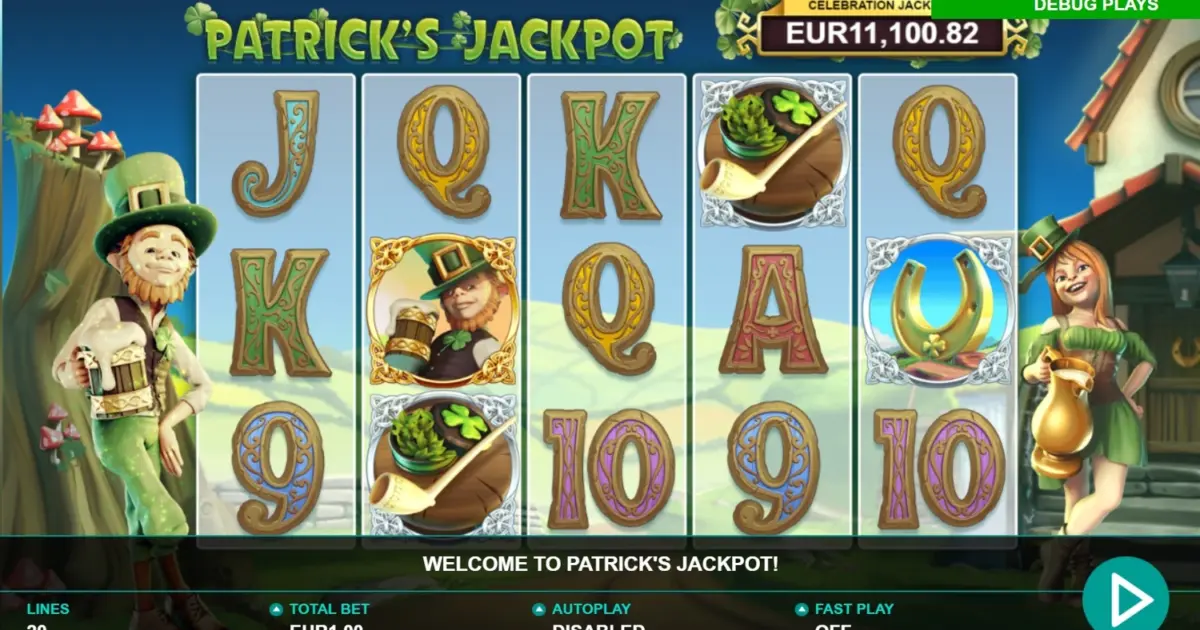
Patrick’s Jackpot makes a quick case for itself: a 97.17% RTP on a 5-reel Irish slot, which is 1.46 points above the corpus average of 95.71%. If you are comparing games on numbers first and theme second, this patrick’s jackpot slot deserves a spot on your shortlist to try in free demo and see if the pacing suits you.
There is not much else on the public sheet to go on — no published volatility, paylines, stake limits or max win — so the decision comes down to whether that strong return figure plus a simple 5-reel set-up is enough to earn your time. The sections below unpack what is known, what is missing, and what both mean for a real session.
First look at Patrick’s Jackpot
Patrick’s Jackpot is listed as a Slot Machine from Leander Games, tagged with Irish and 5-Reels themes. The primary theme is Irish, which tells you the general inspiration it draws on without confirming any particular characters, symbols or visual treatment beyond that label.
Leander Games has 62 titles in the dataset, with an average RTP of 95.73% across its portfolio. At 97.17%, this title sits comfortably above both that provider average and the wider corpus average of 95.71%. On popularity, it ranks 2635 with a percentile of 86.8, which puts it outside the most-played group but still seen enough to have a stable data footprint.
Free demo play is available, so you can check the feel of the game — reel speed, sound, menu layout — without wagering. That matters here because several key figures that normally help you judge fit are not published. Treat any third-party claim that fills those gaps with extra detail as unverified unless you see it on the official Leander Games sheet or in the in-game help file.
The table below collects every concrete figure supplied for this title. Only rows with a published value are shown; anything absent is addressed in the sections that follow.
| Item | Value |
|---|---|
| Provider | Leander Games |
| RTP | 97.17% |
| Reels | 5 |
| Themes | Irish, 5-Reels |
| Provider game count | 62 |
| Provider average RTP | 95.73% |
| Corpus average RTP | 95.71% |
| RTP vs corpus | +1.46pp |
| Popularity rank | 2635 |
| Free demo | Available |
How a round plays out
From the verified data, you can be sure of one structural point: this is a 5-reel game. That tells you the grid has five vertical columns that spin and stop independently each round. Beyond that, the sheet does not publish a payline count, a “ways” count, or a reel height, so you should not assume a specific number of winning lines or a particular way wins are evaluated until you open the in-game paytable.
Many slots use wilds to substitute for other symbols, scatters to trigger features, or free spins and other bonus events to vary the pace. Those are general concepts that apply across thousands of games, not facts about this one. Leander Games has not published a feature list for Patrick’s Jackpot in the data supplied here, so there is no confirmed information about wilds, scatters, free spins, multipliers, respins, jackpots or a buy feature. If a site lists a specific count such as “10 free spins” or a named bonus round for this title, treat it as unconfirmed unless the game itself shows it.
The practical way to fill the gap is to use the free demo. In demo you can verify the actual number of paylines or ways, how wins are formed, what symbols are present, and whether the help screen describes any additional mechanics. That first-hand check is more reliable than any summary that invents detail the official sheet does not contain.
Every spin is independent, regardless of what happened before. Demo play shows you the structure at no cost, but it does not change the maths and does not predict real-money results over a short session.
Reading the 97.17% return figure
RTP — return to player — is a long-run statistical average, not a promise for your session. A 97.17% figure means that, across a very large number of spins, the game is designed to return £97.17 for every £100 wagered in total, with the remaining £2.83 as the house edge. That average is calculated over millions of outcomes. Your 100, 500 or 1,000 spins can sit well above or below it.
Putting the number in context helps. The average across the corpus here is 95.71%, and Leander Games averages 95.73% across its 62 games. At 97.17%, Patrick’s Jackpot is 1.46 percentage points above the corpus average and 1.44 points above its own provider average. Over a large sample that difference is material: for every £100 wagered, the theoretical loss is about £1.44 less than on a 95.73% game, and about £1.46 less than on a 95.71% game.
To make that concrete, take a simple stake and multiply it out. At £0.50 per spin, 200 spins is £100 wagered, with a theoretical return of about £97.17; 1,000 spins is £500 wagered, with a theoretical return of about £485.85. At £1 per spin those figures double: £200 wagered over 200 spins with about £194.34 returned, and £1,000 wagered over 1,000 spins with about £971.70 returned. Individual sessions will vary widely around those centres, and short samples can be much more volatile than the average suggests.
A higher RTP does not mean more frequent wins, larger wins, or a better chance to profit in a single sitting. Hit frequency and the size of individual payouts are separate design choices. What the 97.17% does give you is a more favourable long-run expectation than most comparable titles, which is useful when you are narrowing a list rather than choosing a guaranteed outcome.
Why volatility changes your bankroll maths
The supplied data does not include a volatility rating for Patrick’s Jackpot. That absence matters because volatility is one of the main drivers of how a session feels and how much bankroll you need to ride out swings.
In general terms, low volatility tends to mean steadier, smaller results and longer sessions for a given budget, with fewer large gaps between wins. High volatility tends to mean longer stretches with little return punctuated by bigger swings when a larger result lands, which calls for a larger buffer or a lower stake relative to your total budget. Medium volatility sits between those two patterns. These are descriptions of the concept, not statements about this specific game, because no rating has been published for it.
Without a declared level here, you should avoid assuming the game is “low risk” or “high risk” and avoid any advice that treats it as one or the other. There is also no published hit frequency or max win figure to use as a proxy, so you cannot reliably infer volatility from other numbers.
The sensible approach is to treat volatility as unknown and plan conservatively. Use demo play to get a sense of how often wins of any size appear and how the balance moves over 200–300 spins, remembering that a short demo window is only an impression, not a measurement. If you move to real money, keep stakes modest relative to your session budget so that a run of empty spins does not force you to stop earlier than you intended, and remember each spin remains independent.
Bet sizing and stake planning
No minimum stake, maximum stake or default stake range has been published for Patrick’s Jackpot in the data provided. That means there is no confirmed bet ladder to quote and no specific coin or line structure to describe.
In general, stake range interacts with bankroll in a straightforward way: your total budget divided by your stake per spin gives you the number of spins your budget supports before variance is considered. For example, a £50 budget at £0.20 per spin supports 250 spins on paper, while the same £50 at £0.50 supports 100 spins. Those are arithmetic facts, not recommendations, and they do not change the expected value, which remains negative by the house edge on every spin regardless of stake size or pattern.
Because the range is unpublished here, check the in-game settings or the casino lobby where you intend to play. Look for minimum and maximum bet controls, any adjustable lines or coin values, and whether autoplay or quick-spin options are present in that implementation. If you see conflicting stake figures across different sites, trust the controls inside the game you are actually playing, and treat any single number quoted elsewhere with caution.
For session planning without a published range, keep the maths explicit: decide in advance how many spins you want your budget to cover and what loss limit ends the session, then choose a stake that fits both. No progression, timing trick or bet pattern alters the house edge; it only changes how quickly you reach your limits.
Where patrick’s jackpot slot sits among Irish slots
There are 391 Irish-themed games in the dataset, so there is no shortage of alternatives if you like the general setting but want a different maths profile or feature set.
On return, Patrick’s Jackpot at 97.17% sits just below Leprechaun Wish at 97.20%, which is one of the strongest returns among the related Irish examples supplied. It sits clearly above Gold Party at 96.50% and above Pop O Gold at 96.00%, both of which share the same broad theme but carry a larger long-run house edge. If RTP is your primary filter, Patrick’s Jackpot compares favourably within this group, trading only 0.03 points to Leprechaun Wish while beating the other two by 0.67 and 1.17 points respectively.
From the same provider, the related figures show a similar gap. Diamond Blast Zone at 96.08% is the closest of the Leander Games examples here, yet it still sits 1.09 points below Patrick’s Jackpot, with the other provider examples a little lower again. That reinforces that this title is on the generous end of its own stable on long-run return.
What the numbers do not tell you is how each game distributes its returns, because volatility, hit frequency and feature design are not in the sheet. Two games with similar RTPs can feel very different in practice. Use free demo on any shortlisted Irish title to confirm the paytable, the number of lines or ways, and whether the presentation matches what you enjoy, then let the published RTP be the tie-breaker rather than the whole decision.
The honest verdict
Patrick’s Jackpot earns attention for one clear reason: a verified 97.17% RTP that beats both its provider average and the corpus average by more than a full point, while offering a plain 5-reel Irish set-up and free demo access. If you filter first on long-run expectation, that combination is enough to justify a test run, especially when so many peers sit in the 95–96% band.
The trade-off is the thin specification sheet. With no published volatility, paylines, stake range, feature list or max win, you cannot judge swing size, hit rate or bonus style from the data alone. That limits how precisely you can match the game to a bankroll plan before you open it. Demo play closes some of that gap, but short samples remain noisy and should not be mistaken for the long-run average.
Consider this a high-RTP Irish option worth trying if you value the maths edge over detailed pre-play information. If you prefer a fully documented sheet or a specific feature type, compare the related Irish titles and provider examples noted above and choose the one whose paytable you can verify. Keep expectations grounded: even a 97.17% game has a negative expected value, and the house edge applies on every independent spin.
Play responsibly and keep it 18+. Set a budget and a time limit before you start, treat any money wagered as the cost of entertainment, and stop when you hit your limit. If you need support, use your local responsible-gambling resources and self-exclusion tools.
Frequently Asked Questions
Can I play Patrick's Jackpot for free without risking money?
Free demo play is listed as available for Patrick's Jackpot, so you can load the game and explore its 5-reel layout at no cost. Demo uses play money, so any wins stay in the demo balance and cannot be withdrawn. Use it to check the paytable and stake controls before deciding whether to play with real funds.
What does the 97.17% RTP mean for my session?
The 97.17% RTP is a long-run theoretical average across millions of spins, not a guarantee for one session. It implies about £97.17 returned for every £100 wagered in the very long run, versus a corpus average of 95.71%. In a short session your actual return can be much higher or lower than the average.
What is the volatility of Patrick's Jackpot?
No volatility rating has been published for Patrick's Jackpot in the data supplied, so its risk profile cannot be stated reliably. As a general guide, higher volatility means larger swings and a need for a bigger bankroll buffer, while lower volatility means steadier small results. Check the in-game help where you play for any updated disclosure.
Who makes Patrick's Jackpot and what else do they offer?
Patrick's Jackpot is made by Leander Games, which has 62 games in this dataset. The provider averages 95.73% RTP across its portfolio, so Patrick's Jackpot at 97.17% sits above that house average. Related titles from the same studio include Diamond Blast Zone at 96.08% and Alexandria: City of Fortune at 95.89%.
What stake range does Patrick's Jackpot offer for bankroll planning?
No minimum or maximum stake has been published for Patrick's Jackpot in the facts available, so no specific range can be quoted. In general, your budget divided by stake per spin determines how many spins you can fund on paper. Confirm the actual bet controls inside the game lobby you use before planning a session.