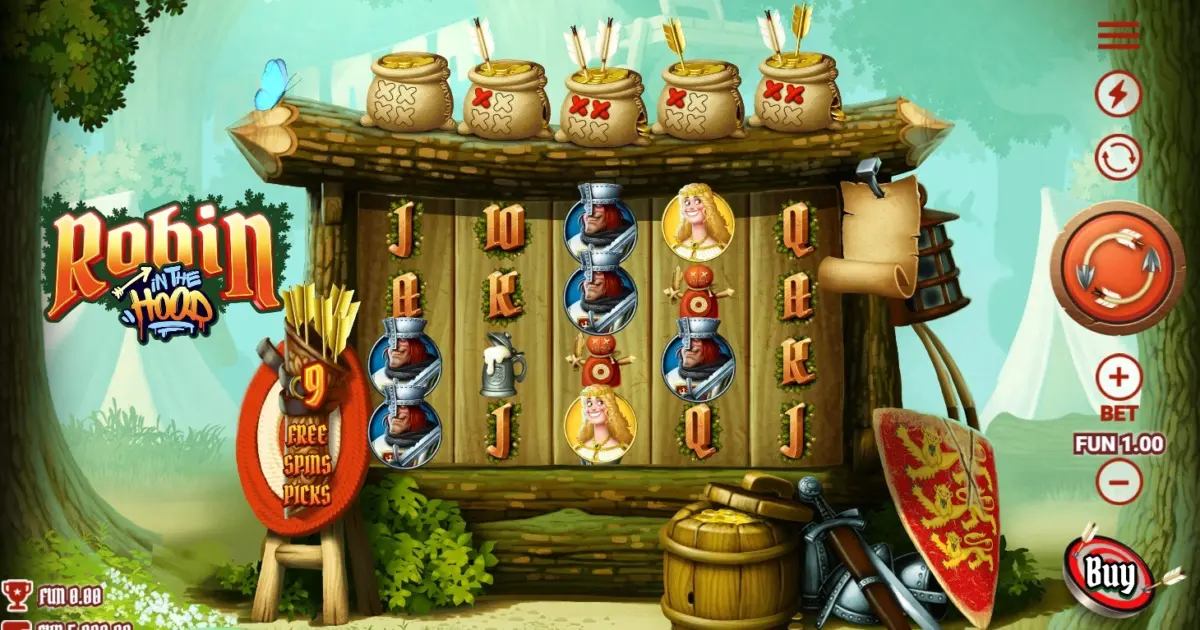
Trigger Button Studios built only two games before this one, and the Robin in the Hood Slot is the second. It sits at the 98.5th popularity percentile, which tells you a lot of people are playing it despite the provider’s small catalogue. That alone makes it worth a closer look before you deposit.
First look at the Robin in the Hood Slot
The game runs on five reels with a Medieval theme, also tagged Fantasy. Trigger Button Studios is a small provider—Mister Payman is their only other title, and it carries an identical 96.15% RTP. That symmetry suggests the studio uses a single return framework across its catalogue rather than tuning each game independently.
What you will not find in the published data: a hit frequency, a maximum win multiplier, a payline count, or a named bonus feature set. Those gaps are not unusual for smaller studios, but they do mean you should not rely on marketing copy elsewhere for specifics. The only hard numbers below are what the provider has committed to.
How a round plays out
With five reels confirmed, you are looking at the most common reel layout in modern video slots—typically three rows deep, though the provider has not stated row count. Five-reel layouts generally give developers room to place scatter symbols on multiple columns, but without published payline data or feature descriptions, you cannot know whether this game uses fixed lines, ways, or cluster mechanics.
What the Medieval and Fantasy tags tell you is the design language: the symbols and visual framing draw on archery-and-forest storytelling, likely with period-inspired high-value icons. How wilds, scatters, or free-spin triggers work in this specific game is not documented in available data. Treat any review that describes bonus mechanics for Robin in the Hood as unverified unless it cites an official source.
One structural note: the game’s title itself evokes the Robin Hood legend, and the Medieval tag confirms that connection. Whether the theme translates into a specific bonus round—archery minigames, loot-building sequences, or simple free spins—is unknown.
Reading the 96.15% return figure
| Spec | Value |
|---|---|
| Provider | Trigger Button Studios |
| RTP | 96.15% |
| Reels | 5 |
| Volatility | Not published |
| Max win | Not published |
| Bet range | Not published |
| Free demo | Available |
| Popularity rank | #295 |
| Corpus avg RTP | 95.71% |
RTP is a long-run statistical average calculated across millions of simulated spins. At 96.15%, the theoretical house edge is 3.85%: over an enormous number of rounds, you would expect to retain roughly £96.15 for every £100 staked. That does not describe any individual session. You will run hotter or colder than that figure with extreme frequency, and the gap between theory and one evening’s play can exceed hundreds of percentage points.
The 96.15% RTP is 0.44 points above the corpus average of 95.71%, placing Robin in the Hood in slightly better-than-typical territory. Across two games from this provider, both carry 96.15%—so the number is consistent, but it is also the only data point you have from them.
Why the missing volatility rating changes your bankroll maths
Volatility determines how returns distribute around that average. Low-volatility slots pay small wins often; high-volatility slots pay rarely but in larger amounts. Trigger Button Studios has not published a volatility rating for this game, and that is the single most important gap in the data.
Without it, you cannot properly size your bankroll. If the game is high-volatility, 40–50 times your average bet is a reasonable session buffer. If it is low, 20–25 times may suffice. Playing without knowing which regime applies means you might under-fund a high-variance game and bail early, or over-fund a low-variance game that cannot deliver meaningful swings at your stake.
The practical workaround: play the free demo version with a fixed number of spins—say 500—and log your wins and losses. Watch for streak length and payout clustering. A game that goes 30+ spins between any return behaves differently from one that pays something every third spin. This observation is not precise, but it gives you a rough directional read on variance before you wager real money.
Bet sizing when the minimum is unpublished
Neither the minimum nor maximum stake appears in available data. That absence means you cannot build a session plan from the provider’s numbers. Your options narrow to three practical steps.
First, open the demo mode and read the stake selector directly—most interfaces display minimum and maximum bets clearly before you start. Second, once you know those bounds, apply a simple rule: divide your intended session bankroll by the number of spins you want (aim for 200+ to ride out variance), and that quotient is your per-spin stake. Third, never let the stake exceed what you can afford to lose over those 200 rounds. Every spin is independent; no sequence of losses creates an obligation for the game to pay back.
If you find the minimum bet is unusually low—say £0.10—resist the temptation to treat that as a free-exploration budget. The RTP and volatility apply identically at every stake level. Playing at the minimum simply extends your session, which extends your total expected loss.
Where it sits among 232 Medieval slots
The game shares a theme category with 231 others, so the landscape is crowded. Here is how Robin in the Hood stacks against three notable neighbours.
Centurio carries 96.08% RTP—seven hundredths of a point below. At that level, the difference is statistically meaningless for any individual player. The practical distinction comes from volatility and feature design, neither of which Centurio’s data clarifies either. What it does offer is more visual detail in its published materials, which means you can make a more informed demo-to-deposit decision.
Two Tribes runs at 96.91% RTP—0.76 points higher. Over a large sample, that gap compounds: £100 per wagered bracket returns 76 pence more on Two Tribes. If your priority is purely mathematical return, Two Tribes is the stronger choice, though neither figure guarantees a better session.
On the low end of this comparison sits Da Vinci Diamonds at 94.94%—a full 1.21 points below Robin in the Hood. That gap is meaningful over thousands of spins but invisible over dozens. Most players never reach the sample sizes where these differences manifest as bankroll outcomes.
The honest verdict
Robin in the Hood is a competent five-reel slot with a marginally above-average return. It earns its place among Medieval titles on RTP and popularity. It loses points on transparency: no published volatility, no max win, no bet range, no documented feature set. That opacity forces you to self-audit in demo mode before committing funds, which is a burden most major-studio titles remove through clear documentation.
If you enjoy the theme and want to try it, play the free demo first, observe at least a few hundred spins to estimate variance yourself, then set a hard budget. Slots are paid entertainment, not an investment strategy. Only spin with money you are genuinely prepared to lose, and if you find yourself chasing losses or extending a session beyond what you planned, stop. For those in the UK, the National Gambling Helpline is available 24/7 at 0808 8020 133.
Frequently Asked Questions
Is there a free demo of Robin in the Hood?
Yes. Trigger Button Studios offers a free play version of Robin in the Hood, and it is available on review sites like this one. Demo play uses virtual credits, so you cannot win real money. It does let you observe spin frequency and payout patterns to estimate variance before depositing.
What does the 96.15% RTP mean for my sessions?
The Robin in the Hood slot returns 96.15% in theory across millions of spins, giving the house a 3.85% edge. That figure exceeds the corpus average of 95.71% by 0.44 points. In practice, no single session reflects this number—variance from the mean over 200 spins can swing by hundreds of percentage points in either direction.
What volatility does Robin in the Hood use?
Trigger Button Studios has not published a volatility rating for this game. That means you cannot determine whether wins arrive frequently in small amounts or rarely in large bursts without extended demo observation. The absence of this data is a meaningful gap—most major providers specify at least low, medium, or high.
How does Robin in the Hood compare to other Medieval slots?
Among 232 Medieval-themed slots, Robin in the Hood ranks 295th in overall popularity, placing it in the 98.5th percentile. Its 96.15% RTP sits above Centurio at 96.08% and well above Da Vinci Diamonds at 94.94%, though below Two Tribes at 96.91%.
What other games has Trigger Button Studios released?
Robin in the Hood is one of only two titles published by Trigger Button Studios. Their other game, Mister Payman, shares an identical 96.15% RTP. Both games carry the same return figure, suggesting the studio applies a uniform mathematical template across its small catalogue rather than designing per-game return profiles.




