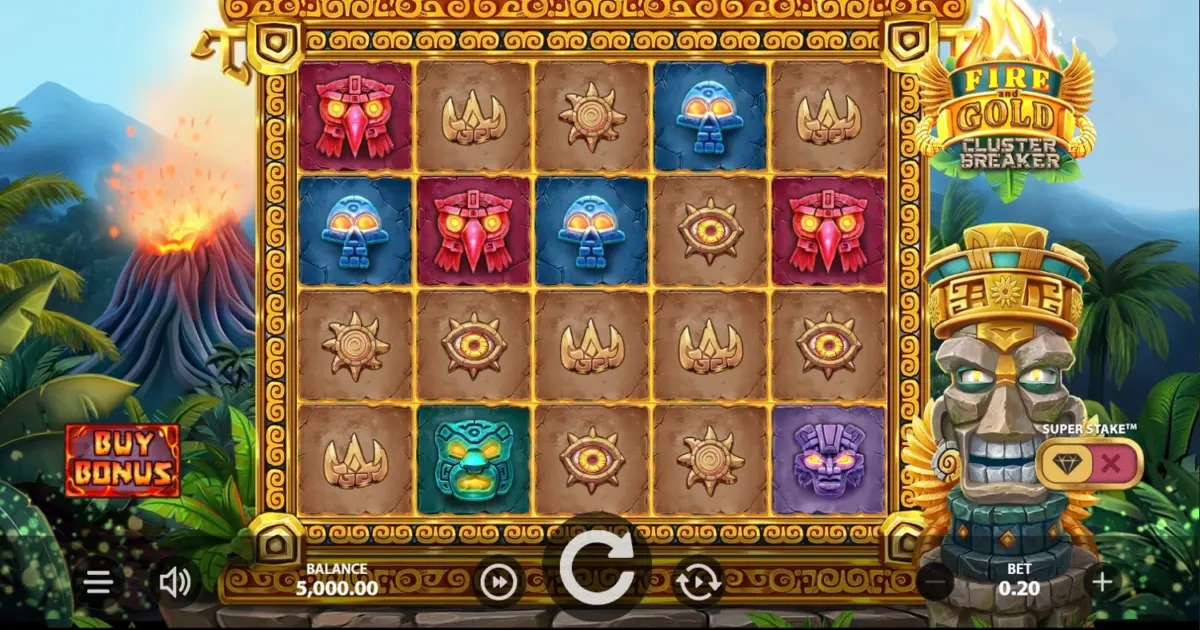
Fire and Gold Cluster Breaker is a Jungle-themed 5-reel slot from Stakelogic that you can try as a free demo before deciding if it fits your session. The fire and gold cluster breaker slot has no published RTP, volatility, stake range or max win in the facts available here, so your decision has to rest on what is known — provider, reel count, theme and popularity — and on a clear understanding of what missing numbers mean for risk.
Is fire and gold cluster breaker slot worth playing?
It depends on what you value most in a slot. If you want a fully documented maths model to plan around, this title is hard to recommend right now because its core figures are not published. If you want to sample a Stakelogic Jungle-themed game with 5 reels for free and form your own view on pacing and presentation, the free demo makes that easy and risk-free.
The facts that are available are limited but concrete. The game is listed as a Slot Machine in the Jungle/Aztecs family, built on 5 reels, and supplied by Stakelogic, a studio with 182 titles in the current corpus. It sits at popularity rank 2577, which puts it at the 87.1 percentile — meaning about 87% of tracked games rank lower and about 13% rank higher. That is not a top-100 hit, but it is well above the median, so you will find an audience and community discussion without the saturation that comes with the most-played releases.
What is missing matters as much as what is present. No RTP, no volatility label, no hit frequency, no stake range and no max win have been supplied for this specific game. That does not mean the game lacks those characteristics in the real product; it means you cannot verify them from this data set. Missing data is itself useful information: you should treat any third-party claim about those figures with caution until Stakelogic confirms them in a paytable or official game sheet, and you should prioritise demo exploration and conservative session planning over assumptions.
| Item | Detail |
|---|---|
| Game | Fire and Gold Cluster Breaker |
| Provider | Stakelogic (182 games tracked) |
| Format | 5 reels — Slot Machine |
| Themes | Jungle (primary), Aztecs, 5-Reels |
| Popularity | Rank 2577 — 87.1 percentile |
| Provider average RTP | 95.56% |
| Corpus average RTP | 95.71% |
| Free demo | Available — no download required to try |
What the missing RTP means over 1,000 spins
No specific RTP has been published for this game in the facts provided, so there is no title-specific figure to project over any sample. That limits what you can say about expected return for Fire and Gold Cluster Breaker itself. You can still understand what RTP means in general, so you can interpret a figure correctly when one does appear and avoid common mistakes in the meantime.
RTP is a long-run statistical average, not a promise for a session. A 96% RTP means that across a very large number of spins — millions, not hundreds — the game is designed to return £96 for every £100 wagered, on average, with the remaining £4 as the house edge. Over 1,000 spins at £1 a stake, a 96% game would have a theoretical expected return of £960 on £1,000 wagered, but actual results in 1,000 spins will vary widely around that average due to variance. Some 1,000-spin samples will be above, some below, and a minority will be far from the average.
Because no title RTP is available here, you cannot do a precise 1,000-spin maths model for this game. You can use reference points only for context. The average RTP across Stakelogic’s 182 tracked games is 95.56%, and the average across the wider corpus is 95.71%. If this game were to publish at or near those levels, its expected long-run return would be slightly below 96%. For example, at 95.56% a £1,000 total wager has an expected return of £955.60 and an expected loss of £44.40 across a huge sample, again with wide short-term swings. Treat that as illustration of how the maths works, not as a claim about this title.
The practical takeaway while the figure is missing is simple. Do not assume a high or low RTP based on theme or reel count; reels do not determine return. When an official RTP appears, check whether it is the single verified figure or a range of selectable settings, and note which setting the free-demo version uses, as real-money versions can differ by operator.
How volatile is Fire and Gold Cluster Breaker?
Volatility for this title has not been published in the facts provided, so no low, medium or high label can be assigned here. Without that, you cannot reliably predict how the game will distribute wins between frequent small hits and rarer larger hits, or what bankroll and patience a typical session will require.
Volatility as a concept describes the shape of results, not the size of the long-run return. In general, low-volatility games tend to produce more frequent, smaller wins that can keep a balance ticking over and extend session time on a given budget, but they rarely produce large multiples of stake. High-volatility games tend to produce longer stretches with no return, punctuated by larger potential hits that create bigger swings up and down. Medium volatility sits between, with moderate hit frequency and moderate swing size. All three can share the same RTP and still feel very different to play because the distribution is different.
Because the volatility is unknown here, plan for uncertainty rather than assuming a profile from the reel count or theme. A 5-reel format does not by itself indicate high or low volatility; you can find both extremes in 5-reel games. The same applies to cluster-style naming conventions: the name includes “Cluster Breaker” but without a published mechanic description you should not assume a specific cluster-pay or break mechanic is present in this build.
Until Stakelogic publishes a volatility rating or a detailed paytable, use the demo to observe session feel in general terms — how often any return occurs and how variable the balance feels — without treating that short sample as predictive. Short samples are noisy, and every spin remains independent, so a few demo sessions cannot confirm a volatility label.
What the Jungle theme brings to the game
The primary theme is listed as Jungle, with Aztecs and 5-Reels as additional tags. That tells you the intended setting and the structural category, but no further visual or audio detail is provided in the facts, so you should not infer specific characters, animals, temples, animations or soundtrack elements.
In general, a Jungle label signals a game that draws on jungle imagery, and an Aztecs tag often points to Mesoamerican motifs. The facts here do not confirm how those two ideas are combined in this title, how prominently each appears, or whether the art is realistic, stylised or symbolic. If theme is a major driver for you, the free demo is the cleanest way to see the actual presentation without relying on assumptions from the label alone.
Theme tags also have limited relationship to maths. Two games can share a Jungle tag and have very different reel counts, payline structures and volatility profiles. Here, the 5-reel tag confirms reel count, but it does not confirm a specific payline count, a “ways” system, or any feature set. Many slots use wilds, scatters or free spins as concepts, but the facts for this game do not list any such features, so you should not assume they are present or absent. When evaluating theme against preference, focus on whether the setting keeps you engaged during normal base play, since that is where most spins occur in any slot.
Stakes, session length and bankroll
No stake range has been published for this title in the facts provided, so no minimum bet, maximum bet or default coin size can be quoted here. That means you cannot calculate precise session length from a given bankroll using this data set alone, and any stake figures you see elsewhere should be checked against the in-game paytable once published.
Even without title-specific stakes, the general relationship between stake, bankroll and session length still applies and helps you plan once a range appears. Your number of spins is bankroll divided by stake per spin, before wins. A £50 budget at £0.50 per spin buys 100 spins of base wagers; at £0.20 it buys 250 spins; at £1 it buys 50 spins. Wins recycle some of that, but the starting maths of how long your budget lasts is driven by that simple division. A smaller stake relative to your budget extends the number of decisions you get to make, a larger stake shortens it and increases swing.
Because volatility is also unpublished, you should allow extra cushion for variance when you first try the game for real. In general, higher-volatility games can require more spins to experience their typical distribution, which translates to a need for a larger bankroll or a lower stake to keep the session comfortable. Lower-volatility games often need less cushion to achieve a similar number of hits. Until both stake range and volatility are known for this title, a cautious approach is to start at the lower end of whatever stakes are offered and decide whether the hit pattern suits your preference before adjusting.
Remember that every spin is independent and that RTP, when published, is a long-run average, not a compensating mechanism. Changing stake size or timing does not alter the expected value per £ wagered, and demo balance behaviour does not predict real-money outcomes. Use stake choice to manage entertainment time and comfort, not to chase recovery.
Alternatives if Fire and Gold Cluster Breaker is not for you
If the lack of published figures makes you prefer a title with a fully documented sheet, several related games give you different trade-offs while staying broadly comparable. All links below go to other slots in the same data set, with their RTPs stated where published.
If you want to stay with the same provider but see a confirmed RTP, Wild Buzz from Stakelogic is listed at 96.2% RTP, which is above both the provider average of 95.56% and the corpus average of 95.71%. That higher figure does not guarantee a better session — variance still drives short-term results and every spin is independent — but it does give you a verifiable long-run reference that is currently missing for Fire and Gold Cluster Breaker, which some players prefer for planning.
For a similar provider comparison with a smaller edge difference, Mega Fortune Hold ‘N’ Win is listed at 96.03% RTP and offers a Hold ‘N’ Win style alternative within Stakelogic’s catalogue. It keeps you in the same studio’s ecosystem while giving you a published number to anchor expectations, and the popularity and feature concepts will differ, so use its demo to judge fit.
If the Jungle theme is the attraction, Hypercharged Inca Jungle is a Jungle-tagged alternative listed at 96.0% RTP. That keeps the jungle setting while providing a stated RTP at the widely recognised 96% level. It is a cleaner comparison on theme, whereas the two Stakelogic alternatives above are cleaner on provider consistency. Which you prioritise depends on whether studio style or theme matters more to you.
Final take
Fire and Gold Cluster Breaker is a 5-reel Jungle slot from Stakelogic with free-demo access and above-median popularity at rank 2577, but with no published RTP, volatility, stakes or max-win detail in the available facts. That makes it easy to sample and hard to evaluate on maths alone. If you enjoy trying new themes without commitment, the demo is the sensible route; if you require verified figures to choose a game, you will want to wait for an official sheet or pick a documented alternative in the meantime.
When you do move from demo to real play on any slot, keep it as paid entertainment. 18+ only — set a budget before you start, use deposit or time limits if they help you stay to that budget, and step away when the fun stops. If gambling stops feeling like entertainment, use a timeout and seek support from a recognised help service in your country.
Frequently Asked Questions
Can I play Fire and Gold Cluster Breaker for free before wagering real money?
Yes, the facts list free demo access as available for Fire and Gold Cluster Breaker, so you can try it without staking. Demo play uses virtual credits, does not pay real money and does not predict real-money results, but it lets you see the 5-reel Jungle presentation and pacing before you decide.
What is the RTP of Fire and Gold Cluster Breaker and what does it mean?
No RTP has been published for Fire and Gold Cluster Breaker in the data provided, so a title-specific figure cannot be quoted here. In general, RTP is a long-run average — for example, 95.56%, the Stakelogic average, would imply £95.56 returned per £100 wagered across millions of spins, with wide variation in any small sample.
How volatile is Fire and Gold Cluster Breaker and what does that mean for my session?
Volatility for Fire and Gold Cluster Breaker is unpublished, so no low/medium/high label can be assigned. Volatility describes how wins are distributed: low tends toward frequent small hits and steadier sessions, high toward rarer larger hits with bigger swings. Without a rating, plan cautiously and consider using the demo to observe feel.
Who makes Fire and Gold Cluster Breaker and what else do they offer?
Fire and Gold Cluster Breaker is by Stakelogic, a studio with 182 games tracked in this corpus and an average RTP of 95.56% across those titles. Related Stakelogic slots in the same data set include Wild Buzz at 96.2% and Mega Fortune Hold ‘N’ Win at 96.03%, giving you comparable, documented alternatives.
Will playing the free demo of Fire and Gold Cluster Breaker pay real money?
Demo play does not pay real money and its results do not forecast real-money outcomes. The free version is for learning the 5-reel format and Jungle theme at no cost. If you later play with real stakes, set a budget, remember each spin is independent, and treat the session as entertainment.