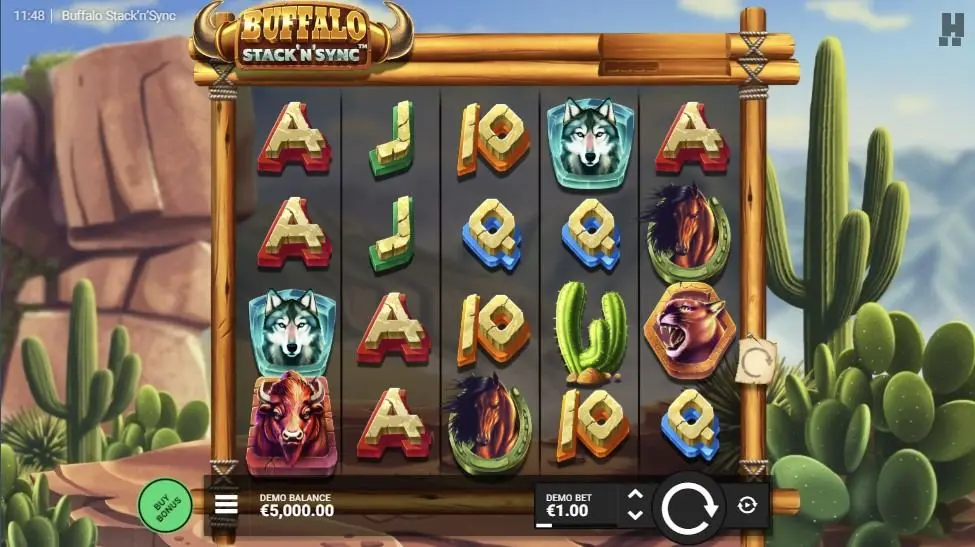
The buffalo stack ‘n’ sync slot is a high-volatility, 10-payline release from Hacksaw Gaming carrying a published RTP of 96.36%. That sits 0.65 percentage points above the 95.71% average across the games catalogued here, so the long-run maths is better than typical. The high volatility rating is the trade-off: returns arrive unevenly, in clusters, with flat stretches in between.
Buffalo Stack ‘N’ Sync at a glance
Here are the figures that actually affect a session, all taken from the game’s published specification.
| Specification | Detail |
|---|---|
| Provider | Hacksaw Gaming |
| RTP | 96.36% |
| Volatility | High |
| Reels | 5 |
| Paylines | 10 |
| Minimum stake | $/£/€0.10 |
| Maximum stake | $/£/€100 |
| Primary theme | Animals |
| Type | Slot machine |
| Free demo | Available |
Popularity-wise it ranks 2,646 overall, which places it in the top 13.3% of titles here by traffic. That is a solid audience without being a household name. The theme grouping is broad: Animals, Nature and American labels, on a five-reel frame. No maximum win figure has been published for this title, and no hit frequency either, so any “max win” number you see quoted elsewhere is worth treating with suspicion until the studio confirms it. Who does it suit? Players who are comfortable with variance, who understand that a 10-payline game gives fewer but structurally simpler win lines, and who plan a stake they can repeat several hundred times without stress.
What a 96.36% RTP actually returns
RTP is a long-run statistical average, not a session promise. At 96.36%, the game is modelled to return $96.36 for every $100 wagered across an extremely large sample of spins, with the remaining $3.64 retained as house edge. Work it through concretely: 1,000 spins at the $/£/€0.10 minimum stake puts $100 through the game. The expected return on that $100 is $96.36, an expected cost of $3.64 for those 1,000 spins. What you will actually see over 1,000 spins on a high-volatility game can sit far above or far below that, because 1,000 spins is a tiny sample against the millions used to certify the figure.
Against the 95.71% average across this catalogue, you are getting 0.65 percentage points back, or about 65 cents per $100 staked. Compared with the 96.1% average across Hacksaw Gaming’s 156 titles, this one is slightly above their house standard. If RTP is your deciding factor, Wanted Dead or a Wild edges it at 96.38% from the same studio. The gap is 0.02 points, which is statistically trivial and should not drive your choice.
High volatility and what your session will feel like
Volatility describes the shape of the distribution, not its average. High volatility means the returns are concentrated into fewer, larger outcomes, with longer gaps of nothing much in between. Two games can share the same 96.36% RTP and feel completely different: a low-volatility title dribbles small returns back regularly and keeps a balance alive; a high-volatility one can run dozens of spins without a meaningful return, then hand back a chunk at once.
In practice that means your balance graph will look jagged rather than gently sloping. It also means short sessions are close to a coin flip in outcome terms. The variance dominates over a few hundred spins, so a good session and a bad session on identical play are both entirely normal. Nothing in the maths changes between spins: every spin is an independent event, and previous results carry no information about the next one. A game is never due, warm or cold.
If jagged is not what you want, Le Bandit runs at a similar 96.34% RTP and is worth comparing on feel before you settle. Match the risk profile to your patience, not to a target.
The 5-reel layout and how wins are counted
Five reels with ten fixed paylines is a deliberately tight structure. Each payline is a defined path across the reels, and a win is registered when matching symbols land along that path according to the paytable. Ten lines is modest by modern standards, where Megaways and cluster engines routinely advertise thousands of ways to win. Fewer lines does not automatically mean worse maths. The RTP is set by the whole model — symbol weighting, paytable values and any features — not by the line count alone. A 10-line game and a 100,000-ways game can both be certified at 96.36%.
What the line count does change is legibility. With ten paths, you can usually see exactly why a spin paid what it paid, which many players prefer over a screen of simultaneous cluster hits. It also means each individual spin resolves into a small number of discrete outcomes, which contributes to the sharper swings that come with the high volatility rating. For a ways-based contrast on the same theme family, Apex Strike Megaways sits at 96.13% and counts wins on an entirely different basis.
Stake range and sizing a bankroll
The stake band runs from $/£/€0.10 to $/£/€100 per spin, a 1,000x spread that covers very cautious play and very large play from the same interface. That flexibility is useful, but it also makes it easy to drift upward mid-session without noticing.
A practical way to size it: decide the total you are willing to spend, then divide by the number of spins you want the session to last. A $50 budget at the $0.10 minimum buys roughly 500 spins. The same $50 at $1.00 a spin buys 50 spins, and on a high-volatility game 50 spins is far too small a sample for the RTP to mean anything at all. At the $100 ceiling, a $50 budget does not cover a single spin.
The honest version of this: on a high-variance game, spin count is your main defence against variance, and stake size is the only lever you control. No staking pattern, progression or timing method changes the expected value of a single spin. The house edge is fixed in the game’s maths, and it applies identically whether you bet $0.10 or $100.
Playing the buffalo stack ‘n’ sync slot demo before you commit
A Buffalo Stack ‘N’ Sync free demo is available, which is the cheapest research you will ever do. Free play lets you check the pace of the reels, how the 10-line structure reads on your screen, and whether the high-volatility rhythm suits your attention span — all without money at risk. Play it long enough to sit through a dry spell, because that is the part of the experience the marketing never shows you.
One caution: demo results do not predict real-money results. A generous demo run is not a signal, and a poor one is not a warning. Both are just small samples from the same random model.
Slots are paid entertainment, not income. Play only if you are 18 or over, set a cash budget before you open the game, and treat that budget as the price of the session rather than as money you expect to get back. If the amount you are staking starts to matter to you, that is the moment to stop.
Verdict: who should play Buffalo Stack ‘N’ Sync
This is a reasonable pick for a player who wants above-average published maths and accepts sharp variance to get it. The 96.36% RTP beats the 95.71% catalogue average and the 96.1% studio average, and the $0.10 floor means you can stretch a modest budget across several hundred spins. The clean five-reel, ten-line structure is easy to follow, which counts for something.
The reservations are honest ones. High volatility makes short sessions unpredictable, and no max win or hit frequency figure has been published, so two of the numbers players most want are simply unavailable here. If those matter to you, that absence is a real drawback rather than a neutral gap. The RTP advantage over rival Hacksaw Gaming slots is also small enough to be noise — a few hundredths of a percentage point is not a reason to switch games.
Start in the free demo, decide whether the rhythm suits you, then set a stake you could repeat 300 times before you move to real money.
Frequently Asked Questions
Can you play Buffalo Stack 'N' Sync for free?
A free demo of Buffalo Stack 'N' Sync is available, so you can test the game with no download and no deposit. Demo mode runs the same 96.36% RTP maths as the paid version, which makes it a genuine way to judge pace and volatility before staking anything real.
What is the RTP of Buffalo Stack 'N' Sync?
The published RTP is 96.36%, meaning the game is modelled to return $96.36 per $100 wagered across a very large sample of spins. That is 0.65 percentage points above the 95.71% catalogue average and slightly above Hacksaw Gaming's 96.1% studio average. Short sessions can deviate widely from it.
Is Buffalo Stack 'N' Sync high or low volatility?
It carries a high volatility rating, so returns tend to be infrequent and larger rather than small and steady. Expect extended stretches without a meaningful win, and plan a spin count rather than a target. Every spin is independent, so past results never indicate what comes next.
Who makes Buffalo Stack 'N' Sync?
Hacksaw Gaming developed it. The studio has 156 titles catalogued here with an average RTP of 96.1%, including Strength of Hercules at 96.31% and Wanted Dead or a Wild at 96.38%. This release sits marginally above their portfolio average on RTP and uses a compact ten-payline structure.
What stakes can you play Buffalo Stack 'N' Sync at?
Stakes run from $/£/€0.10 up to $/£/€100 per spin. A $50 budget covers roughly 500 spins at the minimum, or 50 spins at $1.00 — and on a high-volatility game, more spins gives the RTP a better chance to show itself. No stake size changes the house edge.