Double Double Bonus video poker is worth your time if you already know how a bonus-poker pay chart works and you are willing to open the in-game pay table before you stake anything. Habanero has not published a return figure or a payout schedule for this specific version, and in this family of games the schedule is the return. The free demo is available, which is the right place to read those numbers at no cost.
What follows separates what this listing actually tells you from what the variant name tells you about the maths. Those are two different things, and mixing them up is how players end up assuming a return that the game does not offer.
Is Double Double Bonus worth your time?
Three things are confirmed here: the game is called Double Double Bonus, it comes from Habanero, and a free demo is available. That is enough to place it, and not enough to price it.
For a numerate player, that combination is still useful. Video poker is the one casino category where you can work out your own expected return from the screen in front of you. There is no reel weighting to hide behind and no symbol frequency you cannot see. Every card comes from a freshly shuffled 52-card deck, the ranks of the winning hands are fixed by the rules of poker, and the only variables are what each hand rank pays and how well you play your draws. Read the pay chart in the demo, match it to the published optimal-play figure for that schedule, and you know where you stand.
So the honest answer is conditional. If you treat the demo as a research step, this is a reasonable game to spend time on. If you want a number handed to you before you open it, this listing will not give you one, and neither will the game’s name.
| Provider | Habanero |
|---|---|
| Theme | Cards |
| Free demo | Yes |
| Site-wide average RTP | 97.5% |
Jacks or Better, Deuces Wild or something else? What the name tells you
The name identifies the family precisely. Double Double Bonus is a Jacks or Better derivative: your lowest paying hand is a pair of jacks or better, and there are no wild cards, unlike Deuces Wild where every 2 is wild and payouts start at three of a kind. What the “double double” part signals is a layered four-of-a-kind schedule.
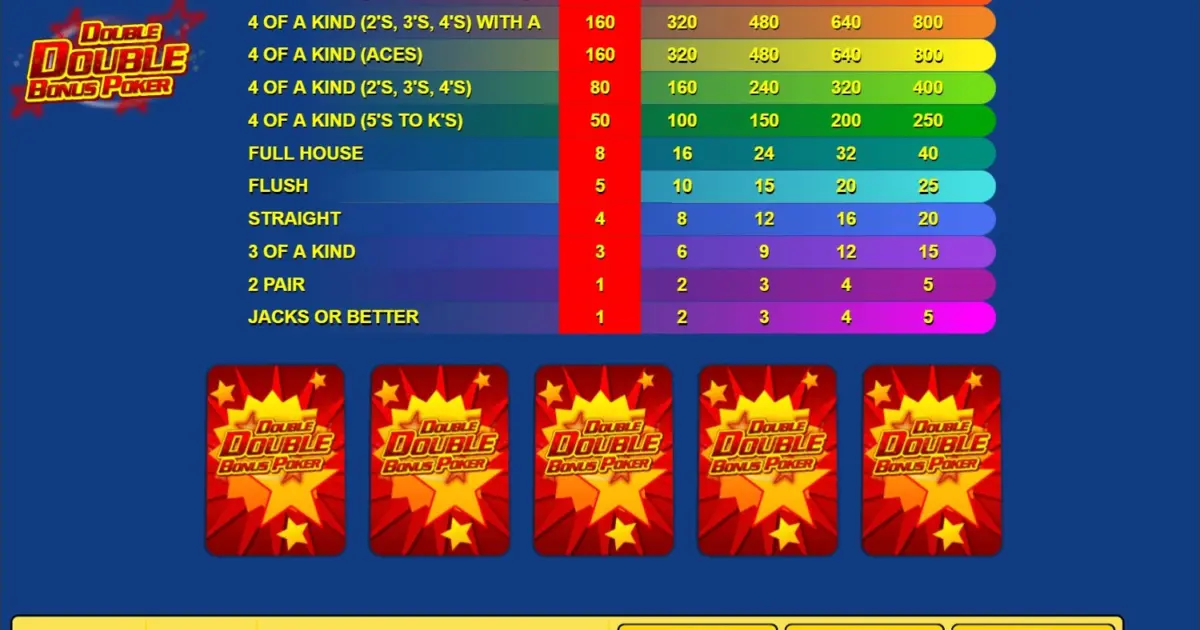
In this family, four of a kind is not one payout but several. Four fives through four kings pay one amount, four twos through four fours pay more, and four aces pay most of all. On top of that, the “double double” games add kicker premiums: four aces with a 2, 3 or 4 alongside them, or four 2s through 4s with an ace kicker, pay a large multiple of the plain quad. That single rule reshapes the strategy chart. Holding a low kicker with three aces, or breaking what looks like a made hand to chase a quad, can be correct here when it would be wrong in plain Jacks or Better.
The money for those premiums has to come from somewhere, and it usually comes out of the two-pair payout, which in this family is commonly cut to 1-for-1 rather than 2-for-1. That is what makes the variance so much higher than a flat Jacks or Better game. None of this tells you what this Habanero table pays, though. It tells you which rows to look at first.
Return to player: not published
Habanero has not published an RTP for this release, so treat any figure you see quoted elsewhere as unverified. The return of a video poker game is decided by exactly two things: the payout schedule on screen, and whether you play the mathematically optimal hold-and-discard chart for that exact schedule.
The size of that effect is easy to underestimate. In plain Jacks or Better, a 9-for-1 full house and 6-for-1 flush returns about 99.5% with perfect play. Change only those two numbers to 8-for-1 and 5-for-1 and the same game returns roughly 97.3%. Cut them to 6-for-1 and 5-for-1 and it falls below 95%. Two entries on a pay chart, more than four percentage points of return. No other mainstream casino category moves that far on detail that small.
Double Double Bonus games are usually tuned in the same way, most often by adjusting the full house and flush rows while the headline four-aces-with-kicker payout stays impressive. So the row that looks most exciting is rarely the row that decides your return. Open the pay chart, note the full house and flush, note the two-pair line, and compare against published optimal-play returns for that combination before you play for money.
The five-card draw and your one real decision
The structure is the same as every draw game. You are dealt five cards from a shuffled deck, you choose which to keep, the discards are replaced from the remaining cards in that same deck, and the final five are scored against the pay chart. That is one decision per hand, made once.
That decision is fully solved. For any given paytable, there is a published hold chart that lists the highest-expected-value hold for every possible deal. It is a lookup table, not a system, not a read, and not a feel. Following it does not change the deck or the odds behind it; it changes which five cards you keep so that your return matches the game’s mathematical ceiling instead of falling short of it. Deviating costs you expected value every time.
Two practical points for this variant. First, the chart you need is the Double Double Bonus chart for the exact schedule on your screen, because the kicker premiums shift correct holds away from plain Jacks or Better play. Second, no deal is influenced by the one before it. A machine that has not shown a quad in two hours is not “due” one, and a machine that just paid one is not “cold”. Each shuffle is independent.
If the game offers a multi-hand or multi-play format, keep in mind that dealing your held cards across several hands at once does not change the per-hand return. It multiplies your stake and your swings, and it gets you through many more hands per hour.
How Double Double Bonus compares to other video poker
The average published RTP across the games in this collection is 97.5%, and a well-paying video poker schedule usually sits above that. Since Habanero has not published a figure here, you cannot place this game against that benchmark from the listing alone, which is a reason to check the pay chart rather than assume.
For a documented reference point, Jacks or Better (Red Rake Gaming) lists 99.55%, close to the textbook 9/6 ceiling and the cleanest baseline for what optimal play can return in a non-wild draw game. Russian Poker lists 98.42% and plays quite differently, with a table-game structure rather than a straight five-card draw.
Within Habanero’s own dozen-title range, Joker Poker (Habanero) is the closest comparison in spirit: a wild-card game where the joker changes both the hand rankings and the strategy chart, with a flatter distribution than the kicker-heavy Double Double Bonus. If you want something further from draw poker entirely, Three Card Poker from the same studio is a table game with no draw decision at all. None of those three list a published RTP either, so the same pay-chart check applies.
Bankroll and session limits
Double Double Bonus is a high-variance shape by design. Cutting two pair to 1-for-1 removes a large slice of the small, frequent wins that keep a Jacks or Better session ticking over, and it hands that money to hands you will see rarely. Four aces with a low kicker is not a hand you plan around; it is a hand you occasionally get. Between those, the drawdowns are longer and deeper than the average return figure suggests.
The practical consequence is that a short session tells you almost nothing about the long-run return, in either direction. Size your bankroll for the dry stretches rather than the highlight, and remember that demo results are a display of the same maths on play credits, not a forecast of what real money will do.
Play only if you are 18 or over, decide what the session costs you before you start, and treat that figure as money already spent on entertainment rather than money you expect back. Video poker rewards accuracy and patience; it does not pay a wage.
Verdict
Double Double Bonus from Habanero is a recognisable, well-understood variant with an unpublished paytable and no stated RTP. The variant name tells you the shape of the game: Jacks or Better base, no wilds, tiered quads, kicker premiums on aces and low quads, and almost certainly a reduced two-pair payout funding it.
What the name cannot tell you is your return, because that lives on the full house, flush and two-pair rows of this specific schedule. The free demo is the answer to that. Open it, read the pay chart, find the published optimal-play return for that exact combination, and pull up the matching hold chart. Do that and you are playing a game whose maths you know precisely. Skip it and you are guessing at a number that could differ by several percentage points from what you assumed.
Frequently Asked Questions
Can I play Double Double Bonus for free?
Yes. A free demo of Double Double Bonus is available, so you can deal hands on play credits with no download and no deposit. That is the most useful way to read the in-game pay chart and confirm what each hand rank pays before you commit real money, since Habanero has not published the schedule.
What is the RTP of Double Double Bonus video poker?
Habanero has not published an RTP for this release. In video poker the return is set by two things only: the payout schedule shown on screen and whether you follow the optimal hold chart for that exact schedule. Check the in-game pay table and compare it against published optimal-play returns before staking anything.
Which variant is this and how do you play it well?
The name identifies it as a Double Double Bonus game, a Jacks or Better derivative with no wild cards, tiered four-of-a-kind payouts and bonus premiums for four aces or low quads with a specific kicker. Optimal play means following the published hold-and-discard chart written for that precise paytable.
Why does the paytable matter so much in this game?
Because it is the return. In Jacks or Better, moving the full house and flush from 9-for-1 and 6-for-1 down to 8-for-1 and 5-for-1 drops perfect-play return from about 99.5% to roughly 97.3%. Double Double Bonus games are tuned the same way, usually on those same rows.
How does it compare to Jacks or Better (Red Rake Gaming)?
Jacks or Better (Red Rake Gaming) lists 99.55%, close to the textbook 9/6 ceiling, with frequent small wins and a flat quad payout. Double Double Bonus has no published figure here and a much higher-variance shape, since kicker premiums on quads are typically funded by cutting the two-pair payout.