If you want a card game where the maths is visible rather than hidden, russian poker is a reasonable place to spend time: OneTouch publishes a return of 98.42%, which sits about 0.92 points above the 97.5% average across the video poker titles on this site. That is a genuinely competitive figure for the category.
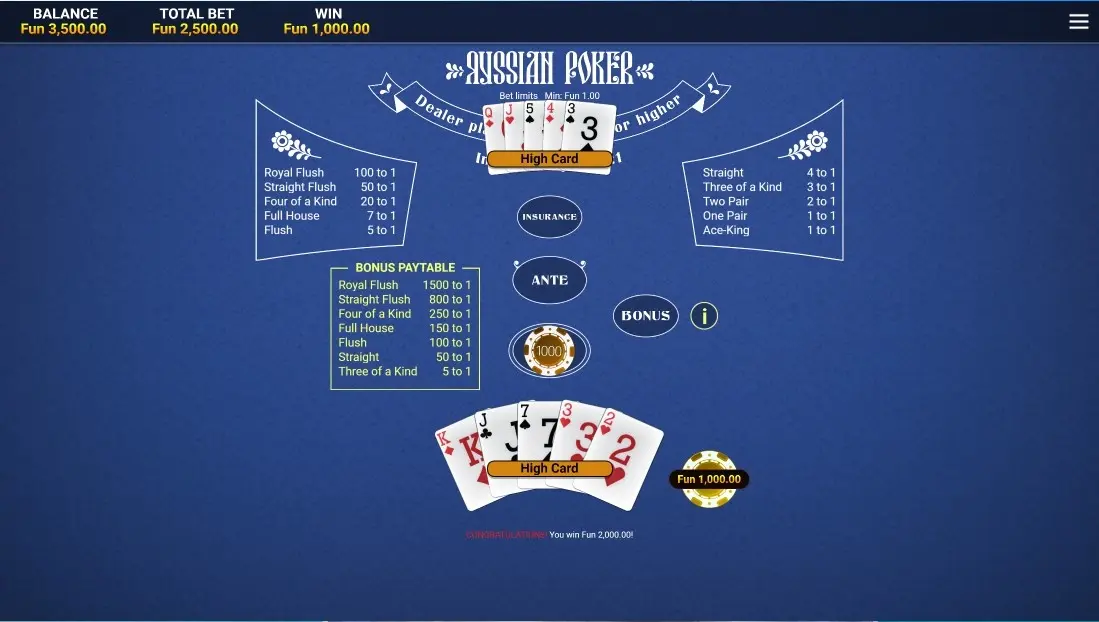
The caveat matters just as much. This listing carries the return but not the payout schedule that produces it, and in this game category the schedule is the single biggest lever on your expected return. Read the in-game pay chart before you play for money.
Russian Poker in one minute
Russian Poker is a card game from OneTouch, filed here under the Cards theme alongside 49 other titles and under the video poker subcategory. It ranks third in this section and sits in the 98.6th popularity percentile, so a lot of people are opening it.
The number that should decide whether you keep reading is the 98.42% return. For context, OneTouch’s four listed games average 94.54%, so this title runs almost four percentage points above its own studio’s typical figure. Against the wider category average of 97.5%, it is still ahead.
A free demo is available, which means you can open the pay chart, deal a few hundred hands and learn the decision points without staking anything. That is the practical way to fill the gap in this listing.
What is not stated anywhere in the published data: the exact payout schedule, the bet levels or coin denominations, whether any progressive element is attached, or when the game was released. None of that can be inferred from the return figure alone, so treat those as open questions to answer inside the game itself.
What perfect strategy actually means here
In video poker, optimal strategy is a solved list of hold-and-discard decisions. For any five cards you are dealt against a given payout schedule, there is one mathematically best set of cards to keep, and it can be written out as a chart. It is published, checkable arithmetic, not a hunch and not a betting system.
That distinction is worth being precise about. Optimal play changes which cards you keep. It never changes the deck, the odds of drawing a specific card, or the sequence of hands you are dealt. Every deal comes from a freshly shuffled 52-card deck, independent of the one before it. No hand is ever due, warm or overdue.
The 98.42% figure quoted for this game is what you approach when you make the best available decision on every hand. Deviate — keeping a low pair over four cards to a flush, chasing a hand the schedule barely rewards — and your actual return drops below the published number. The published figure is a ceiling reached by correct play, not a floor you get for showing up.
Because the correct chart depends on the payout schedule, and this listing does not include one, the specific hold decisions for this table cannot be laid out here. Read the pay chart in the demo, then match your play to the ranks it actually rewards.
Where the 98.42% comes from
Two inputs, and only two, produce a video poker return: the payout schedule and the assumption that you play every hand optimally. There is no reel weighting to hide behind and no symbol frequency to tune. A 52-card deck has fixed probabilities for every hand rank, so once you fix what each rank pays, the return is arithmetic.
That is why a figure like 98.42% is more meaningful in this category than an equivalent percentage on a slot. It is derived from a schedule you can read on screen and probabilities you can verify yourself. It is also why it comes with a condition attached: the number assumes correct play throughout.
Comparison gives it shape. OneTouch’s four listed games average 94.54%, and the two Hold em Poker variants on this site both sit at 92.58% — see Hold em Poker if you want to see how far apart two card titles from the same studio can be. At the other end, Jacks or Better (Red Rake Gaming) lists 99.55%, showing what the top of this category looks like.
What the return does not tell you is variance — how bumpy the ride is on the way to that long-run average. Two games with identical returns can feel completely different across a few hundred hands.
Paytable differences that change everything
Here is the clearest illustration in the whole category. Jacks or Better on a 9/6 schedule — nine coins for a full house, six for a flush, per coin staked — returns roughly 99.5% with perfect play. The identical game on an 8/5 schedule returns about 97.3%. Drop to 6/5 and it falls below 95%. Same rules, same deck, same strategy discipline. Two numbers on the pay chart moved.
| Hand rank | 9/6 schedule (per coin) | 8/5 schedule (per coin) | 6/5 schedule (per coin) |
|---|---|---|---|
| Full house | 9 | 8 | 6 |
| Flush | 6 | 5 | 5 |
| Straight | 4 | 4 | 4 |
| Three of a kind | 3 | 3 | 3 |
| Approximate return | ~99.5% | ~97.3% | below 95% |
Those are the well-known general figures for Jacks or Better, included to show the mechanism, not as this game’s schedule. OneTouch has not published the payout table for this exact version of Russian Poker, and since the schedule decides the return here far more directly than in most casino game categories, open the in-game pay chart before you stake anything. A percentage-point swing hides in two rows.
Multi-hand and multi-play formats, explained
Multi-hand and multi-play video poker deals one set of five cards, you choose your holds once, and those holds are then played out simultaneously across several independent decks. Three hands, five, fifty — the format scales.
The important point is what it does not change. Per-hand return is untouched. Each hand still draws from its own freshly shuffled deck with the same probabilities, and the same payout schedule applies to each one. Playing ten hands at once does not improve or worsen your expected return by a fraction of a point.
What changes is variance and speed. Ten hands per deal means ten times the money in play per decision and ten times the hands per hour, so both swings and total turnover grow. Sessions get shorter in time and larger in throughput. If you stake the same per-hand amount across ten hands as you did on one, you have multiplied your exposure tenfold without touching the maths.
This listing does not state whether Russian Poker offers a multi-hand mode or how many hands it supports. The demo will tell you.
Trying the demo first
Free play is available, and for this game it is more useful than usual. The demo is where you read the payout schedule this listing omits, count the rows, and work out which hand ranks the game actually rewards. That single piece of information is what the 98.42% return rests on.
It is also where you practise holds without cost. Deal a few hundred hands, notice the recurring decisions, and check them against a published chart for the schedule you found. Demo results tell you nothing about future real-money outcomes — every deal is independent, and a hot demo session predicts precisely nothing.
Video poker is for players aged 18 or over. Set a budget before you open the game and treat it as money spent on entertainment, in the same category as a cinema ticket. It is not income, and no run of good hands makes it one.
If you want a wider sense of how card titles vary, In Between Poker at 94.6% is another OneTouch entry worth a few demo hands for comparison.
Who should play Russian Poker
This suits players who read pay charts. The 98.42% return is competitive, comfortably clear of the 97.5% category average and well clear of OneTouch’s own 94.54% studio average, but it only materialises for someone willing to learn the correct hold decisions and stick to them across a long run of hands.
It suits you less if you want to press deal without thinking. Deviating from optimal play does not break anything, but it quietly reduces your return below the published figure, and in a game this transparent that is a self-inflicted cost.
Anyone chasing the highest listed return in this section should look at the 99.55% option instead. Anyone who wants to understand where a video poker number actually comes from will get more out of Russian Poker’s demo, because the whole mechanism is on screen.
One last thing worth stating plainly: no staking pattern changes any of this. Raising bets after losses, lowering them after wins, alternating sizes — none of it alters the probabilities in a shuffled deck or the return the schedule produces. The only lever you control is which cards you keep.
Frequently Asked Questions
Can you play Russian Poker for free?
Yes, a free demo is available for Russian Poker, and it is genuinely useful here. The demo lets you read the in-game payout schedule that this listing does not publish, and practise hold decisions at no cost. Demo results do not predict real-money outcomes, since every deal comes from an independently shuffled deck.
What is the RTP of Russian Poker?
OneTouch lists Russian Poker at 98.42%, which is 0.92 points above the 97.5% average for video poker titles on this site. In this category the return is determined by two things: the payout schedule and whether you play every hand optimally. Deviating from correct holds pulls your actual return below that figure.
Why does the paytable matter so much in Russian Poker?
Because it is one of only two inputs that set the return. In Jacks or Better, moving the full house from nine coins to eight and the flush from six to five drops the return from roughly 99.5% to about 97.3%. OneTouch has not published this table's schedule, so check the pay chart before staking.
Who makes Russian Poker?
OneTouch, which has four games listed here averaging 94.54% RTP. Russian Poker's 98.42% sits nearly four points above that studio average, making it the strongest of the group on paper. The two Hold em Poker variants from the same provider both list 92.58%, so returns vary widely within the range.
How does Russian Poker compare with Jacks or Better (Red Rake Gaming)?
Jacks or Better (Red Rake Gaming) lists 99.55% against Russian Poker's 98.42%, so the Red Rake title has the higher published return by just over a point. Jacks or Better pays only from a pair of jacks upward and has a widely published strategy chart. Russian Poker's exact schedule is not listed here.