If you want a video poker game where the published number holds up under scrutiny, this one does. Double Aces and Faces video poker carries a stated return of 99.27% with optimal play, which puts it 1.77 percentage points above the 97.5% average across the games we list. That is a genuinely tight game by casino standards, and the free demo lets you drill the hold decisions before any money is involved.
How Double Aces and Faces plays
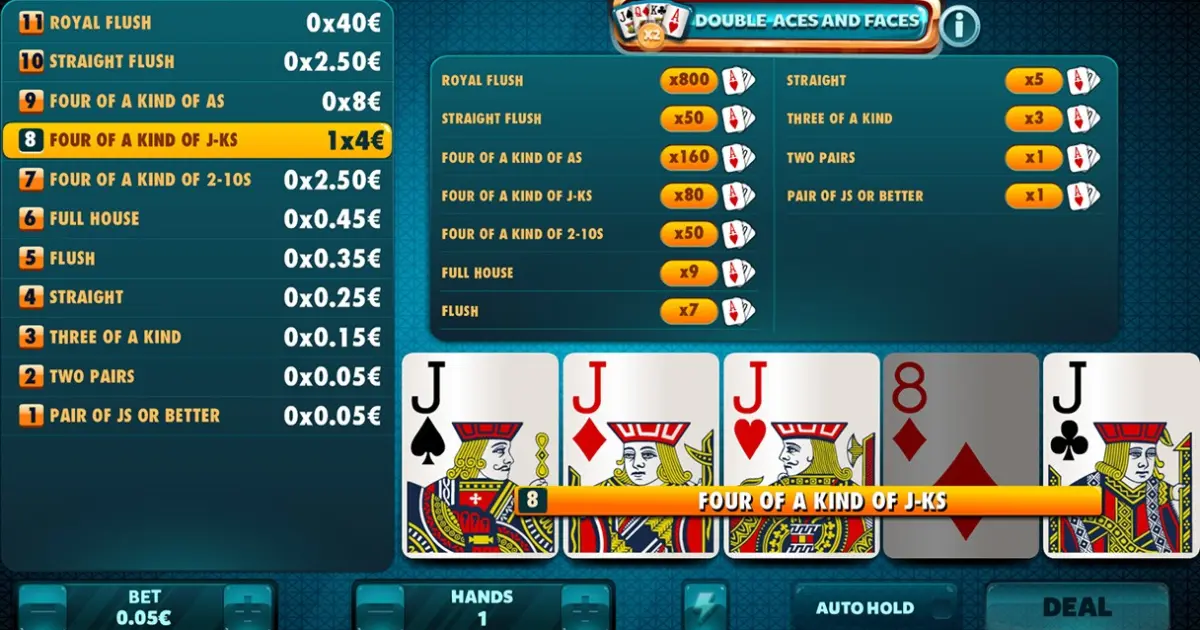
The title tells you what kind of machine this is. An “Aces and Faces” game is a Jacks or Better derivative: you are paid from a pair of jacks upward, and the paytable adds enhanced payouts for four-of-a-kind hands made of aces and of face cards, on top of the standard schedule. The “Double” prefix in this family conventionally signals a further step up in those quad premiums.
Mechanically it is standard five-card draw against a machine. You are dealt five cards from a freshly shuffled 52-card deck, you choose which to hold, the rest are replaced, and the final hand is paid according to the pay chart. There are no reels, no symbol weighting, no hidden frequency tables. Every card that can appear is one of 52, and every deal is independent of the one before it.
What that structure gives you is unusual transparency. Because the deck is known and the payouts are printed, the return is not an estimate produced by a studio’s internal model — it is arithmetic. Where the bonus-quad structure changes things is in the decisions: hands that would be routine discards in plain Jacks or Better become worth chasing when four aces or four faces pay a premium, which is why the strategy chart for this family differs from the base game.
Red Rake Gaming and this game
Red Rake Gaming lists 20 games in the section of our database this one sits in, and the average return across them is 98.89%. That is a high group average, and it tells you something useful: this studio is not building loose paytables and hoping nobody checks. Double Aces and Faces at 99.27% sits above that studio average, though not at the top of it.
The comparison worth making is against the studio’s plain-vanilla option. Jacks or Better (Red Rake Gaming) is listed at 99.55%, roughly a third of a point higher, and it is the simpler game to play correctly — fewer exceptions in the chart, less temptation to chase premium quads. If you want the highest listed return in the Red Rake set, Triple Bonus Poker is published at 99.95%, which is about as close to break-even as video poker gets, with the variance that bonus structures imply.
None of those differences are large in absolute terms. But video poker is a game where you can play thousands of hands in an evening, and a third of a percentage point compounds over volume in a way that a single-session difference never shows you.
Reading the 99.27% figure
The 99.27% return is a long-run theoretical figure, and it comes with two conditions attached. First, it assumes the specific paytable this version ships with — not the paytable of another Aces and Faces game with the same name. Second, it assumes you play the mathematically optimal hold and discard on every single hand. Miss either condition and the number you actually face is lower.
That is not a warning unique to this game; it is how every video poker return is quoted. What it means practically is that 99.27% is a ceiling, not a floor. A player making reasonable-looking but suboptimal holds typically gives up somewhere between half a point and two points of return, depending on the variant and how often the tricky spots come up.
It also says nothing about any individual session. A 99.27% game returns 99.27% across an enormous number of hands, and the distribution around that average is wide, because a meaningful chunk of the return is concentrated in rare high-paying hands you may go a very long time without seeing. Short-run results will scatter well above and well below the figure, and no sequence of hands makes the next deal any more or less likely to pay.
Why the paytable moves the return more than almost any other game
Here is the single most important habit to build with video poker: open the in-game pay chart and read it before you stake anything. The paytable is not decoration. It is the thing that determines the return, and two machines with identical names and identical artwork can differ by more than a full percentage point purely because of two numbers on the chart.
The textbook illustration is Jacks or Better. The “9/6” version pays 9-for-1 on a full house and 6-for-1 on a flush, and returns about 99.5% with perfect play. Change those two lines to 8-for-1 and 5-for-1 and the same game, same deck, same strategy family, drops to roughly 97.3%. A “6/5” schedule falls well below 95%. Nothing else changed.
| Hand | 9/6 Jacks or Better | 8/5 Jacks or Better | 6/5 Jacks or Better |
|---|---|---|---|
| Full house | 9 for 1 | 8 for 1 | 6 for 1 |
| Flush | 6 for 1 | 5 for 1 | 5 for 1 |
| Straight | 4 for 1 | 4 for 1 | 4 for 1 |
| Three of a kind | 3 for 1 | 3 for 1 | 3 for 1 |
| Approximate return | 99.5% | 97.3% | Below 95% |
Those are the well-known general figures for the base variant, shown to make the mechanism visible. They are not this game’s numbers — this listing does not include the exact schedule for Double Aces and Faces, so read the in-game chart, particularly the full house, flush and the ace and face quad lines, before playing for money.
Optimal strategy: a chart, not a system
Optimal video poker strategy is a solved, published hold-and-discard chart, computed for one exact paytable. It ranks every possible five-card deal by expected value and tells you which cards to keep. It is not a betting system, and it makes no claim about staking. It changes which five cards you keep, and nothing else.
Bonus-poker variants like this one shift the chart in a specific direction. Because quads made of aces and of face cards pay a premium, holding a single ace or a lone face card gains value relative to the base game, and some marginal draws that plain Jacks or Better tells you to break become correct to keep. The size of that shift depends entirely on how large the premiums are, which is another reason the pay chart comes first.
What no strategy does is alter the deck. Every hand starts from a fresh 52-card shuffle, so no machine runs hot or cold, no hand is due, and no progression of bet sizes changes expected value. Raising your stake after losses raises the amount at risk per hand and nothing else. Playing the chart accurately is the only lever you control, and it is the one that matters.
Free play before real money
The free demo is available here, no download required, and it is the right place to build the habit. Load it, open the pay chart, and play a few hundred hands with a printed strategy chart beside you until the exception cases stop needing thought. That is training you cannot get any other way, and it costs nothing.
Be clear about what the demo does not do: it does not predict real-money outcomes. Demo results are just another short run from the same independent deals, and a hot demo session tells you nothing about the next one. If you do move to real stakes, this is 18+ entertainment you pay for, not a way to make income. Set a budget before you start, treat it as the price of the evening, and stop when it is gone.
If you want to compare feel across the Cards video poker games in this category, Russian Poker at 98.42% plays to a different ruleset entirely, and Royal Court is listed higher at 99.78% if raw return is your filter.
Final take on Double Aces and Faces
At 99.27%, this is a game worth your time. It is above the studio’s own 98.89% average, comfortably above the 97.5% corpus average, and it sits inside the small band of casino games where the house edge is measured in fractions of a percent rather than whole digits. It ranks 13th in our listings and sits in the 91.4th popularity percentile, so plenty of players have already found it.
The caveats are the ones that apply to the whole category. The published return holds only if this version’s paytable matches the one the figure was calculated from, and only if you play the chart properly. Check the ace and face quad lines and the full house and flush rows before you stake anything. If you would rather trade the bonus-quad complexity for a simpler chart and a slightly higher number, the studio’s plain Jacks or Better is the alternative. If you want the bonus structure and the swings that come with it, this one is well priced.
Frequently Asked Questions
Can I play Double Aces and Faces for free?
Yes, a free demo is available and no download is needed. It runs the same deal-and-draw mechanics as the real-money version, so it is the right place to practise the hold decisions with a strategy chart open. Demo results do not predict real-money outcomes, since every deal is independent.
What is the RTP of Double Aces and Faces video poker?
The published return is 99.27% with optimal play, which is 1.77 percentage points above the 97.5% average across the games listed here. That figure assumes two things: this version's exact paytable, and perfect hold-and-discard decisions on every hand. Suboptimal play lowers the return you actually face.
Which video poker variant is this and how do you play it well?
It is an Aces and Faces game, a Jacks or Better derivative that pays from a pair of jacks up and adds premium payouts for four-of-a-kind aces and face cards. Playing it well means following the published strategy chart for its exact paytable, which values lone aces and face cards more than the base game does.
Why does the paytable matter so much in video poker?
Because the paytable and optimal strategy fully determine the return, with no hidden reel weighting involved. Changing two lines on a Jacks or Better chart from 9-for-1 full house and 6-for-1 flush to 8-for-1 and 5-for-1 drops the return from about 99.5% to roughly 97.3%. Always read the in-game chart first.
How does it compare to Jacks or Better from Red Rake Gaming?
Jacks or Better (Red Rake Gaming) is listed at 99.55%, about a third of a point above this game's 99.27%, and it is simpler to play correctly because its strategy chart has fewer exceptions. Double Aces and Faces trades that for premium ace and face quad payouts, which means bigger swings around the same kind of return.